Advanced Planning and Scheduling
KPIs in Production and Manufacturing
What are manufacturing KPIs? Learn how to pick KPIs and track OEE, downtime, setup time, throughput, scrap, and on-time delivery.
Track 7 manufacturing KPIs—OTD, OEE, throughput, lead time, scrap, changeover time, and schedule adherence—and compare scenarios with APS dashboards.
The schedule was fine on Friday.
By Monday morning, it was already wrong.
A supplier delivery that was supposed to arrive overnight didn’t show up. One of your critical machines is down, not catastrophically, but long enough to blow the day’s plan. And before anyone can regroup, two “hot” orders land at the same time, both promised, both important, both needing the same constrained capacity. And of course, the fixture for one of them is still sitting in the tool crib, not staged.
The planner starts reshuffling. One order moves forward. Another slips. Set up time jumps. Overtime gets discussed. Someone asks which customer matters more. Someone else points to utilization and says the line is already “full.”
Within an hour, the schedule has been rebuilt twice. And the KPIs don’t agree.
On-time delivery says you’re in trouble. Utilization still looks strong. Cost per unit is about to spike. Throughput depends on which job you protect. Everyone has numbers. No one has a clear answer.
That’s the gap manufacturing KPIs are supposed to close.

Most manufacturing teams don’t struggle because they lack data. They struggle because their metrics explain what happened, but don't help decide what to do next. KPIs should clarify trade-offs when reality hits, not just summarize performance after the fact.
This post breaks down seven manufacturing KPIs operations teams rely on most, not as abstract metrics, but as signals that should change how you plan, sequence, and protect capacity. You’ll see where each KPI helps, where it misleads, and how comparing schedules under real constraints turns a Monday morning reschedule from guesswork into a decision.
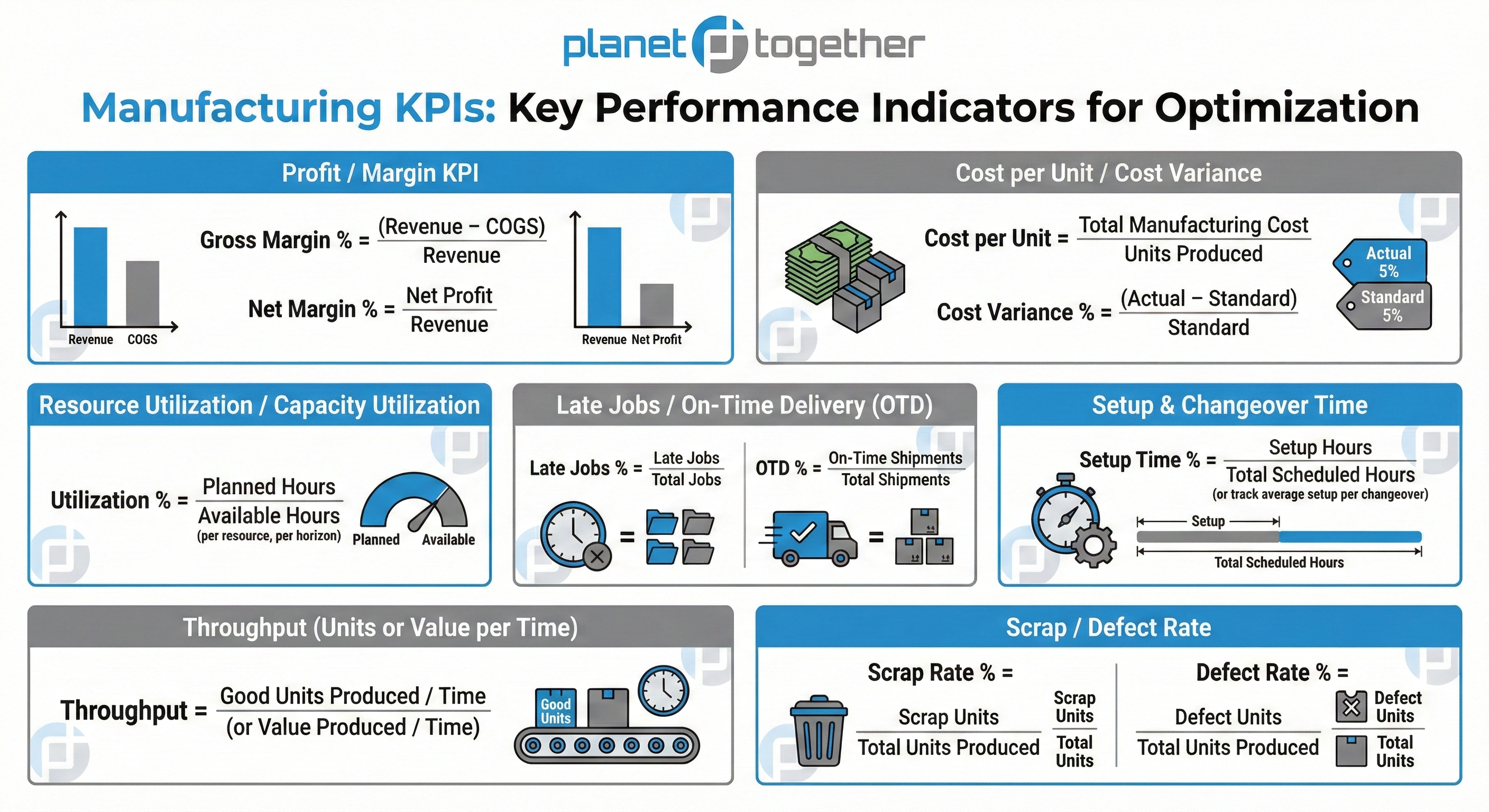
Manufacturing KPIs turn day-to-day production data into signals you can act on. A practical set covers profitability (margin), cost control (cost per unit and variance), capacity pressure(utilization), customer service (late jobs and on-time delivery), hidden capacity loss (setup and changeover time), constraint output (throughput), and quality loss (scrap and defect rate).
Review them on a consistent cadence, but don’t stop at the dashboard. When one moves, the schedule should move with it. APS supports that link by tying KPIs directly to the feasible plan rather than just to the report.
A manufacturing KPI is a measurable metric that guides shop-floor decisions.
On paper, it’s a measurable value used to track performance. On the shop floor, it’s the thing that tells planners, supervisors, and operations leaders what to do next. If a KPI doesn’t change how you schedule, sequence, staff, or prioritize orders, it isn’t managing anything. It’s reporting. If you want a broader structure for how KPIs support operational and organizational improvement, the NIST Baldrige Excellence Framework is a useful reference for connecting measures to strategy and execution.
That distinction matters. Most plants track dozens of metrics, but only a handful actually drive behavior. On-time delivery forces trade-offs between customers. Utilization pressures planners to keep machines running, even when it builds the wrong inventory. Throughput exposes where capacity is truly constrained, not where it looks busy.
A useful KPI does three things at once:
This is where many KPI programs break down. Teams measure everything, review it in meetings, and then manually rebuild schedules when reality hits the floor. The numbers look clean. The plan doesn’t survive contact with late material, changeovers, or a down machine.
In manufacturing, KPIs are only valuable when they’re tied to the plan. When a metric moves, the schedule should move with it. If that link doesn’t exist, the KPI may be accurate, but it’s not operational.
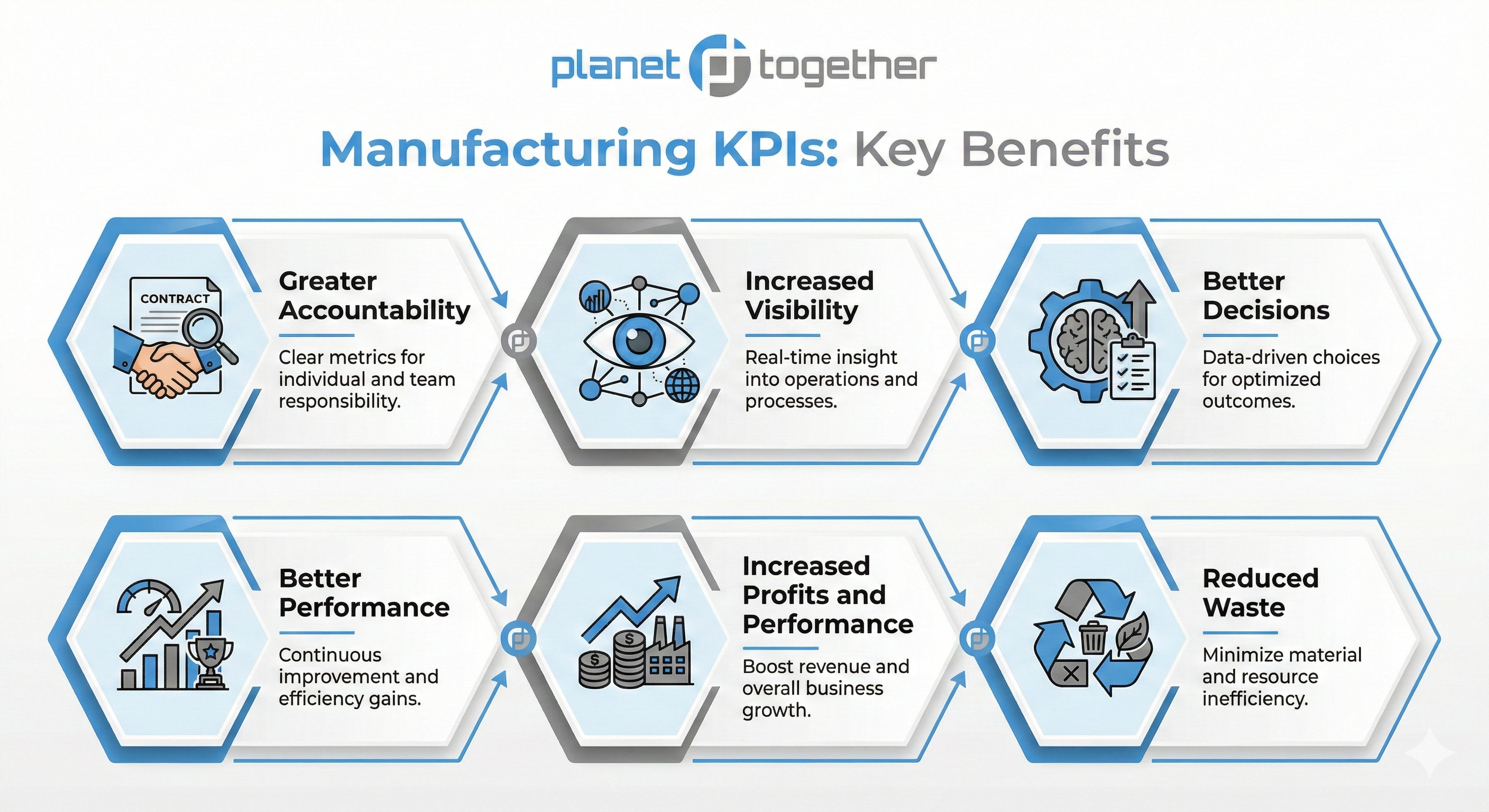
While specific KPIs may vary from each operation or industry, there are a few that are important within most areas. Here are some of the key performance indicators for manufacturing.
These KPIs help you balance service, cost, capacity, and quality. The goal is not to “improve every number.” It’s picking a small set of numbers you review consistently, then tying your actions back to the schedule, sequencing rules, constraints, and capacity.
If you’ve ever hit every production target and still watched margin sag, you already know the uncomfortable truth: output does not always equal value.
What it actually answers: Are we using our constrained capacity on work that pays us back?
How to measure
The operational twist: Pair margin with your constraint. A high-margin order that consumes the bottleneck for three days might still be the wrong choice if it causes missed deliveries on higher-priority customers.
What changes in the schedule
This KPI metric can be useful, but it’s also one of the easiest to misread when your schedule is unstable.
How to measure
Common mistake: Treating cost variance like a pure efficiency problem when it’s often a planning problem. Expedites, overtime, extra setups, partial runs, and rework show up here, even if the process is fine.
Use it like a detective
Utilization is the KPI that gets leaders nodding and makes planners quietly nervous.
How to measure
Trade-off you should state out loud: High utilization at the constraint is normal. High utilization everywhere is usually a queue factory. If every work center is at 95%, you don’t have a high-performing plant; you have no place for variation to go. When every resource is “full,” WIP and lead time often rise, and on-time delivery takes the hit.
What good looks like
Scheduling moves that help
On-time delivery is the KPI your customers feel most. Late jobs are the KPI your plant feels first.
How to measure
Decision rule (planner-friendly):
If late jobs rise, do not start by pushing harder. Start by asking which constraint is being overloaded and which orders are consuming that capacity.
This is exactly what shows up on a Monday morning when a supplier delivery is late, a machine is down, and two hot orders collide. One order gets protected, another slips, and suddenly OTD drops even though utilization still looks “healthy.” The metric isn’t lying; it’s exposing a trade-off you’re forced to make.
Two patterns to watch
Actions tied to the plan
Setup time is the silent thief of capacity. It rarely looks dramatic on a dashboard, but it steals hours in small increments, making your plan collapse.
How to measure
What to do with it (beyond “reduce setups”)
A quick gut check
Throughput tells you how quickly you turn constrained time into real output. Not “hours logged.” Not “machines running.” Output that can actually move your goals forward.
How to measure
A practical way to use it
Ask one question every week: What is stopping the constraint from producing good units for the next eight hours?
Material, labor, downtime, long setups, missing tooling, bad sequences, all of it shows up here.
Where teams go wrong
Scrap is not only a cost, but it’s also time. And time is usually the one thing you can’t buy back.
How to measure
What it changes operationally
A targeted approach
Tracking these KPIs tells you where the pressure is, but comparing schedules is what shows you which decision relieves it without breaking something else.
Knowing the right KPI targets is one thing. Building a schedule that holds under real constraints is another. Advanced Planning and Scheduling (APS) improves KPI performance by tying your metrics to the one thing that ultimately determines outcomes: the schedule you’re going to run, with constraints included. Instead of treating KPIs like a report card, APS uses real capacity limits, setup and changeover time, labor coverage, and material readiness to build a plan that can survive the week.
In PlanetTogether APS, you can run what-if scenarios and compare options using KPI views before you commit. Change the sequence at the constraint, add a shift, swap an alternate resource, or protect a customer order, then immediately see what that decision does to late jobs, bottleneck loading, throughput, setup time, and scrap risk. That’s the difference between “we’ll make it work” and “we can promise this, confidently.”
And because APS can connect to ERP/MRP data, you’re not starting from scratch. You’re turning the data you already have into a feasible schedule, then using KPI trade-offs to choose the plan that protects delivery without creating the next fire drill.
Step 1 — Name the decision you’re trying to improve. Pick one: protect delivery, free capacity, cut cost pressure, protect margin, reduce scrap.
Step 2 —Choose your primary KPI (the one you’ll optimize first).
Step 3 —Pick 2 guardrail KPIs so you don’t “win” the wrong way.
Examples:
If you optimize OTD, guardrail cost variance, and setup time.
If you optimize utilization, guardrail OTD and scrap.
Step 4 —Define the constraint you’re protecting.
Bottleneck machine, crew, tooling, or a material gate.
Step 5 —Set targets and boundaries.
Targets = what good looks like. Boundaries = what you refuse to sacrifice(service floor, max changeovers, max scrap, etc.).
Step 6 —Compare scenarios before releasing work.
Test alternate sequences, shift changes, and routing options, then choose the plan that hits the primary KPI without breaking the guardrails.
Step 7 —Review on a cadence and adjust policy.
Daily/shift: execution KPIs (late jobs, setups, constraint load). Monthly: policy KPIs (margin, cost variance, scrap trends).
This is how that Monday morning stops being a guessing game: you compare two or three schedules side by side and see which one protects delivery without creating the next problem.
In the video, you’ll see how to build a sandbox scenario without disturbing the live schedule, then compare a few options by the outcomes that matter: late jobs/OTD, throughput, changeovers, and constraint loading. The point is to answer the hard questions fast: what breaks, what it costs, and which customer risk you’re accepting.
If your team is rebuilding schedules weekly, it’s worth understanding what a disciplined APS rollout actually looks like. Implementation isn’t just about features. It’s about data integrity, integration with ERP/MRP, and making sure planners trust the schedule before it goes live.
The APS Implementation Guide: “Just the Facts” outlines what to expect in a real-world project, including:

A manufacturing KPI is a measurable metric used to track how well production is meeting objectives like delivery performance, throughput, quality, and cost. The best KPIs are tied to a clear target, reviewed on a cadence, and used to trigger action—not just reporting.
Start with late jobs (count or %) and OTD, then watch the drivers that usually cause slips: setup/changeover time and constraint utilization. If you also track schedule adherence, treat it as a diagnostic for churn, not the goal.
Lagging KPIs confirm outcomes (e.g., profit, scrap rate, on-time delivery). Leading KPIs predict outcomes and help you correct earlier (e.g., setup time, constraint utilization, WIP, schedule adherence). A balanced set avoids optimizing one area while hurting another.
Planners typically review schedule-and-constraint KPIs daily or per shift (late jobs, utilization, setup time). Leadership reviews weekly/monthly trends for targets and policy changes (throughput, cost, quality, service). If you only look monthly, you’re not managing, you’re autopsying. The cadence should match decision speed.
Use guardrails. For example, if you raise utilization targets, set minimum service-level targets (OTD) and maximum WIP or lead-time thresholds. Targets should be achievable under realistic constraints, not “wishful capacity.”
APS helps by generating a feasible schedule under real constraints, then letting you test a couple of alternatives before you commit and spend the week paying for the wrong choice.
Ready to see KPI tradeoffs before you release the schedule? Request a PlanetTogether APS demo.
What are manufacturing KPIs? Learn how to pick KPIs and track OEE, downtime, setup time, throughput, scrap, and on-time delivery.
Examples of Manufacturing Indicators include factors such as OEE and performance time. Manufacturing Indicator examples are important to understand.
Use scheduling optimization to manage changing demand, machine downtime, labor limits, and ERP, SCM, and MES data in one production plan.