Quick Answer: How Demand Planning and Production Scheduling Work Together
Demand planning forecasts what customers are likely to need. Production scheduling tests whether the factory can actually deliver by checking capacity, labor, materials, changeovers, and maintenance constraints. When manufacturers connect both with APS, they turn demand signals into feasible schedules and make planning decisions based on real operating limits instead of assumptions.
Why Demand Planning Alone Cannot Validate Production Plans
You have probably invested serious time and capital into improving demand planning over the last several years. Forecast accuracy has improved, replenishment decisions are more disciplined, and inventory targets feel far more intentional than they used to. When you look at the upstream numbers, there is a sense of maturity and control that simply was not there before.
Yet the plant still feels like it can’t hit the OTIF numbers you expected...
Campaign sequencing does not align cleanly with available labor. Changeovers consume more capacity than the plan suggested. An expedite request comes in from a key customer and suddenly three production lines have to be reshuffled while everyone tries to understand the ripple effects. At some point, you start asking yourself whether the real challenge is still the forecast.
The reality is that demand planning and production scheduling cannot function as separate disciplines if you want sustained operational stability. Demand planning defines intent. Production scheduling determines feasibility. When they are disconnected, improvements in one area simply expose weaknesses in the other.
.png?width=1920&height=1080&name=Demand%20Planning%20and%20Production%20Scheduling%20(2).png)
What Demand Planning Gets Right
Let’s acknowledge the progress first.
Demand planning platforms have brought a level of discipline that was difficult to achieve a decade ago. Even small improvements in forecast accuracy can meaningfully reduce finished goods inventory, transportation costs, and obsolescence exposure. Multi-echelon planning has improved inventory positioning across networks. S&OP conversations are more data-driven and less reliant on instinct.
These are substantial gains and represent large operational and financial improvements.
But demand planning answers a specific set of questions. It tells you what the market is likely to require, when it will be required, and how inventory should be positioned to support service levels. What it does not answer is whether the factory can execute that plan under true operating constraints.
That distinction is where many organizations plateau.
It is relatively easy to model theoretical capacity in a spreadsheet. It is much harder to model regulated capacity that must respect batch dependencies, cleaning validation rules, certified labor pools, QA review timing, and material shelf-life constraints. The forecast can be right and still be operationally fragile if the schedule assumes labor that is not actually available, compresses quality review windows that cannot realistically be shortened, or sequences products in a way that increases contamination risk.
You have likely seen this tension play out before. The demand plan looks solid in the executive deck, yet the plant absorbs losses day after day because the schedule does not fully reflect operational reality.
A Scenario That Feels Familiar
Let me tell you a brief story about a mid-market manufacturer that I have recently worked with that underwent maturation in its demand planning process. Forecast accuracy improved, replenishment logic was refined, and leadership gained confidence in the numbers driving production volumes. Upstream stability was clearly improving.
Downstream, however, production scheduling was still exclusively managed in Excel. Institutional knowledge lived primarily with one experienced scheduler. Labor availability was assumed rather than enforced. QA hold times varied significantly by product but were not explicitly modeled. When an order changed, planners manually traced the impact across multiple lines and even multiple plants.
As expedite requests inevitably increased, planners rebuilt the schedule repeatedly each day. Overtime crept upward. Changeover frequency increased. Delivery confidence began to fluctuate, not because the forecast was wildly inaccurate, but because execution was fragile. Eventually the executive team realized something important: the forecast was no longer the primary issue to their growth goals, execution discipline was.
That shift in perspective reframed the entire conversation. Instead of asking how to refine forecast accuracy by another percentage point, leadership began examining how capacity, labor, material requirements, and compliance constraints were embedded in the production schedule itself.
How Closed-Loop Planning Connects Demand and Scheduling
This is where advanced planning and scheduling becomes more than a planning tool. It becomes a mechanism for enforcing operational excellence. A constraint-based scheduling engine accounts for finite machine capacity, sequence-dependent setups, and actual labor capabilities. It embeds cleaning intervals and compatibility rules directly into the sequencing logic. It respects shelf-life constraints and enforces first-expire-first-out usage where appropriate. It can incorporate regulatory blackout windows and validation periods into the available production calendar.
The result is not simply a more organized schedule. It is a plan that reflects what the factory can feasibly do under compliance and resource constraints.
When those constraints are modeled explicitly, several changes follow naturally. Infeasible commitments surface earlier in the planning cycle. Changeovers can be sequenced intentionally to reduce unnecessary downtime. Labor bottlenecks become visible before they turn into overtime spikes. Most importantly, volatility begins to decline because the schedule is no longer built on optimistic assumptions.
Capacity does not magically increase. What changes is transparency. Leadership can see where the constraints are and make decisions accordingly.
Decision Framework: When to Connect Demand Planning and Production Scheduling
Use this quick check to decide whether your planning environment is ready for tighter demand-to-schedule integration:
- If forecasts look stable but schedules keep changing, real production constraints are probably missing from the planning model.
- If planners rebuild schedules throughout the week, scheduling is likely still happening in spreadsheets instead of a constraint-based engine.
- If demand planning and production scheduling live in separate systems, the business probably lacks a closed-loop planning model.
- If sales, supply chain, and operations do not work from the same capacity assumptions, planning and execution are still disconnected.
If two or more of these are true, it is time to connect demand planning with constraint-based production scheduling.
When Planning and Scheduling Reinforce Each Other
The relationship between demand planning and production scheduling is not a one-way handoff. It is a continuous feedback loop.
It starts with demand planning establishing the planning horizon forecasts. Forecasts shape production volumes, replenishment logic positions materials, and the organization defines what it believes it needs to manufacture and when. That forecast then flows into the production schedule, where it meets operational reality. Finite capacity, certified labor pools, cleaning intervals, QA review timing, and material availability all begin to influence what is actually feasible. The production schedule will make or break your ability to execute the plan.
And this is where the loop closes.
When the scheduling engine reveals that a campaign will overload a constrained line, extend changeovers beyond acceptable limits, or compress quality timelines beyond what is realistic, that insight does not stay in operations. It flows back upstream. Production capacity assumptions are adjusted, replenishment timing shifts, and demand priorities may need to be re-sequenced. The next planning cycle should incorporate these new execution constraints rather than theoretical capacity.
- Over time, planning becomes more accurate because it reflects validated constraints instead of theoretical ones.
- Scheduling becomes more stable because it is fed by disciplined material positioning.
- Replenishment improves because it reflects actual production cadence rather than static forecasts.
.png?width=1920&height=1080&name=Demand%20Planning%20and%20Production%20Scheduling%20(3).png)
Instead of planning pushing volume into the factory and the factory absorbing the shock, the system begins to self-correct. Daily disruptions should decline because capacity assumptions are continuously recalibrated. Labor planning improves because workforce requirements are visible earlier in the planning cycle. Maintenance windows are placed with an understanding of actual throughput rather than projected averages. New product introductions are evaluated against validated bottlenecks before they disrupt existing flow.
This is what a closed-loop operating model looks like. Planning informs scheduling. Scheduling validates planning. The next planning cycle improves because of what execution revealed. That is very different from layering another tool onto an already complex system. It is about creating an operating discipline where intent and execution constantly refine one another.
The Broader Organizational Effect
When demand planning and production scheduling operate as one system, the impact is not confined to the planning team. It reshapes how the entire leadership team makes decisions.
For Sales, delivery commitments stop being educated guesses. Instead of negotiating dates based on historical averages or optimistic capacity assumptions, they are working from schedules that reflect machine availability, certified labor, material constraints, and compliance timing. That shift alone changes customer conversations. Capable-to-promise simulations allow delivery commitments to become defensible; expedite requests become exceptions rather than routine; credibility with key customer accounts strengthens because commitments are grounded in realistic views of production.
For Operations, the daily rhythm of the plant stabilizes. Changeovers are sequenced intentionally rather than reactively. Labor assignments reflect actual certification requirements and availability. Maintenance windows can be positioned with an understanding of true volume requirements instead of broad assumptions. The team spends less time firefighting in spreadsheets and more time improving throughput and quality. They gain the ability to spot issues before they hit the floor and adjust without destabilizing the entire schedule.
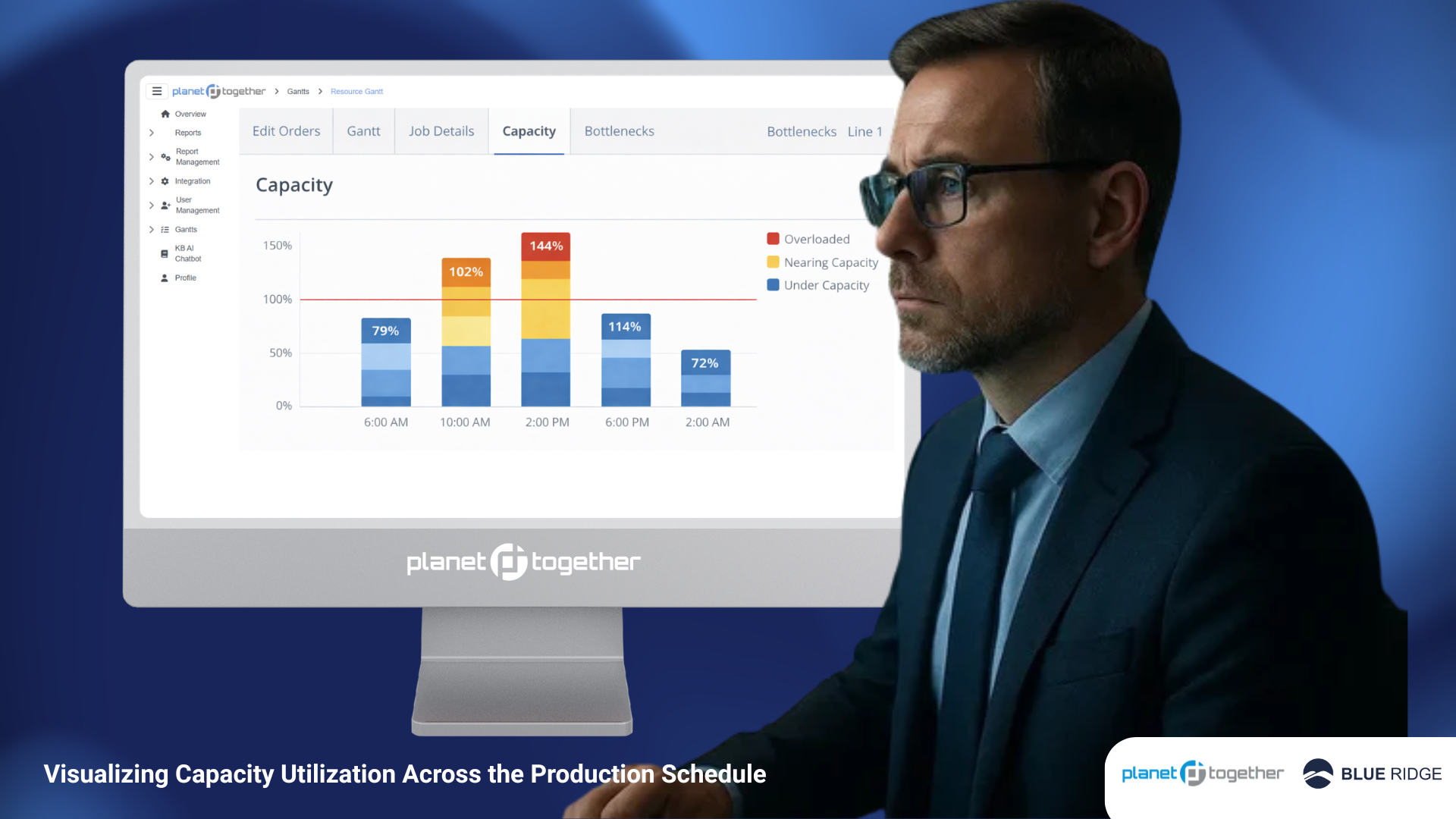
For Finance, predictability improves. When schedules reflect actual capacity and inventory consumption, margin projections become more reliable. Overtime spikes decline because labor constraints are visible earlier. Obsolescence risk is reduced when shelf-life and production timing are aligned with demand. Working capital conversations become less theoretical because production plans and inventory positioning are synchronized. Financial forecasting starts to mirror operational reality rather than diverge from it. When evaluating future capital investments, they can model the impact before committing dollars to equipment that may not relieve the true bottleneck in production.
For the executive team, alignment replaces reconciliation. Instead of reviewing separate narratives from planning, production, and finance, leadership sees a unified story. Growth scenarios can be evaluated against capacity before commitments are made. Capital decisions can be informed by transparent bottleneck data rather than anecdotal constraints. Strategic conversations shift from “why did this slip?” to “where should we invest next?”
Because the systems are connected, an organization can operate from a shared model of reality. Over time, that alignment builds institutional confidence. The organization is no longer debating whose numbers are correct. Unexpected situations still happen, but its impact is visible, modeled, and accounted for quickly rather than causing a panic in the planning team. That is where operational maturity begins to compound.
Practically Speaking...
If your demand planning has matured and forecast accuracy is improving, yet the plant still feels reactive, it may be worth asking a simple question.
Is the production schedule enforcing operational excellence with the same discipline your planning team applies upstream?
Improving the forecast is important. Validating that forecast against capacity, material, labor, and compliance constraints is equally important. When those two disciplines operate as one system, operational performance compounds rather than plateaus.
That is not just a technology decision. It is a choice about how rigorously you want your organization to connect planning with execution.
Turn Better Forecasts Into Execution Readiness
Improving forecast accuracy is important, but as this post shows, better demand signals do not automatically create feasible production schedules. When labor, setups, material availability, and real operating constraints are not embedded in the scheduling process, execution stays reactive even when planning improves. The next step is to evaluate whether your organization is truly ready to connect demand planning with constraint-based scheduling discipline.
With the APS Readiness E-Book, readers can learn how to:
- assess readiness to move beyond spreadsheet-based scheduling
- identify the data, constraints, and workflows needed for APS success
- define baseline metrics for schedule quality, stability, and OTD
- align planners, operations, and executives around shared success criteria
- build a practical roadmap for APS adoption and continuous improvement

FAQ: Demand Planning and Production Scheduling
What is the difference between demand planning and production scheduling?
Demand planning forecasts market demand and determines how much product should be produced over a future planning horizon. Production scheduling determines how that demand will be executed on the factory floor by sequencing jobs, allocating resources, and accounting for real production constraints.
Why do manufacturers struggle when demand planning and scheduling are disconnected?
When demand planning and production scheduling operate separately, forecasts may assume theoretical capacity that the factory cannot realistically achieve. This often results in frequent schedule adjustments, expediting, and unstable production plans.
What is closed-loop planning in manufacturing?
Closed-loop planning occurs when demand signals are continuously validated against production constraints. Demand planning generates the forecast, while Advanced Planning and Scheduling systems evaluate whether that plan can be executed within real factory capacity.
How does APS improve demand and production alignment?
Advanced Planning and Scheduling software models machine capacity, labor availability, material constraints, and sequence-dependent changeovers. This allows planners to simulate production scenarios and validate demand plans before they disrupt operations.
What role does ERP play in demand planning and production scheduling?
ERP systems typically manage transactional data such as orders, inventory levels, and work orders. APS systems complement ERP by evaluating whether those plans are feasible within real production constraints.
See PlanetTogether APS in Action
Forecasts only create value when the factory can execute them. Request a PlanetTogether demo to see how APS connects demand signals to feasible schedules using real capacity, labor, materials, and changeover constraints.