Quick Answer: Why Operations Management Components Matter
Operations management turns demand into reliable output by coordinating people, machines, materials, and processes. The 12 components help manufacturers improve flow, cost, quality, inventory, and delivery performance. Use this guide to find the components that affect your biggest constraints first, then improve planning and execution where they matter most.
12 Main Components of Operations Management
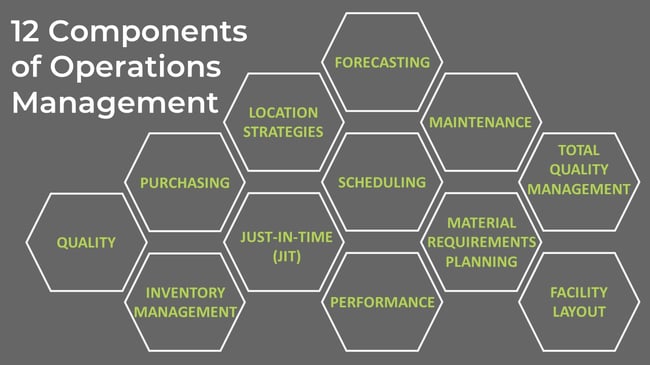
The 12 main components of operations management work together. Each one affects output, cost, flow, and delivery performance.
Forecasting
The demand forecasting process uses historical demand data to estimate future demand. That helps manufacturers decide how much to produce and when to produce it. Better forecasting reduces shortages, excess inventory, and rushed schedule changes.
Location Strategies
Location strategy is about choosing the right place for a facility. Manufacturers usually look at materials, labor, transportation, and customer demand. A good location helps reduce cost, shorten lead times, and lower risk.
Maintenance
Maintenance keeps machines safe, reliable, and available. Regular checks reduce unexpected downtime and help protect throughput. Good maintenance also supports schedule adherence because equipment is less likely to fail during production.
Purchasing
Purchasing makes sure the right materials arrive on time. It affects cost, supplier performance, and production flow. When purchasing is weak, shortages disrupt schedules and create expediting.
Scheduling
Scheduling assigns the right jobs to the right machines and labor resources at the right time. Good scheduling improves flow, protects bottlenecks, and helps more orders ship on time. It also reduces wasted capacity and last-minute replanning.
Total Quality Management (TQM)
Total Quality Management (TQM) focuses on improving processes so products meet customer requirements more consistently. In manufacturing, that means fewer defects, less rework, and better process control. Strong quality systems also reduce waste and schedule disruption.
Materials Requirements Planning (MRP)
Materials Requirements Planning (MRP) helps teams make sure the right materials are available at the right time. It looks at current inventory, future demand, and planned production. When MRP works well, schedules are easier to run because materials are ready when jobs need to start.
Quality
Quality means meeting product specifications and customer expectations. It affects returns, rework, scrap, and customer trust. Strong quality performance helps protect both margins and delivery performance.
Just-In-Time (JIT)
Just-In-Time means work starts and finishes just when it is needed. The goal is to reduce extra WIP and keep materials moving. In the right environment, JIT can improve flow and reduce inventory pressure.
Process and System Performance
This component measures how well operations are running. Teams can compare planned output with actual output, cycle time, or utilization. That shows where the process is meeting targets and where it is falling short.
Layout of Facilities
Facility layout affects how work moves through the plant. A poor layout creates extra motion, delays, and confusion. One of the 7 wastes comes from unnecessary movement, so an optimal facility layout helps improve flow and reduce waste.
Inventory Management
Inventory management tracks raw materials, WIP, and finished goods. The goal is to have the right stock at the right time without carrying too much. Good inventory management supports service levels, reduces shortages, and lowers carrying cost.
Advanced Planning and Scheduling Software (APS) helps manufacturers connect planning decisions to real constraints. It improves visibility across operations and supports faster, more realistic scheduling decisions. 
Decision Framework: Which Component to Improve First
Start with the business outcome that matters most. That may be on-time delivery, lead time, cost, quality, or working capital.
Then find the main constraint behind the problem.
- Bottleneck work center: capacity planning, scheduling, maintenance
- Chronic shortages: forecasting, purchasing, inventory policy
- Rework or scrap: quality, process design, TQM
- Poor workflow: facility layout, process design
- Frequent schedule changes: scheduling, capacity planning, APS
Choose one KPI and one review rhythm. Then improve from there instead of trying to fix every component at once.
How APS Supports These Operations Management Components
Modern operations management depends on multiple components working together. Forecasting, MRP, scheduling, inventory, and JIT all affect flow and execution. APS adds a planning layer that helps teams update priorities, schedules, and inventory decisions faster as conditions change.
APS also helps close execution gaps that ERP and MRP often leave open. It gives planners a better view of real capacity, changeovers, downtime, and material readiness.
With PlanetTogether APS, you can:
- Build schedules that balance efficiency and delivery performance
- Increase throughput by protecting bottlenecks and constrained resources
- Better align supply with demand to reduce excess inventory
- Improve capacity visibility across teams
- Run what-if scenarios when priorities change
If you want to reduce firefighting and move toward controlled execution, APS helps make schedules more realistic and easier to run.
Integrating APS with Manufacturing Operations: From Plan to Execution
Manufacturing teams lose time when the plan and shop-floor reality drift apart. APS helps connect production priorities to real constraints like capacity, changeovers, downtime, and material readiness. That makes schedules easier to execute.
For operations management, planning, scheduling, and plant supervision, the goal is steady execution. APS supports that goal by helping teams update schedules faster, reduce manual handoffs, and communicate more clearly about what should run next.
APS also complements ERP and MRP by improving schedule accuracy and responsiveness. That helps supervisors, planners, purchasing, IT, and management work from the same plan.
Download the Infographic: Spreadsheet Scheduling vs. APS in Daily Operations
Planning often breaks down because teams spend too much time gathering updates, re-entering jobs, and pushing changes to the floor by hand. When schedules depend on spreadsheets, even small disruptions can create hours of rework.
Download our infographic comparing spreadsheet scheduling vs. APS to see where planners lose time each day and what changes when scheduling is built for manufacturing operations.
What you will take away:
- Typical time spent refreshing planning data
- The difference in speed to optimize a schedule
- How quickly teams can run what-if schedule changes
- The effort needed to communicate schedules clearly to production
- A practical view of time saved each day

Operations Management FAQs
What are the 12 components of operations management?
The main components usually include forecasting, location strategy, process design, facility layout, quality management, capacity planning, inventory management, scheduling, purchasing, human resources, maintenance, and performance management. Together, they turn demand into reliable, cost-effective output.
Which operations management component should you improve first?
Start with the constraint that most limits throughput or on-time delivery. That is often a bottleneck resource, a key supplier, or a quality problem.
How are capacity planning and production scheduling different?
Capacity planning checks whether you have enough labor, equipment, and time to meet demand. Scheduling assigns specific jobs to specific resources in the right sequence.
How does APS differ from ERP/MRP for operations management?
ERP and MRP are strong at transactions, master data, and material planning. APS focuses on finite-capacity planning and detailed scheduling under real constraints .
What metrics show operations management is improving?
Look for better schedule adherence, on-time delivery, throughput, lead time, inventory turns, utilization on constrained resources, scrap, rework, and fewer expedites .
See PlanetTogether APS in Action
Ready to connect forecasting, inventory, and scheduling into one executable plan? Request a PlanetTogether APS demo to see finite-capacity scheduling and scenario planning in action.