Quick Answer: Why Does OEE Matter in Manufacturing?
Overall Equipment Effectiveness (OEE) shows how well a machine or line is running. It combines uptime, speed, and quality in one score. As a result, teams can see where downtime, slow cycles, and defects cut output. In turn, they can improve maintenance timing, protect bottlenecks, and make better schedule decisions.
What OEE Measures in Manufacturing
Overall Equipment Effectiveness (OEE) shows how well a plant runs compared with its full potential. In simple terms, it shows whether equipment is ready when needed, runs at the right speed, and makes good parts.
Teams express OEE as a percentage. For example, a score of 100% means the process makes good output at the planned rate with no avoidable downtime.
Any score below 100% shows room to improve. Because of that, OEE helps teams find losses, track progress, and focus on the work that matters most.
How to Calculate OEE
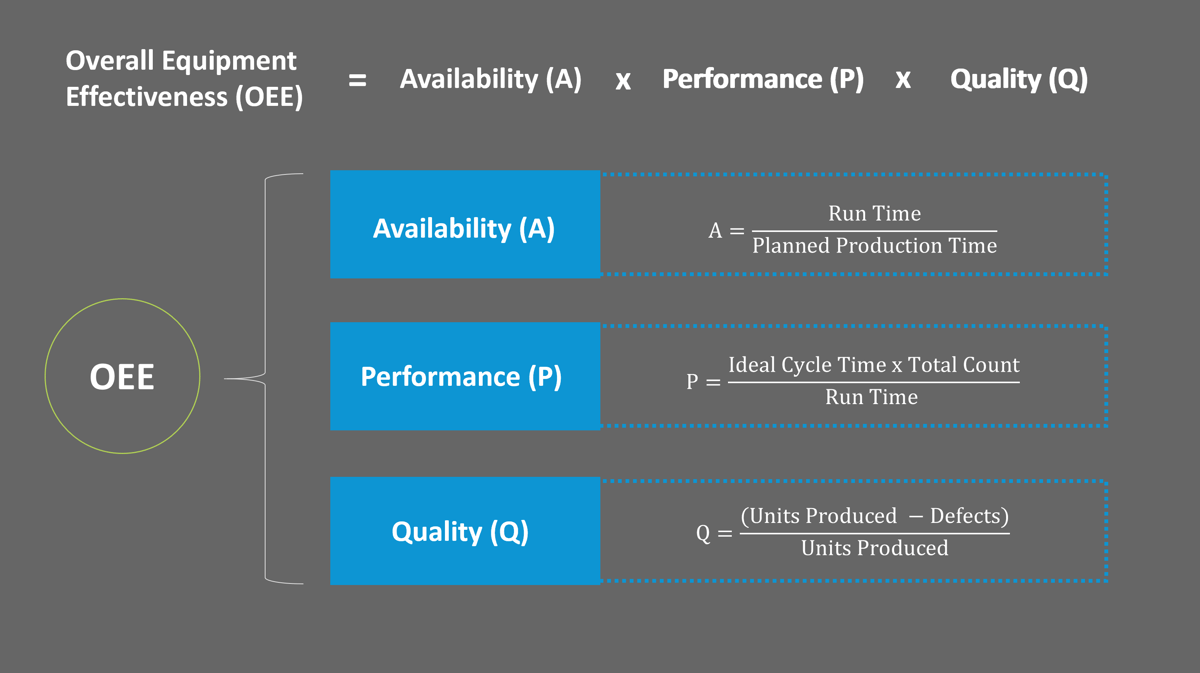
Calculate OEE with this formula:
OEE = Availability (A) × Performance (P) × Quality (Q)
These three factors represent the main sources of production loss.
Availability
Availability = Run Time / Planned Production Time
This factor shows how much planned production time the team used for production. For example, it includes losses from changeovers, setup time, and unplanned downtime.
Performance
Performance = (Ideal Cycle Time × Total Count) / Run Time
This shows whether the process ran at the expected speed. It captures speed loss and other factors that reduce run rate.
Quality
Quality = (Units Produced - Defects) / Units Produced
This factor shows how much output met the quality target without rework or scrap. In other words, it shows how much good output the line made.
Once teams measure OEE, Advanced Planning and Scheduling (APS) software can help planners act on those findings to make better scheduling decisions.
5 Benefits of OEE for Production
Here are five practical benefits of OEE for production.
Benefit 1: Clearer Equipment Visibility
OEE gives teams a clear view of equipment performance. Because it combines uptime, speed, and quality, teams can see where losses happen and where change is needed.
Benefit 2: Better Production Insight
Teams cannot improve what they do not measure. For that reason, OEE helps them compare assumed performance with actual performance. Then they can see which parts of production run well and which parts hold output back.
Benefit 3: Stronger Cost Control
OEE can help cut cost by showing where downtime, slow cycles, and poor quality create waste. As a result, teams can raise output without adding the same level of labor, machine time, or rework cost.
Benefit 4: Smarter Maintenance Planning
OEE helps teams spot equipment issues before they turn into larger problems. In turn, teams can plan preventative maintenance at better times, reduce unplanned downtime, and protect usable capacity.
Benefit 5: Better Investment Decisions
OEE helps teams decide where equipment spend will have the most value. Also, it helps them compare performance before and after a change. That way, they can see whether a new asset or improvement raised output.
When OEE Needs APS Support
OEE shows where teams lose equipment performance. However, it does not fix those losses on its own. APS helps teams act on those findings.
For example, OEE may show that changeovers, unplanned downtime, or idle time are cutting output. In response, APS helps planners build schedules that protect bottlenecks, improve sequence, and place maintenance at better times.
“Another PlanetTogether APS benefit is the ability to integrate preventative maintenance schedules with manufacturing schedules. Commitments cannot be met without maximizing Overall Equipment Effectiveness (OEE). Having the freedom to block out time for preventative maintenance before the schedule is filled with orders increases our uptime and capacity.”
GARY BISHOP, DIRECTOR OF MANUFACTURING OPERATIONS, SUMITOMO ELECTRIC LIGHTWAVE
Advanced Planning and Scheduling (APS) Software
Advanced Planning and Scheduling (APS) software helps teams turn OEE insight into action. For example, it helps planners respond faster to change, protect tight resources, and build schedules that reflect real capacity.
PlanetTogether integrates with ERP/MRP software, so teams can use current operating data in one planning process.
With PlanetTogether APS, teams can:
Lean Manufacturing with APS: Cut Waste and Improve OEE
In this video, you will see how lean manufacturing, Just-in-Time (JIT), and advanced planning and scheduling (APS) work together to reduce waste and improve OEE.
It shows how better sequence, tighter schedule control, and more realistic planning help teams reduce excess inventory, protect flow, and improve day-to-day execution.
See Where Better Planning Improves OEE and Profit
OEE helps teams see where availability and performance losses occur. However, it does not always show the full cost of poor planning decisions.
Download our Planning Profitability Infographic to see how late deliveries, changeovers, bottlenecks, excess inventory, and reactive scheduling affect margin.
What readers will take away:
- how late deliveries turn into lost sales
- how changeovers reduce usable capacity
- why bottlenecks often increase overtime cost
- how unplanned maintenance reduces output
- where excess inventory and expedited shipping costs come from

OEE FAQs
What does OEE measure?
OEE measures how effectively equipment runs by combining availability, performance, and quality into one score.
What is a good OEE score?
A good OEE score depends on the process, but the main value of OEE is showing where time, speed, and quality losses are reducing output.
How do you calculate OEE?
OEE is calculated as Availability × Performance × Quality.
Why does OEE matter to production planners?
OEE helps planners see where downtime, slow cycles, and defects are reducing output so they can schedule work more realistically.
How does APS help improve OEE?
APS helps teams act on OEE insights by improving sequencing, protecting bottlenecks, planning maintenance, and building schedules that reflect real capacity.
See PlanetTogether APS in Action
Ready to turn OEE insight into better scheduling decisions? Request a demo to see how PlanetTogether APS helps protect bottlenecks, plan maintenance, and improve production flow.