Sales just committed to a large customer.
Production is already running at 92 percent capacity.
Procurement says one critical component is tight.
Everyone believes they’re collaborating.
But are they working from the same version of reality?
For a VP of Supply Chain, collaboration means network alignment, not just communication.
For a production planner, it means knowing whether a new order will break the schedule before it’s accepted.
Supply chain collaboration isn’t a buzzword. It’s the difference between predictable delivery and controlled chaos.
At its core, collaboration in manufacturing falls into three levels: transactional integration, operational information sharing, and strategic alignment. Most companies believe they’ve achieved all three. Few actually have.
In practical terms:
- Transactional collaboration moves data.
- Operational collaboration shares plans.
- Strategic collaboration aligns decisions.
- APS makes those decisions executable.
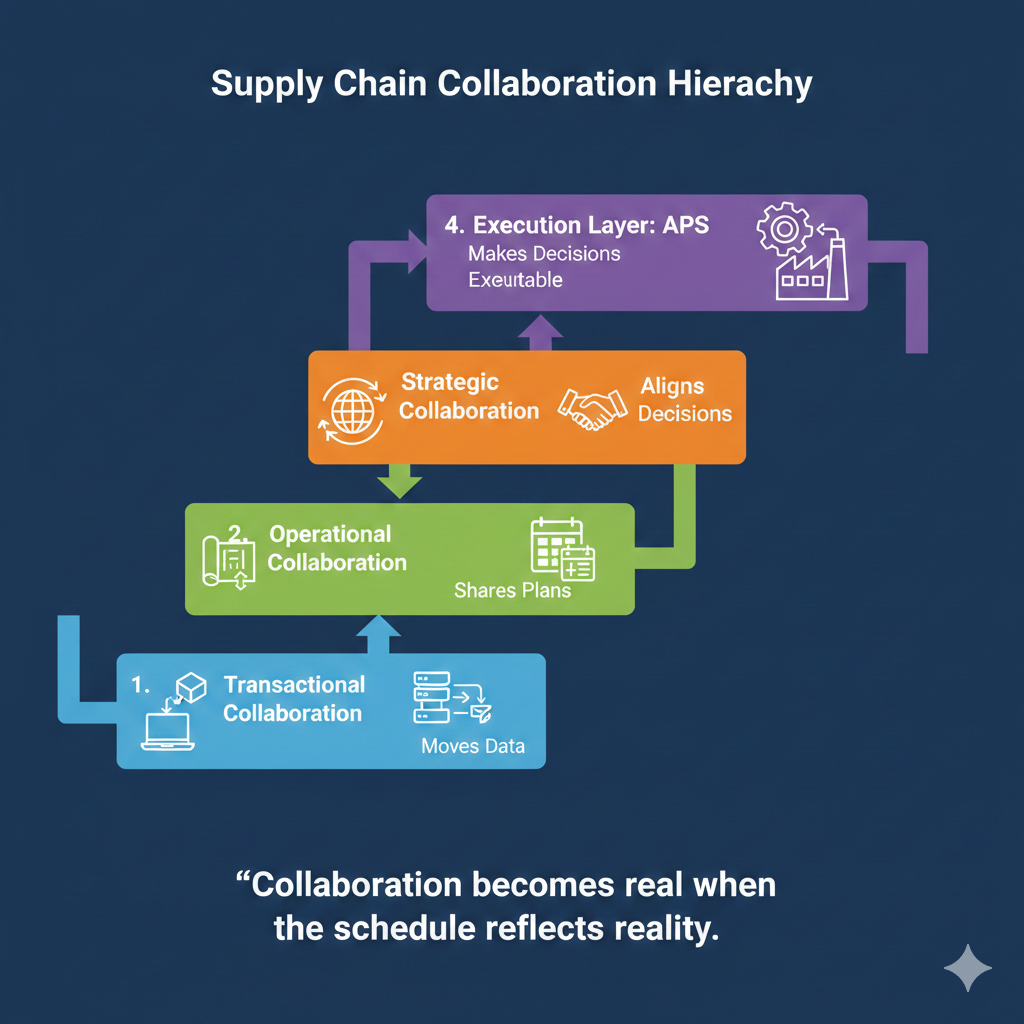
Collaboration becomes real when the schedule reflects reality
Supply chain collaboration matures in layers. Transactional collaboration moves data between partners. Operational collaboration shares plans so teams can coordinate before disruptions hit. Strategic collaboration aligns decisions around shared KPIs and trade-offs. The final step is execution: APS turns shared intent into a feasible schedule by reflecting real constraints like capacity, materials, and changeovers.
What Are the Types of Collaboration in Supply Chain Management?
Supply chain collaboration typically falls into three categories: transactional collaboration, operational collaboration, and strategic collaboration. Transactional focuses on information exchange, operational improves coordination of planning and execution, and strategic aligns long-term goals across partners. Manufacturers use advanced planning and scheduling (APS) systems to enable real-time visibility, constraint-based planning, and synchronized decision-making across these collaboration levels.
Types of Collaboration in Supply Chain Management
The types of collaboration in supply chain management pertain to the following:
Transactional Integration: Data Moves, But Decisions Don’t
At the first level, companies digitize transactions. Orders move through ERP. Invoices are processed electronically. EDI connects suppliers and customers.
Data flows.
But this level doesn’t answer the planner’s real question:
If I accept this order, what breaks?
For a VP Supply Chain, transactional integration creates reporting visibility. For the planner on the floor, it rarely solves constraint conflicts. Machines still have finite capacity. Materials still arrive late. Bottlenecks still dominate throughput.
Transactional collaboration is necessary. It just isn’t sufficient.
Operational Information Sharing: Plans Start Talking to Each Other
The second level moves beyond transactions into shared plans. Forecasts are exchanged. Bills of material are visible. Production and transportation plans are communicated across partners.
This is where things begin to improve.
Planners can anticipate changes earlier. Procurement can see demand shifts. Operations can adjust sequencing before chaos sets in.
But even here, friction remains.
Sharing a forecast doesn’t resolve a capacity shortfall.
Sharing a production plan doesn’t eliminate a bottleneck.
Information sharing improves coordination. It does not eliminate constraints.
Strategic Collaboration: Alignment Around Trade-Offs
The third level is where collaboration becomes executive.
Here, companies align around shared KPIs: OTIF performance, inventory turns, capacity utilization, margin protection.
Risk and reward are shared. Decisions are evaluated before they’re executed.
For a VP Supply Chain, this means balancing service levels against working capital and cost.
For a planner, it means fewer last-minute disruptions and fewer conflicting priorities.
Strategic collaboration is not about sharing more data. It’s about aligning decisions against real constraints.
Strategic collaboration forces trade-offs into the open. Protect margin or chase volume. Build inventory or risk stockouts. Load the bottleneck or preserve flexibility. Alignment only exists when those trade-offs are evaluated against capacity reality.
Where Collaboration Breaks Down: The Constraint Gap
Collaboration often fails at the moment of commitment.
Sales promises delivery.
Procurement orders materials.
Operations builds a schedule.
But none of those decisions are evaluated against finite capacity in real time.
This is where Advanced Planning and Scheduling becomes foundational.
APS does not replace ERP. It sits above it. It translates transactions and forecasts into an executable schedule that reflects:
- Machine capacity
- Labor availability
- Sequence-dependent changeovers
- Material constraints
- Maintenance windows
- Bottleneck resources
For planners, this means seeing schedule impact before moving a job.
For supply chain leaders, it means evaluating trade-offs before committing to revenue that will erode margin or overload the network.
Collaboration becomes real when the schedule reflects reality.
Consider a multi-plant manufacturer running 1,500 SKUs across three facilities. Demand shifts 12 percent in one week due to a customer promotion. Sales sees opportunity. Procurement sees material risk. Operations sees a bottleneck at one coating line.
Without finite capacity modeling, each function optimizes locally. With APS, leadership evaluates throughput impact, margin trade-offs, and delivery risk before committing.
Choosing the Right Level of Supply Chain Collaboration
If you are a Planner and constantly expediting:
You likely have transactional integration, but limited operational alignment. Strengthening schedule visibility and finite capacity planning reduces firefighting.
If you are a VP Supply Chain facing:
-
Multi-plant imbalances
-
Inventory spikes in one facility and shortages in another
-
Conflicting KPIs between sales and operations
-
You may have information sharing, but not strategic alignment.
Ask one simple question:
Can we simulate the impact of a major order or supply disruption before committing to it?
If the answer is no, collaboration is still reactive.
Advanced Planning and Scheduling Software
Supply chain collaboration works best when everyone involved in planning and execution can share the right information quickly and consistently. As collaboration evolves from transaction integration (orders, work orders, invoices) to information sharing (plans, BOMs, forecasts) and strategic collaboration (joint planning, redesign, shared risk/reward), manufacturers need a planning layer that keeps priorities aligned and schedules executable.
Advanced Planning and Scheduling (APS) software has become a must for modern manufacturing operations as higher product mix and faster delivery expectations collide with persistent cost pressure. APS helps planners save time and stay agile as priorities shift, while integrating with ERP/MRP to address common gaps in planning and scheduling flexibility and accuracy.
PlanetTogether APS supports higher levels of coordination by providing visibility into the end-to-end production process, highlighting where efficiency optimization is needed, and enabling teams to visually adjust plans when execution falls behind.
PlanetTogether APS enables manufacturers to:
- Build finite schedules that reflect real capacity limits
- Identify and protect bottleneck resources
- Simulate order impact before committing to delivery dates
- Align production, procurement, and sales to one executable plan
Implementing APS takes your operations to the next level of production efficiency by leveraging the operational data you already have in your ERP, improving responsiveness and overall performance across your supply chain.
Capacity Planning with Finite Scheduling in PlanetTogether APS
This video shows how manufacturers can move from rough-cut capacity estimates to finite capacity scheduling that reflects real constraints—labor, machines, tools, materials, and changeovers. It’s designed for production planners, schedulers, operations leaders, and continuous improvement teams who need schedules that are both feasible and responsive.
You’ll see how capacity planning and production scheduling work together to surface bottlenecks early, reduce firefighting, and improve on-time performance. The video highlights how planners can evaluate capacity impacts before committing to dates—especially when demand changes, priorities shift, or constraints tighten.
If your current process depends on spreadsheets or manual updates, the walkthrough also illustrates how PlanetTogether APS supports faster schedule updates, clearer constraint visibility, and better coordination across planning and shop floor execution—so teams can make decisions based on one version of the plan.
Stop Losing Capacity to Spreadsheet Planning
Capacity planning breaks down when the plan can’t keep up with reality—changeovers, maintenance windows, shifting priorities, and bottlenecks force teams into reactive overtime and expedite mode. The result is lost capacity, late orders, and higher costs—even when demand is strong.
Download our “The Money Is in the Planning” infographic to see the most common ways manual planning undermines manufacturing performance and profitability—and what to fix first to stabilize output and protect margins.
What you’ll learn in the infographic:
- How inefficient sequencing and changeovers can create effective capacity loss
- Why reactive planning drives overtime during bottleneck periods
- How uncoordinated maintenance reduces output and impacts delivery reliability
- Where excess inventory and early buying inflate inventory carrying costs
- Why late completion increases reliance on expedited shipping

FAQ: Supply Chain Collaboration in Manufacturing
What are the three types of supply chain collaboration?
The three main types are transactional collaboration, operational collaboration, and strategic collaboration. Transactional focuses on data sharing. Operational improves coordination across planning and execution. Strategic aligns long-term objectives, shared KPIs, and joint risk management across partners.
Why is operational collaboration difficult without APS software?
Operational collaboration requires real-time visibility into constraints, material availability, and capacity. Without an advanced planning and scheduling system, manufacturers rely on spreadsheets and disconnected ERP data, which creates delays, inaccurate delivery promises, and reactive firefighting.
How does strategic collaboration improve on-time delivery?
Strategic collaboration aligns suppliers, production, and sales around shared goals such as on-time-in-full (OTIF), lead time reduction, and inventory optimization. With synchronized planning systems, companies can evaluate trade-offs before committing to delivery dates.
What role does Capable-to-Promise (CTP) play in supply chain collaboration?
Capable-to-Promise (CTP) allows manufacturers to simulate whether a new order can be fulfilled based on real capacity and material constraints. This strengthens collaboration between sales and operations by ensuring delivery commitments are feasible before they are promised.
How can manufacturers measure collaboration performance?
Manufacturers measure collaboration using KPIs such as OTIF performance, schedule adherence, inventory turns, capacity utilization, and forecast accuracy. APS systems provide real-time KPI visibility and scenario comparisons to evaluate cross-functional impact.
Collaboration Without Constraint Visibility Is Guesswork
If your planners are still rebuilding schedules manually after every priority shift, collaboration is fragile.
If your leadership team cannot see the capacity impact of a revenue opportunity before accepting it, alignment is incomplete.
PlanetTogether APS connects demand, materials, and finite capacity into one executable plan.
Not a report.
A decision engine.
Schedule a live demo to see how finite-capacity APS turns collaboration from shared information into synchronized execution.