Lean methodology has proven to be one of the most effective models for team management in various fields such as software development, manufacturing, and construction. Lean manufacturing pertains to the overall concept of waste elimination and value stream mapping, in which anything that a customer finds to not be of value should be eliminated from the operation.
This has allowed many teams and businesses to be able to adequately increase profits and cut costs within their operation This is because utilizing this methodology is simple to understand and quick to make an impact when implemented properly. The first steps within lean management are by far the most difficult and account for a substantial portion of the teams that fail to implement the methodology. Within this blog we are going to discuss the 6 core principles to implement lean within your operation.
6 Core Principles to Implement Lean
The six core principles to implement lean pertain to the following:
- Set Clear Goals - Setting goals is by far one of the most important aspects within a lean operation. Understanding what your end goal is and communicating it with everybody on your team is essential. It is also important to understand what you are attempting to achieve through implementing the lean process within your company. Are you attempting to optimize workflow so you can have faster product deliveries? Are you attempting to increase overall profitability? Whatever you perceive the goal to be needs to be clearly defined. This way, you will be able to share a path to achieve it and motive people to take the journey with you.
- Identify Value - As mentioned previously in the blog, after you have prepared your team for change as a lean manager, it is essential to identify the value of a team’s work. Therefore, distinguish value-adding from waste activities. In order to understand what value is, consider the end product of your efforts and what your customer gets from it. By definition, value is everything that your customer is paying you for. Locate what they categorize as waste and attempt to eliminate it.
- Value Stream Mapping - After identifying value that a team produces, it is essential to visualize the path to the customer. Within lean management, it is usually aided with the help of Kanban boards. After visualizing workflow, you should also consider mapping your process more precisely by including the steps that compose each stage. Focus on value-adding steps and be sure to correct any shortcoming within the process.
- Create Flow - Flow is a key concept within lean management. Since any kind of waiting is considered a waste, when creating a flow of value, the goal is to ensure smooth delivery from the second you receive an order to the moment that you deliver the product. Locate potential bottlenecks within the process and attempt to remove them. Alleviating bottlenecks in your process is crucial for the creation of a smooth flow. If you are unable to alleviate them, at least be sure to protect any existing ones from getting clogged. As soon as you establish and create flow - you are on the right track toward a lean operation.
- Establish Pull - Once a flow of work is created, it is essential to then establish a pull system. The overall idea is simple - start new work only when there is a demand for it and your team has spare capacity. Your goal should be to produce value that is actually needed by your customer and avoid overproduction. In a pull system, tasks need to be processed and stored in a queue. A developer who is currently not working on anything will go to the queue and take the item with the highest priority that they are able to work on. Then, the people doing the work pull the assignments and start processing them.
- Constant Improvement - The foundation behind lean is to seek constant improvement. The concept of continuous improvement is an integral part of lean management. Improve every process in your team through focusing on enhancing the activities that generate the most value for your customer while also removing any waste activities as possible.
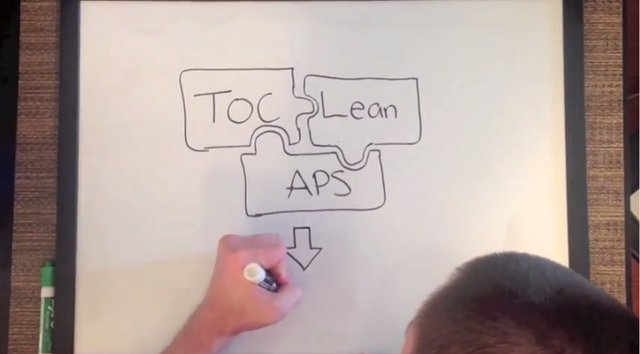
A software that can aid with the implementation of lean methodology is PlanetTogether's Advanced Planning and Scheduling (APS) Software. Advanced Planning and Scheduling Software (APS) enables a visual scheduling production process that gives individuals the power to manipulate the schedule to locate the most effective production route. APS software is being implementing into manufacturing operations around the globe and is aiding production facilities through cost reduction and profit increase.
Advanced Planning and Scheduling Software
Advanced Planning and Scheduling (APS) software has become a must for modern-day manufacturing operations due to customer demand for increased product mix and fast delivery combined with downward cost pressures. APS can be quickly integrated with a ERP/MRP software to fill gaps where these system lack planning and scheduling flexibility and accuracy. Advanced Planning and Scheduling (APS) helps planners save time while providing greater agility in updating ever-changing priorities, production schedules, and inventory plans.
- Create optimized schedules balancing production efficiency and delivery performance
- Maximize output on bottleneck resources to increase revenue
- Synchronize supply with demand to reduce inventories
- Provide company-wide visibility to capacity
- Enable scenario data-driven decision making
Implementation of Advanced Planning and Scheduling (APS) software will take your manufacturing operations to the next level of production efficiency, taking advantage of the operational data you already have in your ERP.
Video: What-If Scenarios in PlanetTogether APS for Lean Production
Lean manufacturing focuses on eliminating waste and maximizing customer value through clear goals, value identification, value stream mapping, flow, pull, and constant improvement.
In this video, you’ll see how PlanetTogether Advanced Planning & Scheduling (APS) uses what-if scenarios to support those Lean principles by testing different production plans before they hit the shop floor.
Watch how planners can:
- Build what-if production scenarios that align with Lean goals such as shorter lead times, higher throughput, and lower inventory
- Use visual APS scheduling (Gantt and other views) to see the impact of changes on capacity, bottlenecks, and due dates in real time
- Compare alternative schedules side-by-side to choose the plan that best supports flow and pull, instead of overproducing or creating unnecessary WIP
- Turn existing ERP/MRP operational data into optimized schedules that reduce waste and improve delivery performance
This video is ideal for Lean leaders, production planners, and operations managers who want to connect Lean manufacturing’s 6 core principles with APS-driven, scenario-based production scheduling.
Make Lean’s 6 Core Principles Real in Your Production Plan
Understanding Lean’s 6 core principles—from setting clear goals and identifying value to mapping the value stream, creating flow, establishing pull, and driving constant improvement—is the first step.
The challenge is turning those principles into a daily production plan that actually reduces waste, shortens lead time, and improves profitability.
Download our one-page “The Money Is in the Planning” infographic to see how combining Lean thinking with Advanced Planning & Scheduling (APS) can help you:
- Translate your value stream maps into optimized, realistic production schedules
- Protect flow by using APS to identify and relieve bottlenecks and avoid overproduction
- Synchronize supply with demand so you can reduce inventories without risking stockouts
- Use your existing ERP data to support continuous improvement instead of rebuilding plans in spreadsheets
- Align teams around a shared, visual schedule that reflects your Lean goals for efficiency and customer value
Share it with your Lean, planning, and operations teams as a quick visual guide to where better planning and scheduling turns Lean from a concept into a measurable operational advantage.
