Advanced Planning and Scheduling
APS Features for Large and Small Manufacturers
Explore APS features like what-if analysis, finite scheduling, and ERP integration for large and small manufacturers.
5 practical benefits of APS in manufacturing, from better production scheduling and capacity visibility to lower inventory and stronger on-time delivery.
APS helps manufacturers build realistic production schedules using actual capacity, materials, labor, and demand data. That improves planning, reduces bottlenecks, lowers inventory pressure, and makes on-time delivery more reliable than spreadsheet-based or ERP-only scheduling.
An APS system is software that helps manufacturers build realistic, finite-capacity schedules. It uses current information about demand, inventory, labor, machine capacity, lead times, and materials to build a schedule the plant can actually run. ERP manages transactions well; APS turns that data into better day-to-day scheduling decisions.

Consider a plant with several product lines, shared equipment, and limited labor. A spreadsheet schedule may look workable at first, but one late material delivery or one long changeover can disrupt the whole plan. APS helps planners respond faster by showing constraints, materials, inventory, and capacity in one place.
APS improves manufacturing efficiency by showing planners where jobs compete for the same machines, labor, and materials. That makes bottlenecks, job-order tradeoffs, and delivery risks easier to see before they affect the plant floor.
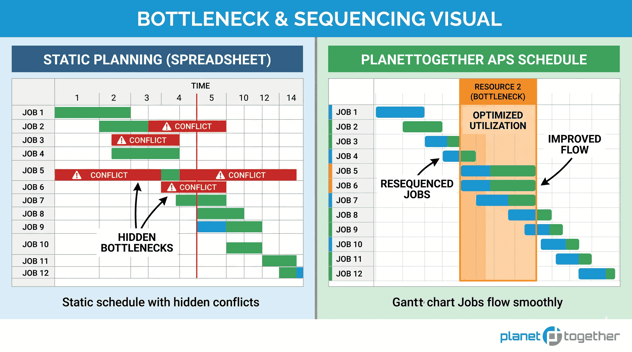
Better production planning starts with realistic schedules. APS helps planners build schedules around real capacity limits instead of ideal assumptions. That makes schedules easier to follow when demand, labor, or material availability changes.
Higher throughput depends on job order and machine use. APS helps reduce unnecessary changeovers, protect bottleneck capacity, and improve machine utilization without making the schedule unstable. .
Supply chain coordination improves when production schedules align with actual material availability and supplier timing. APS helps planners adjust earlier when shipments are late or demand changes.
Reliable delivery starts with better schedule visibility. When planners can clearly see capacity, materials, and bottlenecks, they can provide better dates and respond faster to order changes.
Stronger financial performance often starts with better scheduling. APS helps reduce overtime, cut excess inventory, improve resource utilization, and lower waste from reactive replanning.
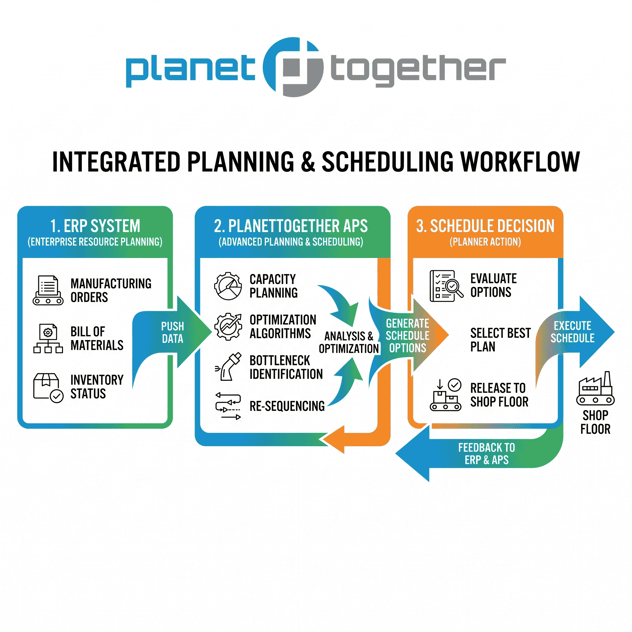
APS helps manufacturers build better schedules and improve throughput. It also helps teams reduce inventory and respond faster when production conditions change. For companies struggling with spreadsheets, ERP-only scheduling, or frequent disruptions, APS can be a major advantage.
Use this framework to decide whether your facility should move beyond spreadsheets or basic scheduling tools.
1. Your schedules look workable on paper but break down on the plant floor.
If labor, machine capacity, materials, or changeovers often disrupt output, you likely need a scheduling system built around real constraints.
2. Your ERP stores the data, but planners still build schedules manually.
ERP is useful, but it does not replace detailed production scheduling. If your team still depends on spreadsheets, manual workarounds, or constant rescheduling, APS can close that gap.
3. Schedule changes create ripple effects across production.
If late materials, rush orders, bottlenecks, or labor shortages often lead to overtime, missed due dates, or unstable schedules, APS helps teams replan faster and make better tradeoffs.
4. You need better visibility before making production decisions.
If planners need clearer insight into bottlenecks, capacity constraints, and material timing, APS provides a more realistic view of the schedule. It also helps teams test what-if scenarios before making changes.
When APS is usually worth evaluating
If two or more of these conditions are true, your operation is likely a strong fit for APS. Manufacturers often see the most value when they need better schedule adherence, faster replanning, and more reliable decisions across labor, materials, and machine capacity.
PlanetTogether APS helps manufacturers move from reactive planning to better daily scheduling. With clearer visibility into materials, labor, machine capacity, and bottlenecks, teams can build more realistic schedules, see tradeoffs earlier, and respond faster when conditions change.
If your ERP handles transactions well but your team still struggles to build realistic schedules, APS is often the next step. It helps planners respond faster, see bottlenecks earlier, and make better schedule decisions before problems reach the plant floor.
For readers comparing APS and ERP more directly, the next best resource is Why ERP Alone Is Not the Answer. In that resource, readers can explore how APS helps manufacturers:

APS stands for advanced planning and scheduling. It helps manufacturers create realistic schedules using current data on materials, labor, machines, demand, and capacity constraints.
The main benefits are better production planning, improved throughput, lower inventory, stronger on-time delivery, faster reaction to disruptions, and better visibility across operations.
ERP manages business data and transactions. APS uses that data to build production schedules that reflect real shop-floor constraints. .
A manufacturer should evaluate APS when planners rely heavily on spreadsheets, bottlenecks are hard to manage, schedules change constantly, or delivery performance and inventory control are slipping.
Yes. APS often connects to ERP, MES, and related systems so planners can work from current data instead of manual updates .
See how PlanetTogether APS fits your products, constraints, and ERP environment. Request a PlanetTogether APS demo to explore how it can improve scheduling, throughput, and on-time delivery in your facility.
Explore APS features like what-if analysis, finite scheduling, and ERP integration for large and small manufacturers.
Learn the 5 core components of APS software in manufacturing: demand forecasting, production planning, scheduling, distribution planning, and...
See how operations management helps manufacturers improve quality, delivery, waste, coordination, and scheduling with realistic APS planning.