How Demand Planning and Production Scheduling Work Together
Demand planning forecasts what the market needs, while production scheduling determines whether the factory can realistically execute that plan. When manufacturers connect demand intelligence with constraint-based scheduling, forecasts are validated against machine capacity, labor availability, material constraints, and changeovers. Advanced Planning and Scheduling (APS) systems create this closed-loop planning model by translating demand signals into executable production schedules.
Most production planning problems do not start on the factory floor. They start several weeks earlier in a conference room where the demand forecast is reviewed, volumes are approved, and the organization aligns around what needs to be produced over the next quarter.
The plan looks solid. Forecast demand flows into the ERP. Production volumes are established. Inventory targets are updated. By the time the meeting ends, the business feels aligned around a clear path forward.
Then the schedule reaches the factory...
Some products run better together than others. A packaging line may need maintenance. A campaign sequence that looked reasonable during planning suddenly creates extra cleanings or unexpected downtime. And the weekly plan that seemed straightforward in the planning meeting starts shifting almost immediately once real constraints enter the picture - so planners adjust.
They move campaign runs. They regroup products to reduce changeovers. They rebalance production between lines based on equipment availability and staffing realities. By the time Wednesday arrives, the original schedule may already look very different from what was approved earlier in the week. And the tool most teams rely on to keep those adjustments moving is usually the same.
A spreadsheet.
This isn’t because the company lacks planning tools. In many cases, the opposite is true. Forecasts exist, ERP systems are in place, and production plans are generated weeks or even months in advance. The organization may even have a dedicated planning application sitting on top of its ERP. But the real work of scheduling still happens somewhere else.
That tension is where demand planning and production scheduling finally meet.
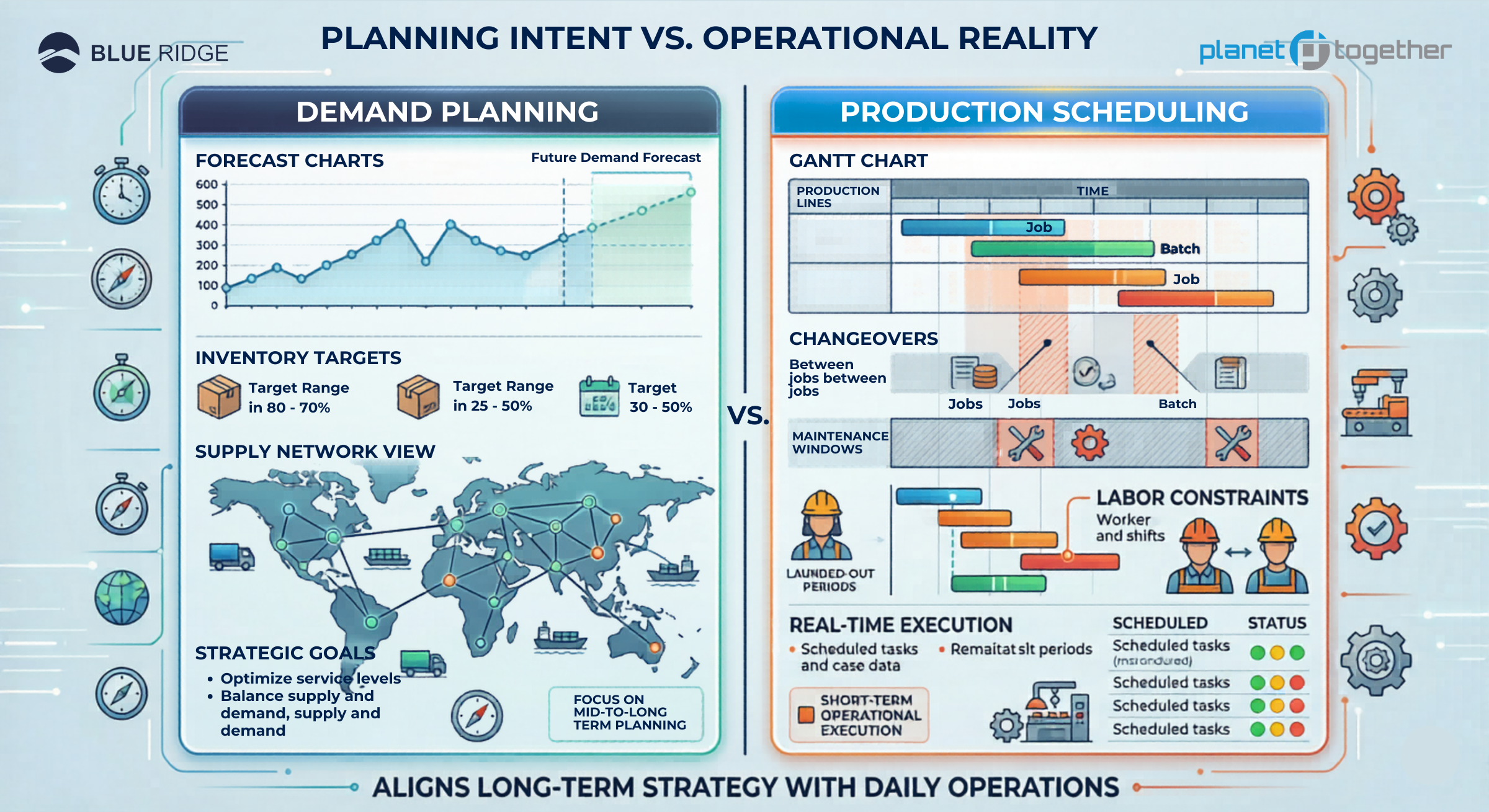
Why Demand Planning Alone Cannot Validate Production Plans
Over the past decade, many manufacturers have invested heavily in improving demand planning. Forecasting tools have matured. Statistical models have improved. Planning teams now have far better visibility into future demand than they did even ten years ago.
Those improvements have been incredible.
Even small gains in forecast accuracy can dramatically reduce excess inventory, improve service levels, and stabilize replenishment decisions across a supply network. When demand planning is working well, procurement becomes more predictable, distribution planning improves, and production volumes are far less volatile.
Demand planning answers a very specific question: What does the market need and when do they need it?
It does not necessarily answer the second question that becomes far more important once those forecasts move closer to execution - Can the factory produce that plan?
A forecast may show stable demand for the next eight weeks, yet the production environment still has to contend with sequence dependent changeovers, labor availability, equipment downtime, quality inspections, allergen cleaning requirements, and packaging constraints.
That is where production scheduling enters the conversation.
What Demand Planning Contributes
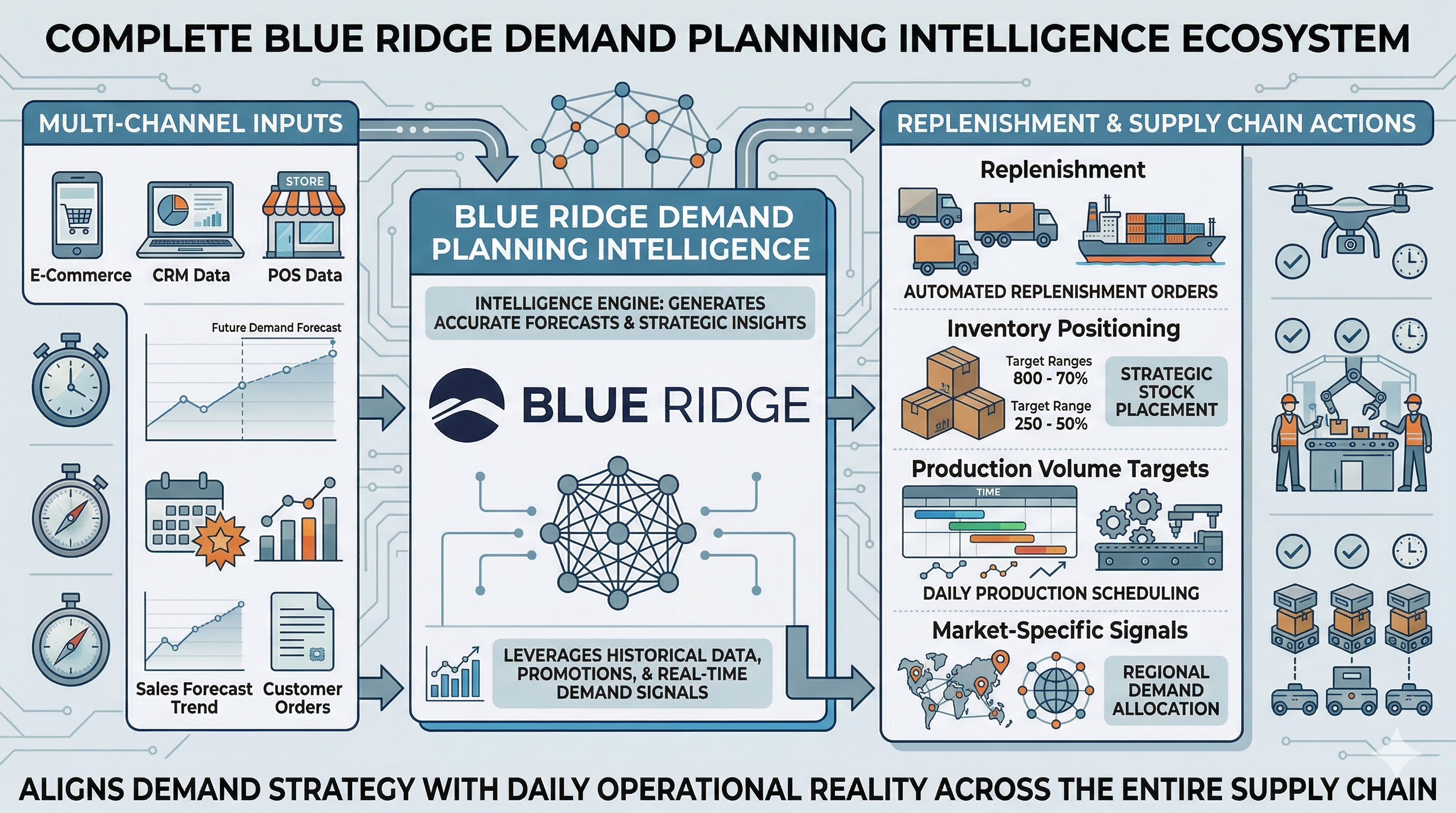
A mature demand planning system does more than produce forecasts. It provides the upstream intelligence that stabilizes supply chain decisions before they ever reach the factory.
Demand planning platforms like Blue Ridge focus on strengthening that upstream visibility. They improve forecast accuracy, automate replenishment planning, and optimize inventory positioning across distribution and manufacturing networks. When those systems are working well, planners gain a much clearer picture of what the organization should produce, when it should be produced, and where inventory should be positioned to support customer service levels.
That stability matters.
When production teams receive reliable demand signals and disciplined replenishment logic, they spend far less time reacting to sudden changes in order volumes or material shortages. But even the best demand signal still needs to be translated into a production schedule that respects the realities of manufacturing.
What Production Scheduling Adds to Demand Planning
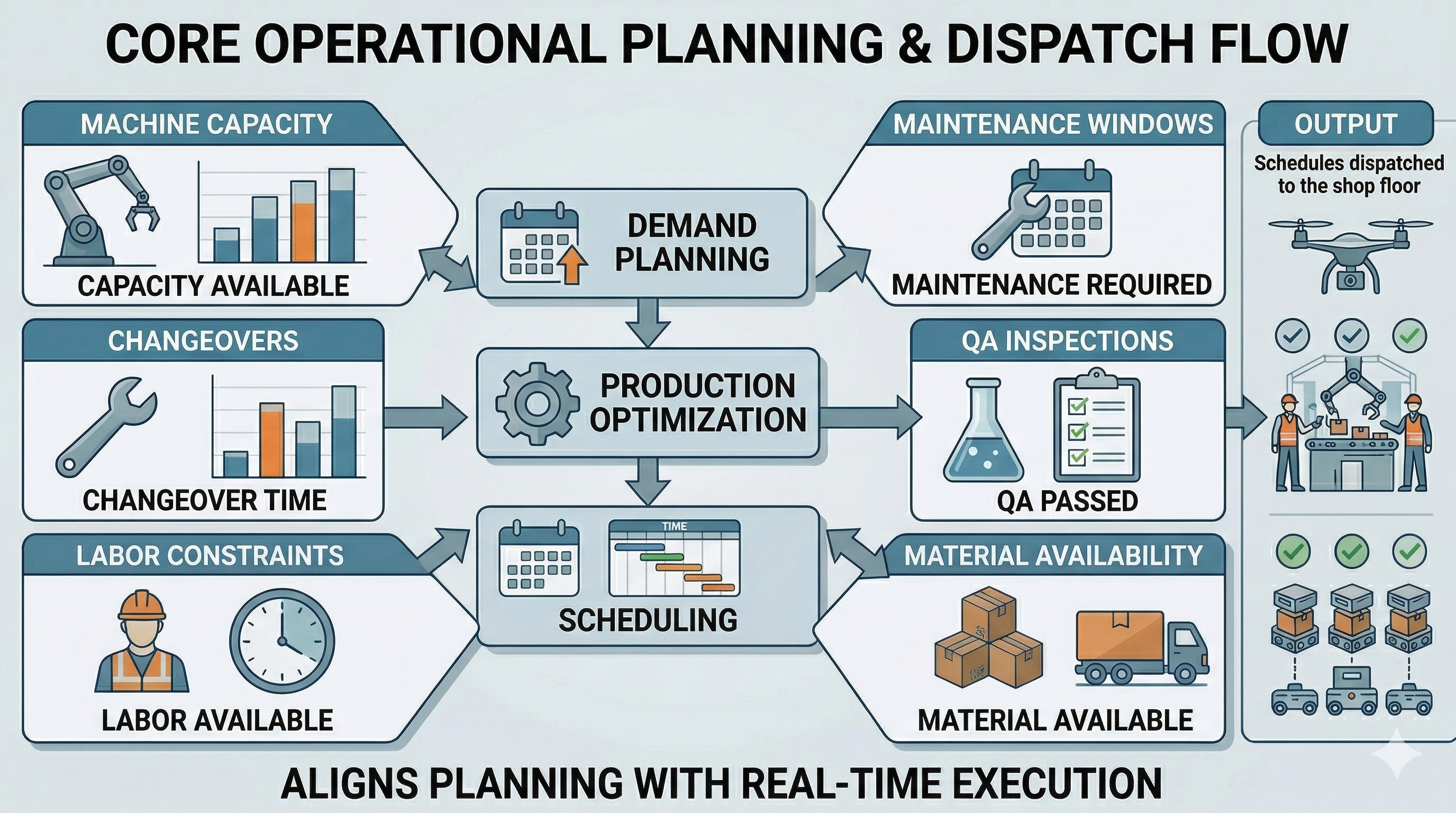
Production scheduling operates much closer to the physical constraints of manufacturing and focuses on a completely different set of questions. The scheduler is not simply asking whether demand exists; they are evaluating whether production is physically achievable within the limits of the factory environment.
Can this product run on multiple lines or only one? How long does the changeover take between these two SKUs? Does the sequence introduce an allergen cleaning requirement that consumes half a shift? Is the necessary packaging equipment available? Will the second shift have enough trained labor to support the run?
These are execution questions.
Advanced Planning and Scheduling platforms such as PlanetTogetherare designed specifically to answer them. APS systems model machine capacity, labor availability, material constraints, sequence dependent setups, and production rules so planners can generate schedules that reflect what the factory can realistically execute.
Instead of manually adjusting spreadsheets throughout the week, schedulers can simulate production scenarios, sequence campaigns more intelligently, and see the downstream impact of schedule changes before they disrupt operations.
How Closed-Loop Planning Connects Demand and Scheduling
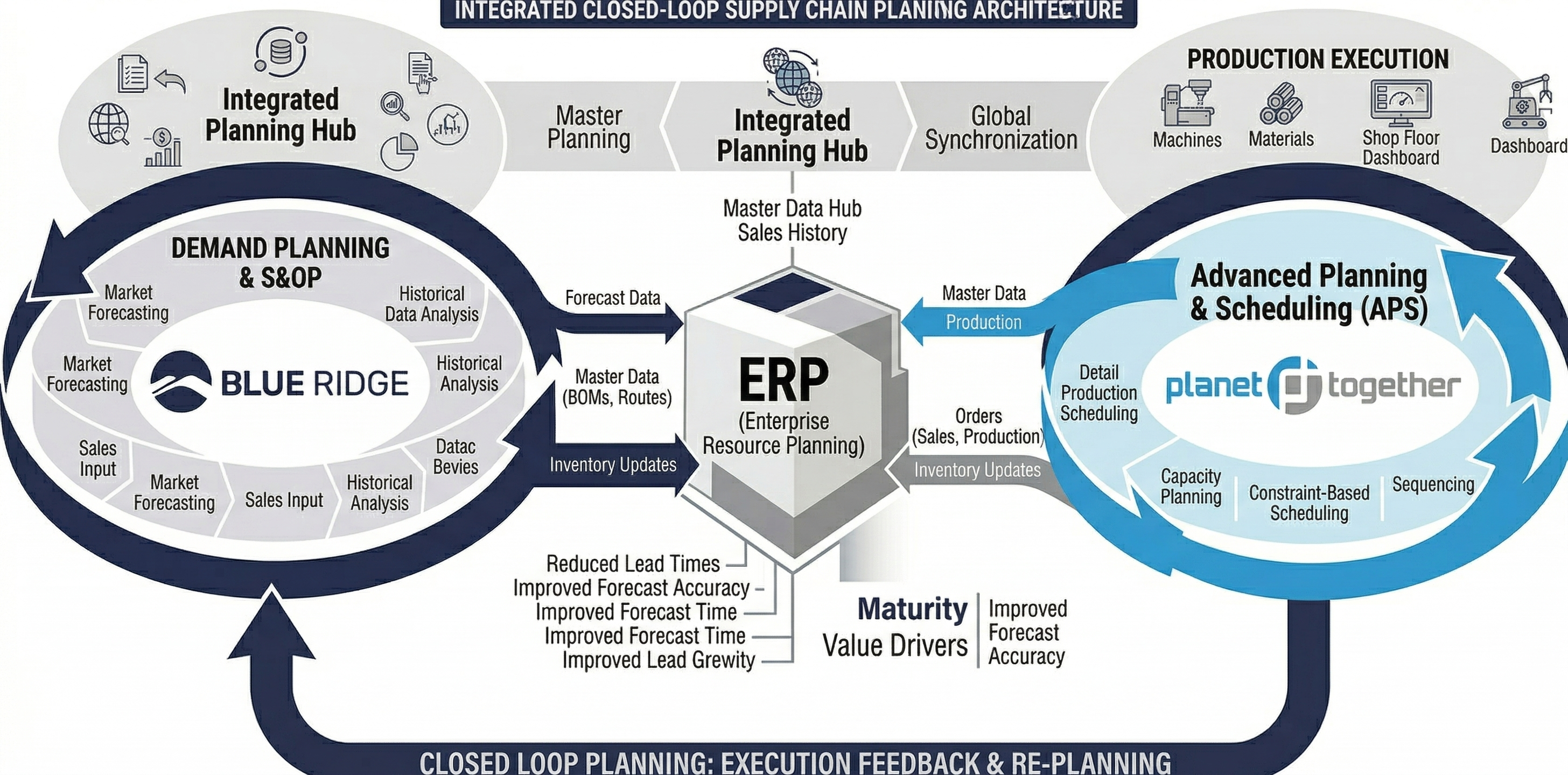
When manufacturers begin connecting demand planning and production scheduling, the shift usually follows a simple structure.
At the top of the planning stack sits demand intelligence. Demand planning platforms such as Blue Ridge generate the signals that shape the rest of the supply chain. Forecasts are refined, replenishment decisions are optimized, and inventory positions are calculated across distribution and manufacturing networks. The goal at this stage is clarity: understanding what the market is likely to require and when that demand will occur.
That demand signal then flows into the scheduling layer.
This is where Advanced Planning and Scheduling systems like PlanetTogether operate. APS engines take the planned demand volumes and test them against the realities of production. Machine capacity, labor availability, sequence dependent setups, material constraints, quality inspections, and cleaning requirements all become part of the scheduling logic.
Instead of assuming the factory can execute the plan, the APS validates it.
Sometimes the schedule confirms the plan works exactly as expected. Other times it reveals constraints that require adjustments. Production campaigns may need to be sequenced differently. Inventory buffers might need to shift. Replenishment timing may change to reflect real throughput limits.
And that information flows back upstream.
The demand plan improves because it is dynamically updated by a finite production schedule. The production schedule becomes more stable because it is fed by disciplined demand signals.
The two systems begin reinforcing each other.
That is what a closed-loop planning environment actually looks like in practice.
Moving From Planning Discipline to Execution Discipline
Many manufacturers have already made the first step in this journey by investing in better forecasting and demand planning. That work is valuable and often delivers immediate benefits across procurement, inventory management, and service levels.
But planning maturity does not stop with forecast accuracy.
Eventually every growing manufacturer reaches the same realization: improving demand planning without validating those plans against real production constraints simply shifts the problem downstream.
The next stage of maturity is connecting the planning signal with the scheduling engine that determines whether the plan can actually be executed.
When demand intelligence and production intelligence operate together, the organization begins planning around operational reality rather than theoretical capacity.
The factory becomes more predictable.
Schedules stabilize.
And supply chain decisions start compounding instead of conflicting.
A Practical Next Step for Supply Chain Leaders
Most supply chain leaders eventually realize that planning friction rarely originates from a single system or a single team. It usually appears in the spaces between them.
Sometimes the issue begins upstream. Forecast revisions arrive late, replenishment decisions introduce unexpected swings in production volume, and operations teams spend the week reacting to changes that were never visible during the planning cycle.
Other times the demand signal itself is relatively stable, yet the factory still struggles to execute the plan as written. Campaigns run longer than expected. Equipment constraints appear midweek. Planners rebuild the schedule repeatedly just to keep production moving.
The common thread is not forecasting accuracy or scheduling sophistication on its own.
It is coordination.
When planning decisions and production realities operate in separate environments, the organization ends up translating information manually between them. Forecasts become targets. Targets become spreadsheets. Schedulers reinterpret the plan in order to make it workable.
The system technically functions.
But it depends heavily on people bridging the gap.
Organizations that move beyond this stage tend to focus on connecting the two planning perspectives rather than refining them independently. Demand intelligence shapes what the business intends to produce across the network, while constraint-based scheduling evaluates whether those intentions can actually be executed inside the factory.
When those perspectives begin informing each other, the planning conversation changes.
Forecast discussions start reflecting real capacity limits. Production plans account for the sequencing realities of the floor. Inventory positioning aligns more naturally with how products are actually manufactured.
This is where many manufacturers begin pairing modern demand planning platforms such as Blue Ridge with advanced scheduling systems like PlanetTogether. One stabilizes the upstream signal that drives production decisions. The other validates whether those decisions can actually be executed given the constraints of the factory.
The result is not simply a better forecast or a better schedule.
It is a planning environment where both are built from the same operational context.
And that is when planning maturity begins to compound.
Stop Translating Forecasts Into Spreadsheets
Your demand plan can look solid in the planning meeting—until real constraints hit the floor. When changeovers, labor limits, maintenance windows, and other realities collide with a forecast-driven plan, teams end up rebuilding schedules midweek and “bridging the gap” manually.
If you’re evaluating how to connect demand planning to a constraint-based scheduling engine, this white paper clarifies where ERP stops—and what capabilities you need next to validate the plan against real capacity.
Download our whitepaper "WHY ERP ALONE IS NOT THE ANSWER" to learn how to:
- Identify the ERP “blind spots” that create unrealistic schedules (capacity, constraints, changeovers)
- Reduce expediting by enabling scenario-driven, what-if scheduling decisions
- Improve schedule stability by planning around bottlenecks instead of reacting to them
- Understand why forward/backward scheduling logic breaks down in complex trade-offs
- Build a stronger business case for APS as the execution layer that validates demand signals

FAQ: Demand Planning and Production Scheduling
What is the difference between demand planning and production scheduling?
Demand planning forecasts market demand and determines how much product should be produced over a future planning horizon. Production scheduling determines how that demand will be executed on the factory floor by sequencing jobs, allocating resources, and accounting for real production constraints.
Why do manufacturers struggle when demand planning and scheduling are disconnected?
When demand planning and production scheduling operate separately, forecasts may assume theoretical capacity that the factory cannot realistically achieve. This often results in frequent schedule adjustments, expediting, and unstable production plans.
What is closed-loop planning in manufacturing?
Closed-loop planning occurs when demand signals are continuously validated against production constraints. Demand planning generates the forecast, while Advanced Planning and Scheduling systems evaluate whether that plan can be executed within real factory capacity.
How does APS improve demand and production alignment?
Advanced Planning and Scheduling software models machine capacity, labor availability, material constraints, and sequence dependent changeovers. This allows planners to simulate production scenarios and validate demand plans before they disrupt operations.
What role does ERP play in demand planning and production scheduling?
ERP systems typically manage transactional data such as orders, inventory levels, and work orders. APS systems complement ERP by evaluating whether those plans are feasible within real production constraints.
See If Your Planning Environment Is Ready for APS
Many manufacturers improve forecasting but still struggle to translate those forecasts into executable production schedules. The next step is evaluating whether your planning environment can validate demand signals against real factory constraints.
Take the APS Readiness Assessment to see how prepared your organization is to connect demand planning with constraint-based production scheduling.