Quick Answer: How Plant Managers Balance Cost, Quality, and Output
Plant managers balance cost, quality, and output by making tradeoffs visible before they hit the shop floor. That means aligning labor, materials, machines, and due dates with realistic schedules, then using data to reduce waste, protect quality, and keep output on plan. APS software supports that balance by helping teams respond faster when capacity, demand, or supply conditions change.
Key Takeaways
- Plant managers rarely improve cost, quality, or output in isolation because each one affects the others.
- The most common breakdowns happen when schedules cannot absorb changes in labor, materials, machine availability, or demand.
- APS helps by making tradeoffs visible earlier, so teams can respond faster without relying on manual replanning.
- Better plant performance usually shows up as stronger schedule adherence, lower overtime, less rework, and more reliable on-time delivery.
- The goal is not to maximize one metric. It is to improve plant performance without creating hidden costs somewhere else.
Why This Tradeoff Is So Hard to Manage
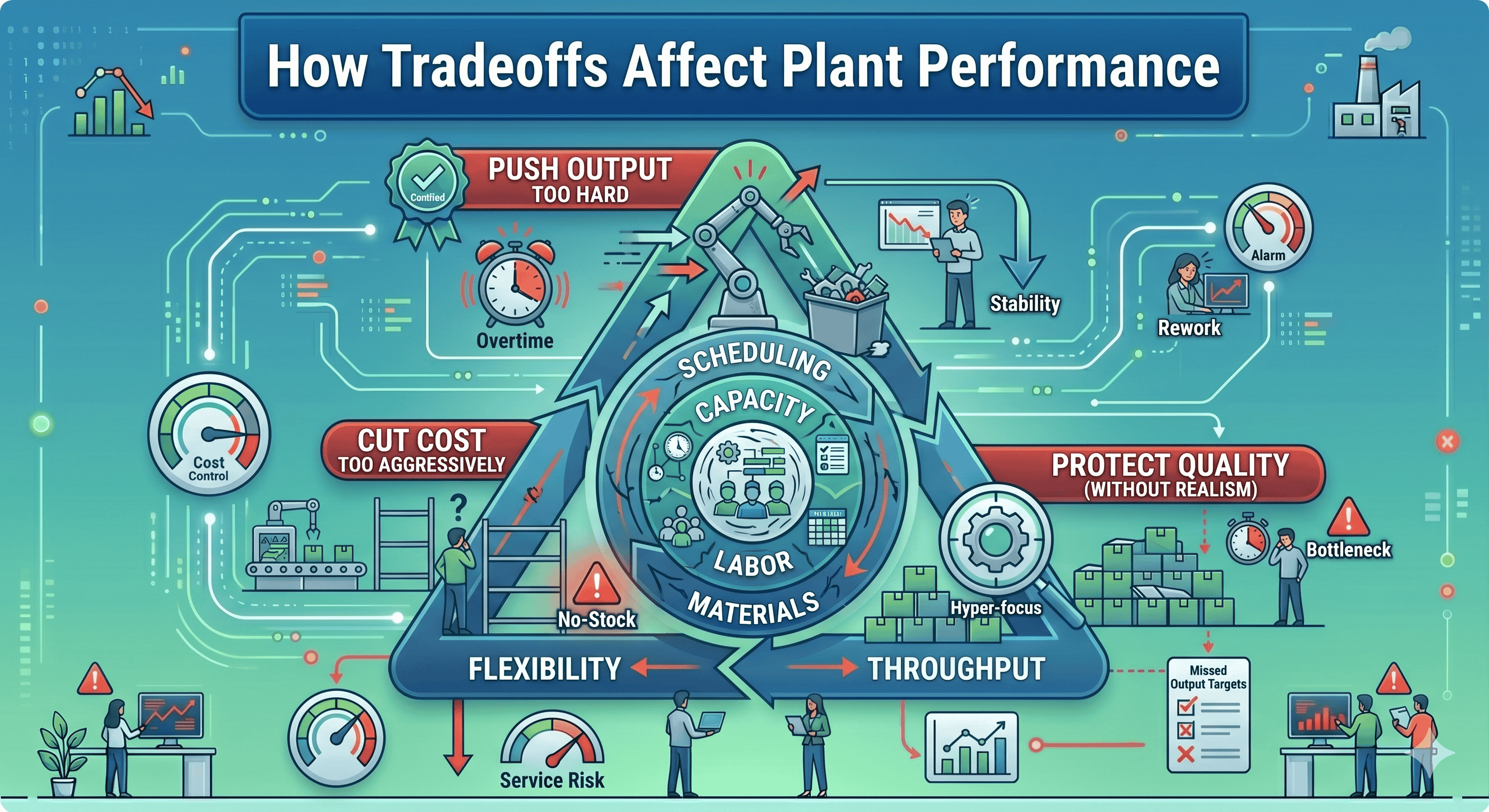
Balancing cost, quality, and output is difficult because plant managers rarely get to improve one without affecting the others. A schedule that pushes output too hard can increase scrap, overtime, and instability. A plant that focuses only on cost can lose flexibility and service performance. The goal is to improve all three with realistic schedules, better resource alignment, and faster decisions when conditions change.
What Balancing Cost, Quality, and Output Really Means
Cost, quality, and output are connected. When one changes, the other two usually feel the impact.
-
Cost includes more than raw material spend. It includes labor efficiency, overtime, changeovers, downtime, scrap, inventory, and logistics.
-
Quality depends on process stability, operator consistency, inspection timing, and whether the schedule allows the work to be done correctly.
-
Output depends on feasible schedules, machine availability, material timing, and how well bottlenecks are managed.
The goal is not to maximize one number in isolation. It is to improve plant performance without creating a hidden penalty somewhere else.
Why This Balance Breaks Down on the Plant Floor
Plant managers usually lose balance when one part of the operation changes faster than the schedule can absorb it.
-
Resource constraints create problems when labor, machines, tools, or materials are not available when planned.
-
Variable demand makes it harder to hold output steady without building excess inventory or forcing expensive schedule changes.
-
Supply chain disruptions create late starts, resequencing, expediting, and quality risk when teams rush to recover.
-
Compliance requirements add inspections, documentation, and process controls that affect both throughput and cost.
These issues are manageable, but they become expensive when the plant reacts manually instead of planning around them.
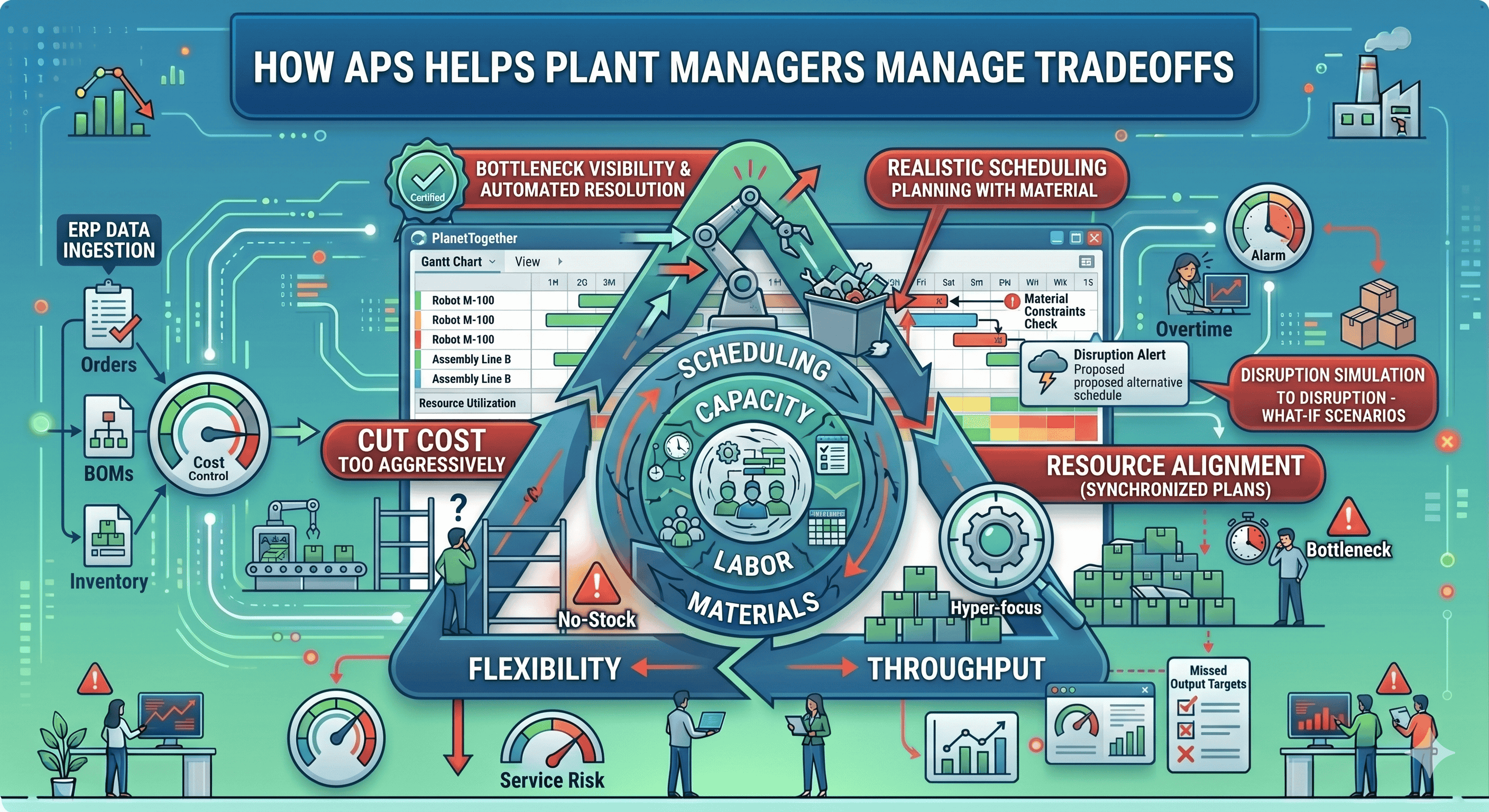
How APS Helps Plant Managers Manage Tradeoffs
PlanetTogether APS helps plant managers make scheduling decisions with a clearer view of capacity, inventory, labor, and demand. Instead of treating the schedule as a static plan, teams can adjust priorities based on what the plant can actually run.
-
Dynamic scheduling helps planners respond faster when demand shifts, machines go down, or materials arrive late.
-
Resource alignment helps match people, machines, and materials to the right work at the right time.
-
Quality protection improves when schedules allow for inspections, process discipline, and fewer last-minute disruptions.
-
Maintenance planning becomes easier when maintenance windows are scheduled around real production needs instead of after unplanned failures.
Four Practical Ways to Improve Cost, Quality, and Output
Plant managers improve cost, quality, and output when they combine better scheduling with practical operating discipline. These four approaches help reduce waste, protect quality, and make output more predictable.
Adopt a Lean Manufacturing Mindset
Lean helps plants reduce waste without treating cost reduction as a standalone goal. The most useful lean gains come from eliminating waiting time, excess movement, unnecessary inventory, and avoidable rework. When planners can see where time and capacity are being lost, they can improve cost and output without creating new quality risk.
Implement Just-in-Time Production Carefully
Just-in-time production can lower inventory cost and reduce waste, but it only works when schedules are realistic and supply timing is dependable. The benefit is not just lower stock. It is better alignment between what the plant needs, what is available, and what must ship next.
Invest in Workforce Capability
A well-trained workforce protects both quality and output. Operators, planners, and supervisors need to understand not only how to run the process, but also how schedule changes, handoffs, and resource limits affect overall performance. Better training reduces avoidable errors and improves response when conditions change.
Use Predictive Analytics Proactively
Predictive analytics is most useful when it helps teams act before a disruption becomes a plant-wide problem. Early signals around bottlenecks, maintenance needs, or supply risk allow managers to adjust schedules sooner, protect quality, and avoid the cost of reactive firefighting.
What ERP-Integrated APS Improves in Daily Operations
When APS is connected to ERP data, plant managers get a clearer operating picture and a faster way to act on it.
-
Better collaboration because planning, inventory, and execution teams are working from the same operating picture.
-
Better visibility because schedule decisions reflect order status, material timing, and available capacity.
-
Better scalability because the system can support more complexity without forcing planners back into spreadsheets.
-
Better decisions because teams can evaluate tradeoffs earlier instead of reacting after performance drops.
What Good Plant Performance Looks Like
Good plant performance is not just higher output. It shows up in more stable schedules, fewer last-minute changes, lower overtime, less rework, better schedule adherence, and stronger on-time delivery. When plant managers can see tradeoffs earlier, they can make decisions that protect quality and cost without losing throughput.
ERP-connected APS supports that by giving teams a better view of demand, capacity, materials, and execution constraints in the same planning flow. That makes the plant more responsive without making it more chaotic.
A 3-Step Decision Framework for Plant Managers
Use this quick check when cost, quality, or output starts moving in the wrong direction:
1. If output is behind plan, identify the real constraint.
Ask whether the problem is labor availability, machine time, material timing, sequencing, or a bottleneck resource. Do not assume the answer is simply “run faster.”
2. If quality is slipping, look for schedule-driven instability.
Check whether rushed orders, excess changeovers, unstable handoffs, or late material substitutions are creating avoidable quality risk.
3. If cost is rising, find out what the plant is doing to compensate.
Look for overtime, expediting, excess inventory, scrap, downtime, or rework that is being used to cover for weak schedule alignment.
When the same root cause shows up in more than one of these checks, the problem is usually not isolated. It is a planning and scheduling issue that needs to be addressed at the system level.
Conclusion
Balancing cost, quality, and output is not about choosing one priority over the others. It is about building schedules and operating decisions that make the tradeoffs visible early enough to manage them. When planners have a realistic view of capacity, materials, labor, and demand, they can protect quality, control cost, and keep output on track more consistently.
If your team is still managing these tradeoffs with manual updates or disconnected systems, PlanetTogether can help improve schedule visibility, resource alignment, and day-to-day production control.
Improve Plant Performance Without Trading Off Cost, Quality, or Output
Balancing cost, quality, and output gets harder when scheduling is reactive, resources are misaligned, and small disruptions turn into plant-wide problems. This guide is a strong next step for plant leaders who want practical ways to improve scheduling, throughput, and profitability with fewer tradeoffs.
Inside, you will find:
- How better planning improves throughput without increasing chaos
- Ways to reduce inventory, overtime, and avoidable waste
- Practical ideas for using production resources more efficiently
- A clearer path to improving plant performance with better scheduling

FAQs About Cost, Quality, and Output in Manufacturing
Why is it hard to balance cost, quality, and output in manufacturing?
Because improving one area often puts pressure on the others. Higher output can create quality risk, tighter cost control can reduce flexibility, and quality protections can slow production if scheduling is not realistic.
What is the biggest mistake plant managers make when balancing these priorities?
The biggest mistake is pushing one target in isolation, such as output or cost, without accounting for labor limits, machine capacity, material timing, and schedule feasibility.
How does APS help improve cost, quality, and output?
APS helps teams build realistic schedules, evaluate tradeoffs faster, reduce bottlenecks, and respond to change without relying on manual replanning.
Does ERP integration matter for plant performance?
Yes. ERP integration improves visibility into orders, inventory, and resource status, which makes it easier to align scheduling decisions with actual operating conditions.
What metrics should plant managers watch most closely?
Watch schedule adherence, throughput, scrap or rework, overtime, changeover impact, and on-time delivery together rather than in isolation.
See How PlanetTogether Supports Better Plant Decisions
Ready to improve schedule visibility, protect quality, and respond faster to change? Talk with PlanetTogether to see how ERP-connected APS helps plant managers balance cost, quality, and output with more control.