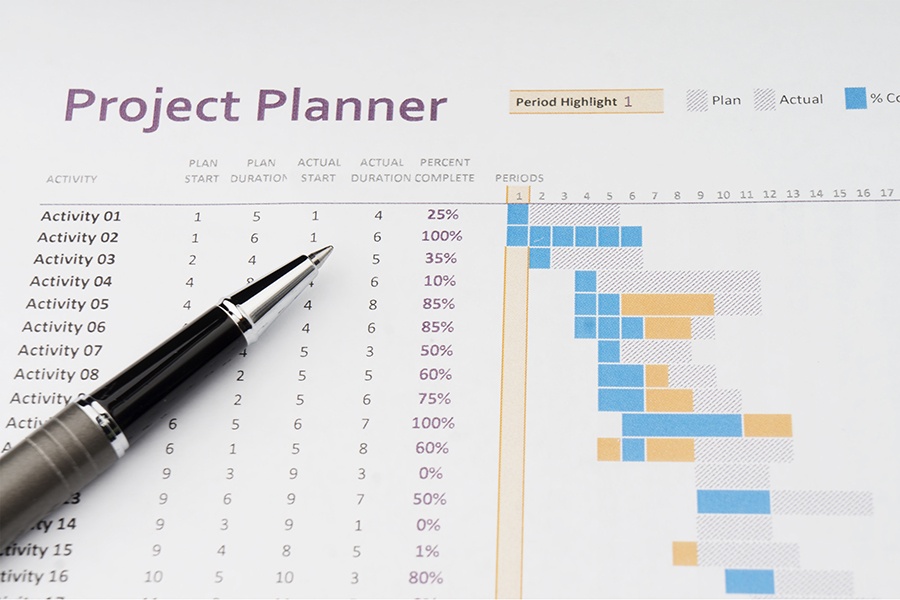
A production planning schedule involves myriad moving parts. A deep understanding of what is involved in the entire operation is integral to preparing a robust master schedule. The planner's overview of the organization generally includes: an awareness of market demand – are the Sales Department members taking orders on a seasonal basis only or is the flow of orders steady; a good feel for the supply chain situation – are suppliers delivering material on time and with consistent quality or is there a weakness in obtaining material as needed; an up-to-date understanding of factory floor equipment availability and capacity – which lines are experiencing bottlenecks, which machines are being serviced, what is the downtime schedule; information about labor availability – are the right people with the right skills available to produce the product orders; and the list goes on.
A strong master schedule needs to accommodate all the above information, and more, if it is to guide an operation well. But it also needs to be flexible enough to react to change if necessary. Most schedules and the process of scheduling can be improved. This basic checklist can be used as a guide:
Step 1: Look at the Big Picture
How is the operation going at present? Identify the weak points in the process. Are some critical constraints repeatedly affecting the production flow negatively? As mentioned above, be sure to consider every aspect of the company and the production line that will affect or be affected by the master schedule. By identifying and quantifying the risk factors that affect production throughout the organization, a planner will be working from a position of strength. Past performance in all areas is invaluable information for use in the planning process.
Step 2: Assess Operational Communications
We've found that clear communication between departments is paramount in order to create a successful schedule and, thus, result in efficient, profitable operation. Not only does the company database need to capture complete and reliable information, but this information should be accessible to all that require it. As well, each functional area responsible for information input needs to keep that information flow timely.
Just as important is the dissemination of the information. Keeping everyone current and in the picture eliminates confusion and contradictions.
Here's one example of a situation some companies find themselves in: a printed production schedule is published and posted periodically. Different groups may be using schedules that are out-of-date and may include errors that have been corrected centrally, but a new hard copy has not yet been distributed. Communication of the planning schedule in this manner opens an organization up to misunderstandings which can have serious effects on production.
Visibility of information may be the most crucial element of good operational communications. Keeping all departments in sync allows a firm to adjust to schedule changes and problems quickly since that new information is transmitted in real-time to all groups. This type of collaboration means that Sales and Customer Service departments can give customers realistic time horizons, the Production floor can bring trained shifts on or off to accommodate these changes, Purchasing will be able to deal with suppliers intelligently, the Shipping department will know when to dispatch transportation properly.
Step 3: Forecasting for Improvement
Once an organization has collected the necessary information, it becomes a simple matter to predict where attention needs to be paid to keep the production schedule on track. Informed anticipation of future bottlenecks, labor skill-set weaknesses, mis-aligned equipment productivity with capacity, allows a manufacturer to address these problems before they happen. Knowing the key elements to concentrate on will keep everyone on track.
Just as importantly, knowing what might happen builds in flexibility to respond to problems since a forecast can include troubleshooting in advance – creating a roadmap that includes solutions to those problems. Additional skills training or cross training can be done if a company knows that is one of their scheduling constraints; departments can collaborate ahead of time on solutions and know how these efforts will affect production flow; problematic machines can be serviced or replaced if that is where efficiency is falling.
In Sum
An organization can improve its production planning schedule if all players know what is involved in the entire production process, have the reliable, shared information to respond flexibly, and problem-solve before those problems can take down the production line.
Video: Forecasting Key Constraints for Better Production Planning.
In this video, you’ll see how forecasting key constraints—like bottleneck machines, labor availability, and material issues—can dramatically improve your production planning schedule. Learn how planners move from reacting to problems after they happen to anticipating them in advance and building more accurate, flexible plans
Key takeaways from this video:
- Why forecasting constraints, not just demand, improves the production plan
- How to identify bottlenecks in equipment, labor, and materials before they hit
- How constraint forecasting makes your master schedule more flexible and realistic
- How better visibility and communication keep all departments working from the same plan
- How forecasting key constraints reduces downtime, late orders, and schedule chaos
Find the Red Flags That Are Quietly Breaking Your Production Plan
A production planning schedule only works if everyone shares the same picture of demand, capacity, and constraints. When Sales, Operations, Purchasing, and the factory floor work from partial or outdated information, you get the same results every time: surprised bottlenecks, last-minute changes, and frustrated customers.
Download our one-page “Red Flags in S&OP” infographic to quickly spot where your planning process is at risk. You’ll see warning signs such as:
- Conflicting numbers between Sales, Operations, and Finance
- Frequent schedule overrides on the shop floor
- Chronic bottlenecks at the same equipment or departments
- Rush orders, overtime, and expediting becoming “normal”
Use it as a quick checklist with your team to identify where communication, data, or process gaps are undermining your ability to forecast key constraints and run a reliable production plan.
