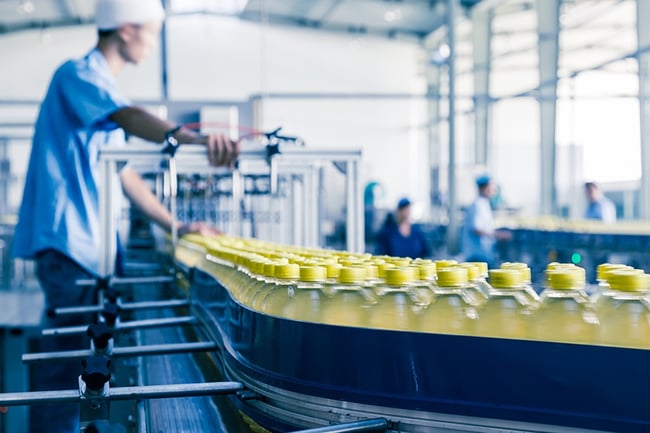
Experienced planning managers know the danger of schedules that assume a manufacturing facility can produce any number of orders simultaneously while expecting on-time deliveries. Ignoring resource constraints will lead to bottlenecks that ripple throughout the system. Business owners want to see building profits – at the same time, they need to deal with a finite capacity system.
It is common for manufacturers to use rough-cut capacity planning as a tool to schedule production. The problem that arises here is that resources are not always capable of performing the work that is assigned to them. Planners and schedulers must ensure that there is a correspondence between the capabilities of the resources, their available capacity, and the work that is assigned to them.
Planning restrictions create inevitable bottlenecks; outside market forces will exist, and supply chain flows can develop problems. Matching requirements with the limited availability of resources is the only way to develop a realistic production plan. Let's look at some of the ways to approach the multiple constraints that may limit production capacity from reaching its potential.
Proactively Identify Bottlenecks
Identifying all of the resources needed to manufacture a product makes for an extensive list. In order to manufacture anything, a production facility may require:
- matching components to customer orders
- allocating sufficient time to complete orders
- the availability of raw materials
- labor with the right skill set
- machines that are available for use
- packaging for the finished product
- storage areas
- transportation to customers and vendors.
Thinking outside the factory walls (out of the box, if you will) is also important. External factors that can impact the production plan and schedule must also be considered:
- Is market demand weakening?
- Are supply chain members able to produce needed parts and materials?
- Are customers requesting more change orders than usual?
If any one of these factors becomes problematic, a bottleneck can occur that may affect many other areas throughout the operation and slow the whole process down. Once potential limiting factors throughout an organization are identified, backup plans can be formulated to offset delays that they can cause and to optimize a factory's finite capacity.
Lessening the importance of a bottleneck can make a great deal of difference in workflows. Attending to limitations – whether it is having a supply of materials located next to the machine that will use them or making sure that workers are cross-trained to accommodate needed breaks – will buffer the effects on the entire operational process. In addition, finding the finite production capacity of your production facility is crucial for anyone that wants to generate detailed production schedules that are realistic and feasible.
Turn Limiting Factors Around with APS
An Advanced Planning and Scheduling (APS) system can help managers deal with the multiple constraints inherent in any operation. Determining the maximum production capacity available to schedule your production can be extremely challenging. This is because there are many variables to consider such as machine capabilities, labor skill sets, varying run rates, changeover time, material availability, and tool constraints.
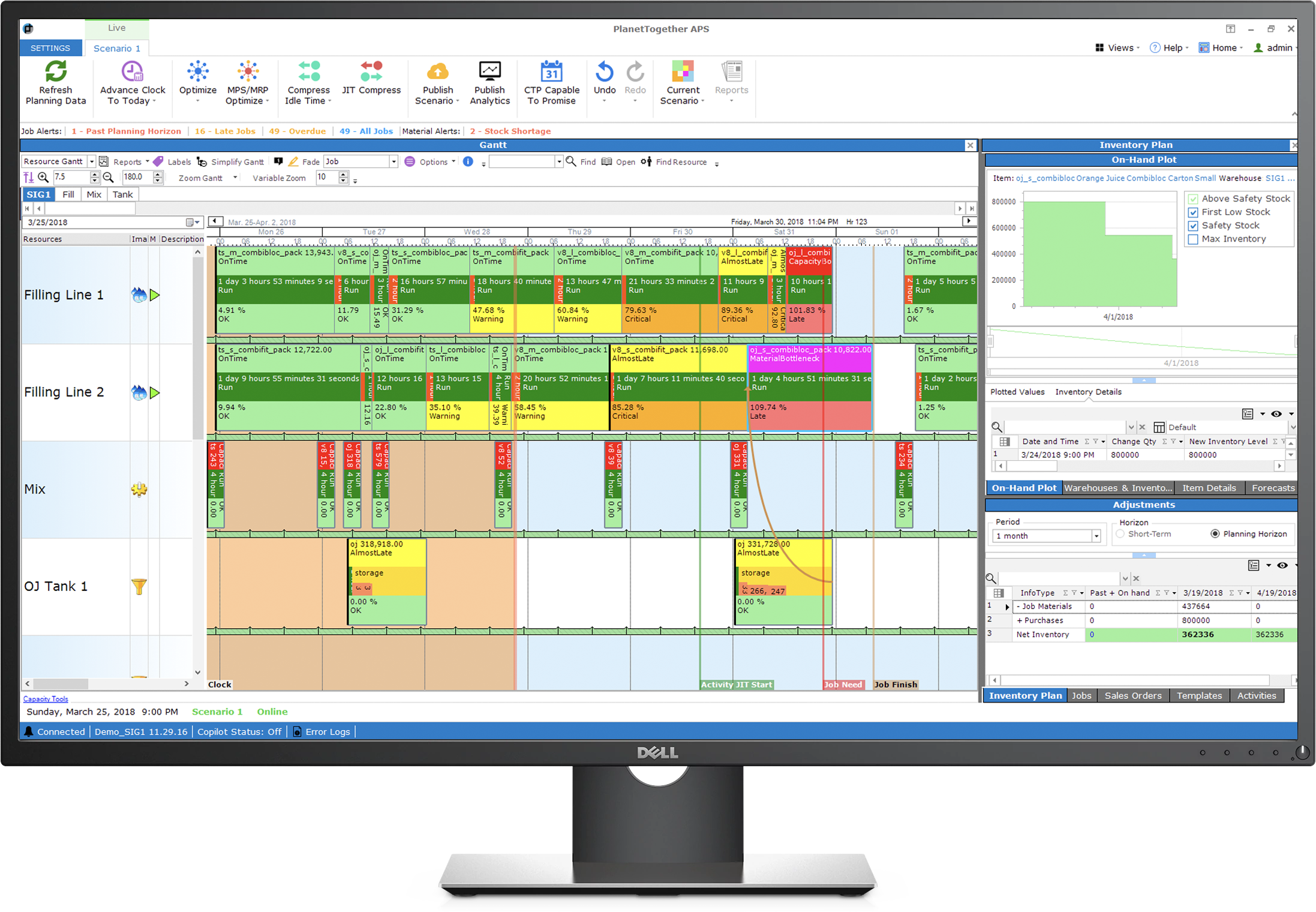
An APS system is digitally integrated into the entire organization in real-time. This ensures that you can produce realistic schedules for every part of the manufacturing process by automatically taking into consideration all of the possible constraints of the system. In addition, an Advanced Planning and Scheduling (APS) system like PlanetTogether APS holds a valuable warehouse of data that can be used to analyze and anticipate bottlenecks.
Create an Optimized Schedule
After an APS identifies weak spots in the process, a clearer path to optimizing a solution emerges. As the production plan and schedule are automatically generated in a matter of seconds, planners and schedulers have the time they need to make strategic decisions to improve the production processes.
An organization might need to re-engineer a product flow route or bring in a newer, more efficient machine. Brainstorming based on real-time data analysis might suggest buying part of the product pre-assembled or deleting a product from sales offerings altogether. Perhaps the system will uncover a need for up-training or cross-training to keep the production floor on target.
Understanding the constraints that produce bottlenecks, and responding to those limitations with the intelligent use of data keep operations flowing around the finite capacity of a production floor.
With PlanetTogether, we implement solutions to problems with confidence, and before constraints become a manufacturing issue.
GREGORY VAN LEIRSBURG, PRODUCTION SCHEDULER, STANDARD PROCESS SUPPLEMENTS
Advanced Planning and Scheduling (APS) Software
Advanced Planning and Scheduling Software have become a must for modern-day manufacturing operations as customer demand for increased product assortment, fast delivery, and downward cost pressures become prevalent. These systems help planners save time while providing greater agility in updating ever-changing priorities, production schedules, and inventory plans. APS Systems can be quickly integrated with an ERP/MRP software to fill the gaps where these systems lack planning and scheduling flexibility, accuracy, and efficiency.
With PlanetTogether APS you can:
The implementation of Advanced Planning and Scheduling (APS) Software will take your manufacturing operations to the next level of production efficiency by taking advantage of the operational data you already possess in your ERP system. APS is a step in the right direction of efficiency and lean manufacturing production enhancement.
Video: Finite Capacity Planning & Bottleneck Management in PlanetTogether APS
In this video, you’ll see how PlanetTogether Advanced Planning and Scheduling (APS) helps planners move from rough-cut, infinite-capacity plans to finite capacity planning that respects real-world constraints. Learn how APS identifies bottlenecks, models machine and labor limits, and creates realistic schedules that improve on-time delivery and profitability.
Every operation has finite capacity. When schedules ignore constraints—machine availability, labor skills, material supply, changeovers, and external factors—bottlenecks ripple through the entire system. This video shows how PlanetTogether APS:
– Automatically accounts for multiple constraints (machine capabilities, labor skill sets, varying run rates, changeover time, material and tool availability) in one scheduling model
– Uses real-time data from ERP/MRP and the shop floor to generate optimized, feasible schedules in seconds
– Highlights bottleneck resources and weak spots so planners can re-route work, re-balance loads, or adjust product flows before issues hit the floor
– Supports scenario-based planning, allowing planners to compare alternatives instead of manually reshuffling spreadsheets
– Provides company-wide visibility to resource capacity so sales, operations, and leadership all work from the same realistic plan
This video is ideal for planning managers, schedulers, and operations leaders who want to increase profitability by planning around real constraints instead of relying on infinite-capacity assumptions.
Turn Finite Capacity Constraints into a Planning Advantage
Every plant operates under finite capacity, but many schedules still assume resources can handle any volume at once. That gap between “infinite” plans and real constraints shows up as bottlenecks, missed due dates, and margin erosion. Rough-cut capacity planning is not enough—you need a way to match real resource capabilities with actual requirements and build a schedule that your factory can truly execute.
Download our one-page “The Money Is in the Planning” infographic to see how advanced planning and scheduling can help you:
- Identify and manage bottleneck resources before they stall the entire operation
- Replace infinite-capacity assumptions with finite-capacity, constraint-aware schedules
- Synchronize supply with demand to cut excess inventory while maintaining service levels
- Use the operational data already in your ERP/MRP to create optimized schedules that increase throughput and profitability
- Free planners from manual rescheduling so they can focus on strategic improvements instead of constant firefighting
Use this infographic with your planning and operations teams as a quick reference for where better planning around constraints will have the biggest impact on your production performance and bottom line.
