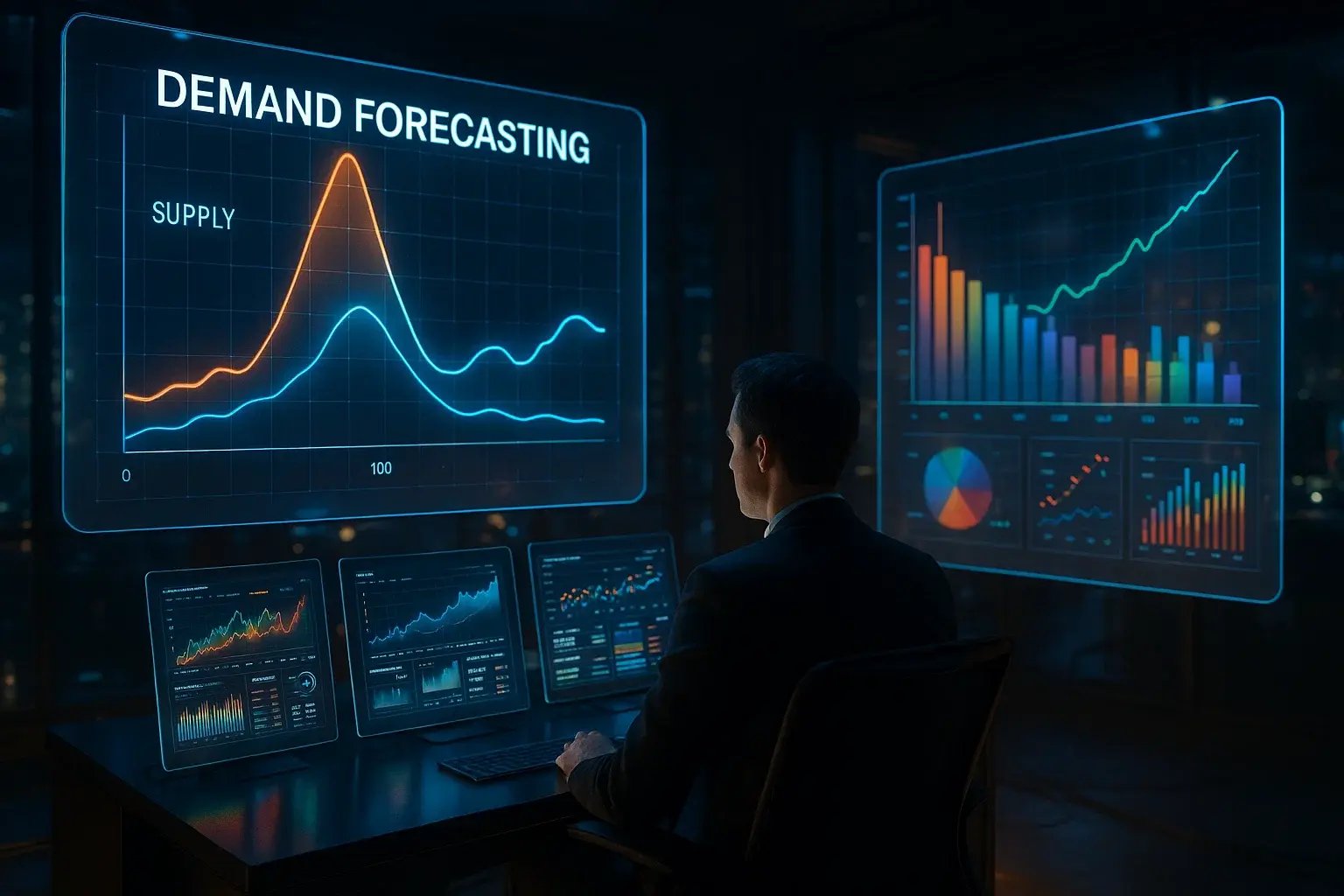
Types of demand forecasting with advanced planning and scheduling software (APS) systems, that may have simulation or predictive analytics capabilities.
By PlanetTogether
Published: May 7, 2018
| Last Verified: Jun 4, 2026
Answer in 60 Seconds: Demand Forecasting Methods
Demand forecasting helps manufacturers predict future customer demand so they can plan production, inventory, and staffing. Common approaches include predictive analytics (data-driven), conjoint analysis (attribute trade-offs), client intent surveys (stated purchase plans), and the Delphi method (expert consensus). The best method depends on data availability, product novelty, and forecast horizon—and APS software can connect forecasts to capacity to make plans executable.Demand forecastingis the process of predicting what the demand for certain products will be in the future. It identifies what both current and future customers will want to buy and tells manufacturing facilities what they should actually produce. This is a core part of supply chain and operations planning, as explained in this overview of demand forecasting techniques in operations management.
Ideally, manufacturing companies want to be able to accurately predict customer demands so that they can produce the right amount of products. Producing too little items leads to stock shortages and can negatively impact customer relationships. On the other hand, having too much inventory is costly and can lead to having excess stock if the items become obsolete.
Along with knowing the quantities manufacturing companies should produce, demand forecasting can help set the price for those items and determine which markets would be best suited for the company.
Methods of Demand Forecasting
Demand forecasting allows manufacturing companies to gain insight into what their consumer needs through a variety ofsteps to improve forecasting methods. These methods include: predictive analysis, conjoint analysis, client intent surveys, and the Delphi Method of forecasting.
Predictive Analytics
Predictive analysis goes further than traditional demand forecasting by evaluating the reason why people buy. The process uses mathematical principles to predict consumer behavior by using current and historic data.
Like traditional forecasting, predictive analysis will determine what the future demand will be but will also identify the reason for this. The overall method depends on research on the company’s products and how consumers have interacted with it in the past. This analysis is then used as a framework to identify the drivers to consumer purchases and provide insights into why these individuals buy.
While this method can be used beyond demand forecasting, it remains limited as it is based on past data and does not account for unforeseen changes/external factors.
Advanced planning and scheduling software (APS) systems may have simulation or predictive analytics capabilities. These robust demand planning and demand forecasting components can predict with a considerable certainty to allow schedules, production plans, inventory and staffing to all be secured and allocated for production.
Conjoint Analysis
Conjoint analysis uses surveys to obtain consumer input about the most favorable attributes of their products. These surveys ask consumers how they would use and respond to certain product attributes.
When selling a product, it is important to recognize the most important attributes that consumers are considering when buying. Trade-offs happen with all goods, so it is important for companies to identify why consumers are choosing certain products over others and which features they value most.
Conjoint analysis can help the company beyond demand forecasting by identifying the products that are most attractive to consumers. This is done by having consumers rank their preferences for features which is then translated by an analysis into a report that shows what customers prefer. The technique provides a forecast of the market preferences to explore market potential for new products or features.
We’re able to make strategic decisions that improve operations. We can proactively prepare for anticipated increases or slowdowns in demand.
MATERIALS MANAGER, TRUCK EQUIPMENT COMPANY
Client Intent Surveys
With a buyer’s intentions survey, it asks what the consumer is planning on purchasing in the future. This technique is used to understand what motivates the customer to actually buy a product they are interested in.
These surveys are usually included before entering a company’s website or accessing certain content such as a video. The survey may include questions asking consumers on a scale of 0 to 10 whether or not they are contemplating purchasing a trampoline.
If the consumers are answering with a high probability, then this can give the company the analysis it needs to possibly go forward on a product that the company is considering. It is important to note that client intent surveys can help predict the likelihood of purchasing but that it does not always reflect actual purchasing behavior.
However, research shows that purchase intent is a better predictor of actual purchase for existing vs. new products, for durable products, and for short-term rather than long-term forecasting horizons. This technique remains a useful component of demand forecasting that considers inputs from those who will actually buy the product - the customers.
Delphi Method
The Delphi method was developed with the assumption that forecasts from a group are generally more accurate than forecasts from individuals. As such, this method uses a panel of experts that provide their forecasts and justifications anonymously. This Delphi method consensus forecasting model structures expert opinions through multiple rounds of questionnaires to reach a more reliable group forecast.
These forecasts are then summarized and shared with the rest of the group to allow each individual expert to adjust their forecasts. This process is repeated multiple times until a consensus is achieved. Consensus is determined by non-significant modifications to their answers.
When executed properly, the Delphi method can provide an accurate forecast that may not have been achieved by any individual person on the team. The downside of this method is that it can be very time-consuming and depends on the facilitator’s expertise to identify the important information of each forecast.
Advanced Planning and Scheduling (APS) for Forecast-Driven Execution
Demand forecasts only create value when they translate into an executable plan. Advanced Planning and Scheduling (APS) connects your forecast to real constraints—capacity, labor, materials, changeovers, and lead times—so production and purchasing decisions are feasible, not best-case assumptions. With APS integrations for ERP/MRP/MES, you can use the operational data you already have to run what-if scenarios, stress-test plans, and respond faster when demand shifts.
Download the Demand Planners Infographic: What You Can (and Can’t) Control
Forecasting is never “set it and forget it.” Even strong methods can be disrupted by factors outside a planner’s control—like sudden market shifts, competitor moves, unexpected regulatory changes, or last-minute sales-driven changes.
This infographic helps demand planners and S&OP stakeholders separate what can’t be controlled from the levers that can be improved—so you can focus effort where it actually increases forecast reliability and reduces downstream turbulence in scheduling and capacity planning.
In the infographic, you’ll see:
What demand planners can’t control, including: sudden market shifts, competitor moves, regulatory shifts, black swan events, seasonal changes, economic changes, geopolitical changes, and last-minute sales-driven changes
What demand planners can control, including: forecast model choice, forecast adjustments/fine-tuning, and cross-functional collaboration
A simple framework to keep forecasting discussions focused on actions vs. assumptions
Demand Forecasting Methods: FAQs
What’s the difference between demand forecasting and demand planning?
Demand forecasting estimates future demand using historical patterns, market signals, and assumptions. Demand planning turns that forecast into decisions—what to make/buy, when, and where—while balancing constraints like lead times, labor, and capacity. In practice, forecasting produces the “expected demand,” while planning determines the “feasible response” across supply, inventory, and production.
Which demand forecasting method is best for new products?
For new products with limited sales history, qualitative and research-driven methods usually outperform pure statistical models at first. Conjoint analysis helps quantify which attributes and price points drive purchase decisions, while client intent surveys provide directional demand signals. Delphi can also help when expert judgment is needed (e.g., regulated markets, complex adoption curves). As real sales data accumulates, layer in predictive analytics.
How accurate can demand forecasts realistically be?
Accuracy depends on volatility, product lifecycle stage, and forecast horizon. Short-term forecasts for stable, repeat-demand items tend to be most accurate; long-range forecasts and new product launches are inherently less predictable. The goal is often not “perfect accuracy,” but reduced error and reduced bias—plus a planning process that updates quickly when signals change.
How often should manufacturers update a demand forecast?
Update frequency should match the pace of change in your business. Many manufacturers refresh monthly for executive planning, weekly for supply and production decisions, and daily/near-real-time for high-volatility items. A practical approach is “fast refresh, disciplined review”: refresh frequently, but lock decisions (like near-term production schedules) with clear time fences to avoid constant churn.
How do you choose between predictive analytics and Delphi?
Use predictive analytics when you have reliable data and need repeatable, scalable forecasts (especially short- to mid-term execution). Use Delphi when data is sparse or structural breaks are likely—new regulations, step-changes in demand, supply disruptions, or strategic shifts—where expert consensus adds signal. Many teams use both: analytics as the baseline, Delphi as a structured override when assumptions change.
Ready to turn forecasts into executable plans?Request a demo to see how PlanetTogether APS connects demand forecasts to real capacity and constraints—so production, inventory, and purchasing decisions stay feasible as conditions change.
Advanced planning and scheduling concepts are important to understand before implementing the software. Advanced planning and scheduling concepts are...
PlanetTogether
Jul 2, 2025
Get notified on insights in manufacturing and the role of APS software
Stay ahead in the dynamic world of manufacturing with our blog, where PlanetTogether explores the latest industry trends, challenges, and innovations.
Whether you're seeking strategic guidance or practical tips, this blog is your go-to resource for navigating the future of manufacturing.