Production Planning & Control (PPC) Functions in Manufacturing
Understand PPC functions in manufacturing—materials, routing, dispatching, follow-up, and evaluation—and where APS fits for better schedules.
By PlanetTogether
Published: Aug 24, 2018
| Last Verified: Apr 30, 2026
Quick Answer: Production Planning & Control (PPC) Functions
Production planning and control (PPC) helps manufacturers turn demand into executable production work. Core PPC functions include materials management, equipment readiness, methods, routing, estimating, dispatching, expediting, and evaluation. Together, these functions help teams confirm what to make, how to make it, when to release work, and how to keep production aligned when conditions change.
What Is Production Planning and Control (PPC) in Manufacturing?
Production planning and control is the process of planning and subsequently controlling the work needed to make and deliver products. It covers materials, labor, machines, routings, schedules, dispatching, follow-up, and delivery coordination.
In practice, PPC connects the plan to the plant floor. It helps planners decide what work should run, which resources should handle it, and how production teams should respond when conditions change.
Example: How Material Delays Disrupt a JIT Schedule
Material delays can break a schedule quickly. If a job is ready to start but the required material has not arrived, planners must delay the job or move another order into that slot.
That change can idle machines, disrupt labor plans, and create late customer orders. The risk grows when the plant uses a just-in-time production model with little buffer inventory.
Therefore, PPC must connect material readiness to the production schedule. A schedule that ignores material status is not an executable plan.
Key Production Planning & Control (PPC) Functions
The main PPC functions help planners control the flow of work from demand to delivery. Each function protects a different part of execution: materials, equipment, process rules, routing, schedule release, follow-up, and improvement.
Materials Management
Materials management confirms what the plant needs, when it needs it, and whether supply can support the schedule. This function helps reduce waste, excess inventory, and inventory carrying costs.
However, materials management also protects production from stockouts. When planners see shortages early, they can resequence work, adjust order priorities, or coordinate with suppliers before the schedule breaks.
Equipment
Equipment planning checks whether machines, lines, tools, and support assets can run the planned work. It also helps planners see where downtime or maintenance could limit output.
When equipment constraints are visible, teams can protect bottleneck resources and reduce avoidable delays. As a result, production has a better chance of meeting customer due dates.
Methods
Methods define how the plant should make a product. This includes standard work, process steps, production rules, and approved alternatives.
Strong methods help planners compare options before work reaches the floor. For example, a planner may choose a different process path when capacity is tight or when a preferred resource is unavailable.
Routing
Routing defines the path materials take through the plant. It shows which work centers, machines, and steps a job must follow before it becomes finished goods.
Good routing reduces unnecessary movement and helps planners choose the best path for production. It also makes schedule timing more accurate because each step has a clear sequence.
Estimating
Estimating sets expected times for setup, run time, movement, and related production work. These estimates help planners understand how long each operation should take.
Accurate estimates improve schedule quality. Poor estimates create hidden capacity problems because the schedule may promise more work than the plant can complete.
Dispatching
Dispatching releases work to the floor. It tells operators what to run, when to run it, and which materials, tools, and instructions they need.
This is where planning becomes execution. If materials, routing, or priorities are wrong, dispatching exposes the issue quickly. Therefore, dispatching must reflect the latest schedule and constraint data.
Expediting
Expediting, also called follow-up, tracks whether production is moving as planned. It helps teams identify late jobs, missing materials, bottlenecks, and work-in-process delays.
Expediting should not become the normal way to run the plant. Instead, PPC should use follow-up data to fix the root causes of schedule disruption.
Evaluation
Evaluation reviews how well the PPC process worked. Planners compare the schedule against actual performance, including delays, output, on-time delivery, and bottleneck use.
Then, managers can focus improvement work where it matters most. This may include better material planning, more accurate routings, stronger dispatch rules, or improved scheduling methods.
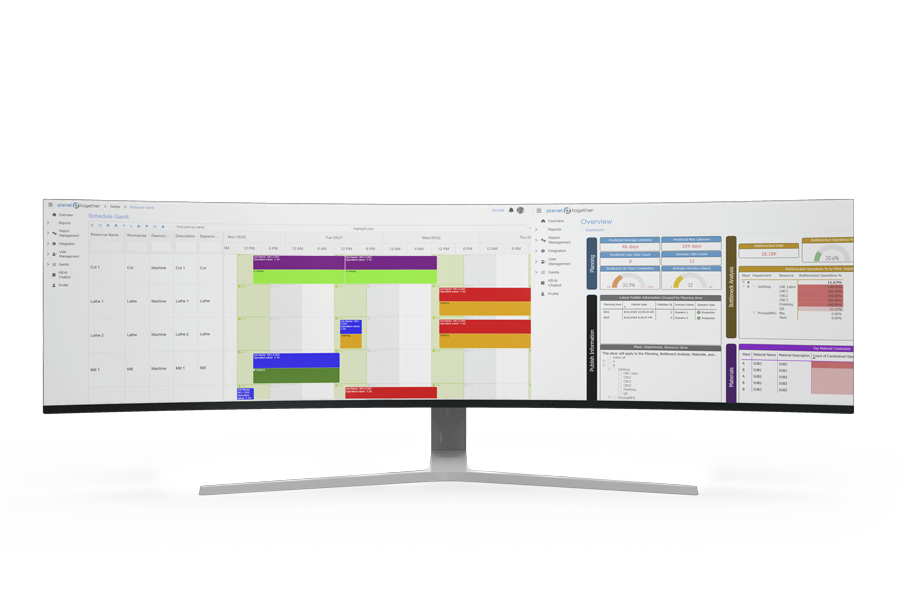
PlanetTogether's advanced planning and scheduling (APS) software supports PPC by connecting planning and scheduling in one constraint-aware process. It helps planners see capacity, materials, production priorities, and bottlenecks before the schedule reaches the floor.
I can just say that every process, from order entry to warehouse management, scheduling, materials planning, and so on, have ALL become more responsive and able to plan better than ever.
CHUCK DIPIETRO, DIRECTOR OF PROCUREMENT & PLANNING, BEMA INCORPORATED
PlanetTogether APS includes finite scheduling, resource planning, production scheduling, and performance tracking. It can also support manufacturers that use ERP, MRP, and MPS systems for production planning.
Decision Framework: How to Strengthen PPC Without Adding Chaos
Start with the constraint that changes the schedule most often. If shortages drive delays, improve materials management first. If downtime limits output, focus on equipment readiness. If SKUs follow different paths, tighten routing and methods. If priorities change daily, improve dispatching and follow-up. When several constraints interact at once, APS can help planners model trade-offs faster.
How APS Software Improves Production Planning & Control
APS software improves PPC by helping planners build schedules around real constraints. These constraints may include materials, labor, equipment, routing rules, changeovers, downtime, and order priorities.
APS also complements ERP, MRP, and MPS systems. ERP and MRP often hold important order, item, routing, and inventory data. APS uses that data to create more flexible and realistic production schedules.
With PlanetTogether APS, you can:
Create feasible schedules that balance efficiency and on-time delivery
Protect bottleneck resources and improve throughput with finite scheduling
Coordinate material readiness with the production schedule
Improve visibility into capacity, WIP, and execution progress
Run what-if scenarios when priorities change
When APS supports PPC, planning and scheduling can happen together. As a result, teams can reduce avoidable delays, improve schedule adherence, and make better decisions with current production data.
Multi-Plant Scheduling 101: Coordinate Plants with PlanetTogether APS
Multi-plant scheduling becomes important when PPC decisions span more than one site. Shared constraints, competing priorities, variable lead times, and material readiness can make manual planning harder.
APS helps teams compare capacity across plants and update schedules when demand or resource availability changes. The video below explains how Advanced Planning & Scheduling helps manufacturers coordinate schedules across sites with realistic capacity and operational constraints in mind.
FAQs: Production Planning & Control (PPC) Functions
What are the key functions of production planning and control (PPC)?
PPC typically includes materials management, equipment readiness, methods, routing, estimating, dispatching, expediting, and evaluation. These functions help planners confirm material availability, choose the right production path, release work, track progress, and improve future schedules.
How is production planning and control different from production scheduling?
Production scheduling decides what runs when. PPC is broader. It also covers materials, routing, dispatching, follow-up, and performance review so the plant can control execution, not just create a schedule.
Why do PPC schedules fail?
PPC schedules often fail because of missing materials, underestimated changeovers, equipment downtime, labor constraints, or daily priority changes. When planners do not model these constraints, the schedule becomes difficult to execute.
Which KPIs show that PPC is working?
Useful PPC KPIs include on-time delivery, schedule adherence, schedule churn, bottleneck utilization, work in process, and expedite frequency. Planners should pair outcome metrics with control metrics to see whether the process is improving.
When should manufacturers use APS for PPC?
Manufacturers should consider APS when capacity is tight, schedules change often, and planners need faster re-optimization. APS is especially useful when teams manage complex changeovers, bottlenecks, multiple lines, or ERP/MRP planning gaps.
Download the Infographic: Scheduling Before & After APS
Spreadsheet scheduling can make PPC harder when planners must chase updates, copy data between tools, and manually compare schedule options. Download the infographic to see how APS helps planners reduce manual scheduling work, run what-if scenarios faster, and communicate clearer production priorities.
See APS Scheduling in Action
Ready to reduce schedule churn and improve on-time delivery with feasible, constraint-based plans? Request an APS demo and see how PlanetTogether supports real-world PPC execution.
.jpeg?width=632&height=316&name=Production%20Planning%20and%20Control%20(PPC).jpeg)