Quick Answer: What are the 5 components of APS software?
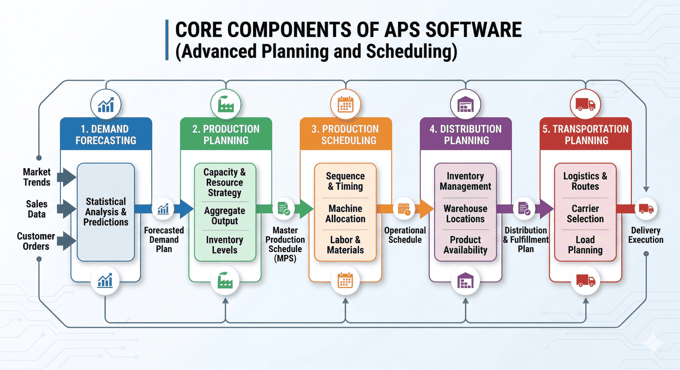
APS software connects five planning layers: demand forecasting, production planning, production scheduling, distribution planning, and transportation planning.
Together, these components help manufacturers turn demand into realistic plans and workable schedules. They help teams plan around real capacity, available materials, and delivery needs.
Key Takeaways
- APS software connects demand, planning, scheduling, and delivery in one system.
- The five core components are demand forecasting, production planning, production scheduling, distribution planning, and transportation planning.
- APS is most valuable when demand, materials, labor, or capacity change often.
- It helps manufacturers build plans that are realistic, not just theoretical.
- APS is especially useful when ERP or MRP data exists, but schedules still break down in execution.
What Is APS Software in Manufacturing?
Advanced Planning and Scheduling, or APS, helps manufacturers plan around materials, labor, machine capacity, and timing.
It is most useful when many products compete for the same resources and priorities change quickly.
Unlike manual planning or ERP-only scheduling, APS helps planners build schedules that can actually run. It accounts for material limits, labor availability, run rates, sequence rules, and bottlenecks.
PlanetTogether APS extends the value of ERP and MRP data by turning that data into better day-to-day planning and scheduling decisions.
The 5 Core Components of APS Software
Many manufacturers do not struggle because one planning step is missing.
They struggle because demand, materials, capacity, scheduling, and delivery decisions are managed in separate places.
APS helps by connecting those planning layers in one system.
1) Demand Planning and Forecasting
Demand planning and forecasting help manufacturers estimate future demand.
This helps teams decide what to make, when to make it, and how much inventory to carry.
In practice, this means using past sales, customer demand signals, and forecast assumptions to reduce both shortages and excess stock.
- Why it matters: If demand is wrong, production plans, schedules, and replenishment decisions become less reliable.
2) Production Planning
Production planning turns demand into a realistic plan for materials, labor, and capacity.
It answers a practical question: can the operation meet expected demand with the resources available?
A strong production plan aligns raw materials, staffing, capacity, and production targets before the daily schedule is built.
That helps teams avoid plans that look good on paper but fail on the plant floor.
3) Production Scheduling
Production scheduling turns the production plan into a daily schedule.
This is where planners decide what runs next, in what order, and on which resources.
It also helps reduce unnecessary changeovers and balance throughput with delivery performance.
For many manufacturers, this is the most visible APS function because it directly affects what the plant runs next.
It is also where manual planning usually breaks down first when labor changes, downtime hits, or priorities shift.
4) Distribution Planning
Distribution planning decides how much inventory is needed, where it should be stored, and when it should be replenished.
It helps manufacturers align inventory, forecasted demand, safety stock targets, and service goals.
This becomes more important when manufacturers serve multiple warehouses, regional stocking points, or more complex replenishment networks.
5) Transportation Planning
Transportation planning connects production output to delivery execution.
It helps manufacturers plan shipments based on timing, routing, freight cost, service needs, and delivery commitments.
This matters because production does not end when the schedule is complete.
Finished goods still need to move through the supply chain efficiently. Poor transportation decisions can erase gains made upstream.
When these five components live in separate tools, planners spend more time reconciling information than making decisions.
APS improves performance by keeping materials, capacity, labor, and scheduling decisions aligned within a single planning environment.
Customer Perspective
With PlanetTogether APS, every process from order entry to warehouse management, production scheduling, and materials planning have ALL become more responsive and able to plan better than ever.
CHUCK DI PIETRO, DIRECTOR OF PROCUREMENT & PLANNING, BEMA INCORPORATED
That kind of improvement happens when planning and scheduling work together in one system.
Instead of managing demand, materials, capacity, and schedules in separate tools, teams can work from one realistic plan.
Which APS Component Should You Improve First?
Use this quick guide to find the APS capability that could create the biggest improvement first:
How PlanetTogether APS Connects Demand, Planning, and Scheduling
Many manufacturers already have useful data in ERP or MRP.
What they lack is the scheduling flexibility needed to use that data well.
PlanetTogether APS helps close that gap by connecting demand, capacity, materials, labor, and sequencing decisions in one planning system.
With PlanetTogether APS, manufacturers can:
- create schedules that reflect real constraints
- improve throughput on bottleneck resources
- synchronize supply with demand to reduce inventory
- improve visibility into available capacity
- run what-if scenarios before making production changes
PlanetTogether APS Software Overview Video
Planning breaks down when demand, capacity, materials, and labor are managed in separate tools.
PlanetTogether APS brings those decisions together so planners can build realistic, optimized schedules that stay aligned with ERP and MRP data.
In this video, you’ll see how PlanetTogether APS helps teams:
- connect ERP and MRP data to capacity planning and scheduling
- create and update schedules faster when demand changes
- improve bottleneck visibility and execution priorities
- run what-if scenarios before committing to changes
- align planning across materials, labor, and resources without spreadsheet churn
If you’re evaluating APS, the next step is to define scope, plan the ERP integration, and build a realistic rollout plan before committing internal time and resources.
Next Step: Plan the Rollout Before You Commit
Understanding the five core components of APS is the first step.
The next challenge is deciding how to scope the rollout, connect APS to ERP data, and prepare planners, operations, and IT for implementation.
APS Implementation: Just the Facts is the best next resource for manufacturers evaluating how to move from APS concepts to execution.
Readers will learn:
- what APS should do before rollout begins
- how APS integrates with ERP in a practical rollout
- which data sets matter most for planning and scheduling success
- how to think about cloud versus on-premise deployment
- who owns testing, proof of concept, and rollout by role

FAQs About APS Software Components
1) What are the five components of APS software?
Most APS systems include demand planning and forecasting, production planning, production scheduling, distribution planning, and transportation planning.
The value comes from linking these layers so changes in demand, capacity, or constraints update plans and schedules consistently.
2) How is APS different from ERP or MRP?
ERP and MRP systems manage transactions and planning logic.
APS helps planners turn that data into realistic schedules. It accounts for capacity, labor, changeovers, downtime, and other real-world limits.
3) Does APS always include demand forecasting?
Not always.
Some APS deployments use forecasting from another system, while APS focuses on turning demand into realistic plans and schedules.
When forecasting is included, it usually drives production and distribution planning.
4) What data do you need for APS to work well?
Common inputs include item masters, BOMs, routings, work centers, capacities, lead times, inventory policies, and order demand.
The more accurate the constraint and shop-floor data is, the more stable and useful the schedule becomes.
5) Which component should a manufacturer implement first?
Start where the biggest daily problem exists.
If demand is unstable, begin with demand planning. If capacity and materials do not line up, begin with production planning. If the schedule changes constantly, begin with production scheduling. If warehouse service or replenishment is the issue, focus on distribution planning. If freight or lead-time pressure is the issue, focus on transportation planning.
See PlanetTogether APS in Action
Ready to see how APS connects demand, capacity, and scheduling in one realistic plan? Request a PlanetTogether APS demo to explore how the platform fits your constraints, priorities, and ERP-connected data.