Quick Answer: What Are the Advantages and Disadvantages of Operations Management?
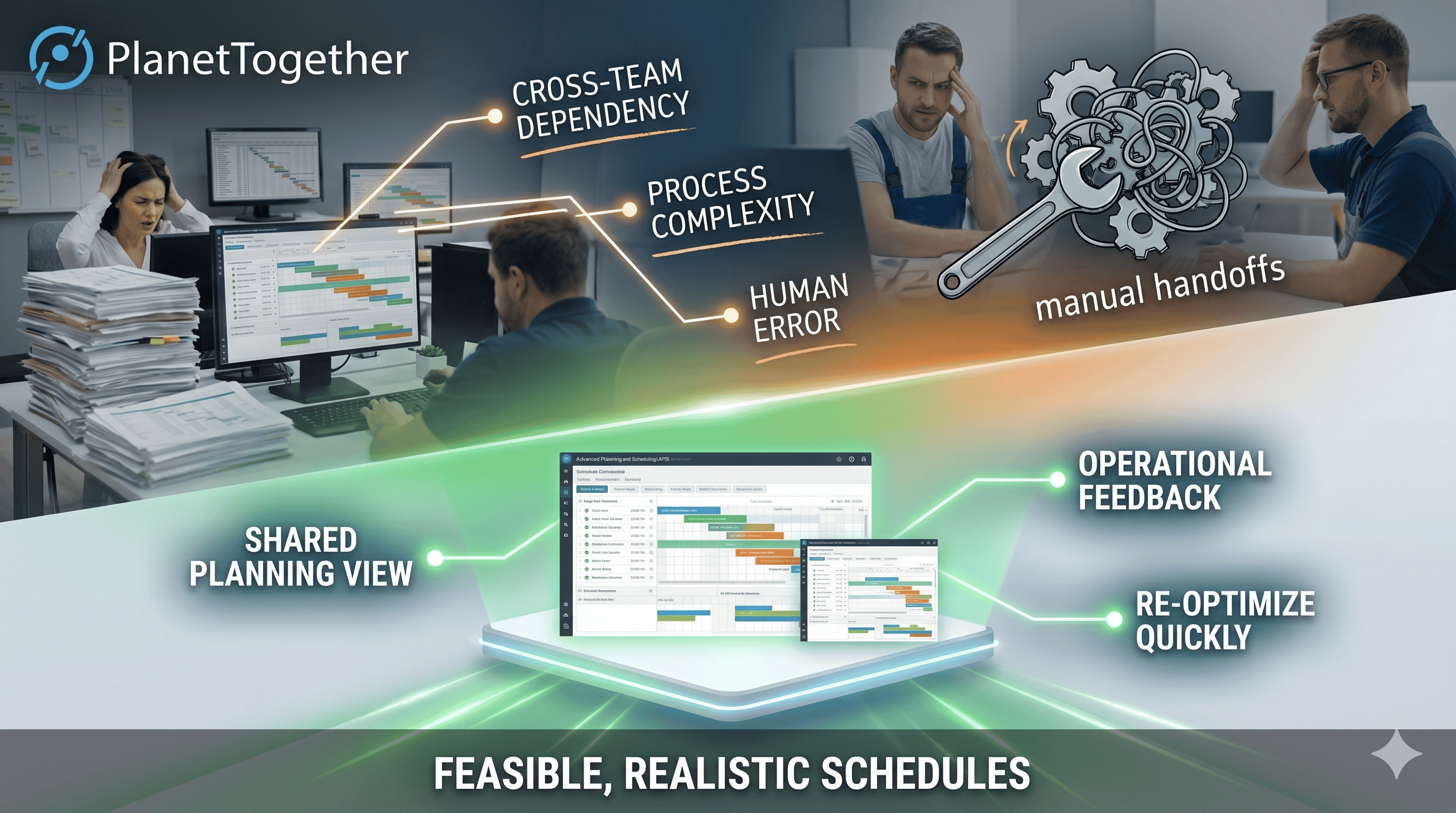
Operations management helps manufacturers coordinate labor, materials, equipment, and workflow so production stays on time and on budget. As a result, teams improve throughput, resource use, and accountability. However, risks still exist. Common problems include cross-team dependency, process complexity, and human error. When ERP/MRP plans stop matching real plant capacity, APS helps close the execution gap.
What Operations Management Means in Manufacturing
Operations management is the discipline used to plan, organize, and supervise the overall production process. In manufacturing, that means coordinating people, materials, equipment, schedules, and workflows so orders move through the plant with fewer delays and less waste.
The goal is not just efficiency. Instead, the goal is reliable execution. Strong operations management helps teams deliver on time, use resources more effectively, and respond faster when priorities change.
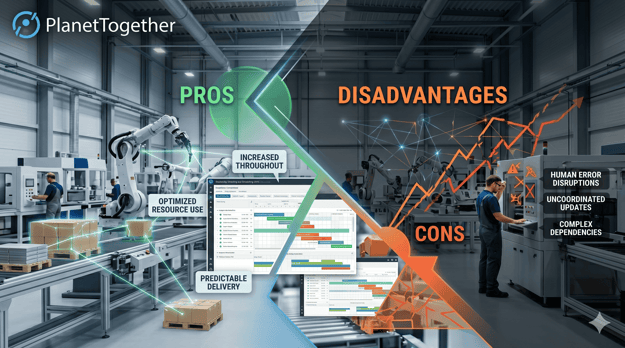
It also connects closely to supply chain and logistics decisions. Together, these functions shape how materials move, how orders flow, and how reliably the plant meets delivery commitments.
Key Advantages of Operations Management for Production Teams
Operations management creates structure around how work moves through the plant. When that structure is strong, teams make fewer reactive decisions and get more value from labor, materials, and equipment.
Profitability Management
When operations are managed well, production activity becomes easier to measure and trust. That gives leaders better visibility into output, cost, and revenue patterns. In turn, they can make stronger decisions about pricing, product mix, and future demand.
Better Resource Management
Operations management helps manufacturers use labor, machines, and materials more effectively. Because of that, teams reduce waste, improve utilization, and spot gaps before they hurt output.
Competitive Advantage
When teams coordinate well across the plant, production moves faster and delivery performance becomes more predictable. As a result, manufacturers meet customer commitments and reduce the disruptions that damage margins and trust.
Where Operations Management Breaks Down Most Often
Operations management can improve plant performance, but it still depends on consistent execution. However, when coordination weakens, the system breaks down quickly.
Multi-Level Dependency
One major risk is dependency across teams. Even a solid process can fail if planning, production, materials, or leadership do not carry it out the same way. One weak handoff can disrupt the whole flow.
Human Error
Another common risk is human error during handoffs, updates, and execution decisions. These issues often appear when information moves across operations, finance, engineering, information systems, and human resources. If priorities are unclear, errors spread fast.
When those breakdowns become frequent, advanced planning and scheduling software becomes more valuable because it gives teams one planning view and one set of operational constraints.
This is where stronger planning visibility starts to change day-to-day operations.
We’re able to make strategic decisions that improve operations. We can proactively prepare for anticipated increases or slowdowns in demand.
DICK MARX, MATERIALS MANAGER, KNAPHEIDE TRUCK EQUIPMENT
Decision Framework: When Is Operations Management Discipline Not Enough on Its Own?
Use operations management processes alone when demand is stable, schedules change infrequently, and teams can coordinate without constant manual rescheduling.
Add APS when one or more of these are true:
If the plant needs schedules that are both realistic and easy to update, APS is usually the better fit.
How APS Software Strengthens Operations Management
Operations management usually breaks down at the handoff points: planning to production, scheduling to execution, and ERP/MRP data to real-world constraints. APS is designed to close that gap.
By integrating ERP/MRP plans with finite-capacity constraints such as labor, machines, materials, changeovers, and maintenance windows, PlanetTogether APS helps teams turn best-effort schedules into schedules production can actually run.
With PlanetTogether APS, teams can:
- build feasible finite-capacity schedules aligned to labor, machines, materials, and changeovers
- incorporate operational feedback and re-optimize quickly
- reduce schedule churn by communicating changes clearly across planning and operations
- protect bottlenecks, improve on-time delivery, and reduce firefighting without relying on spreadsheets
- run what-if scenarios that support faster operational decision-making
Video: Integrating APS with Operations to Improve Production Scheduling
This video shows how stronger coordination between operations teams and planning functions reduces delays, improves responsiveness, and turns best-effort schedules into schedules production can actually run.
You’ll see how advanced planning and scheduling supports finite capacity scheduling by aligning labor, machines, materials, and changeovers to what is truly available. For planners, schedulers, operations managers, and plant leadership, the focus is practical: reduce schedule churn, improve on-time delivery, and keep bottlenecks from controlling performance.
The video also shows how operational feedback, including status updates, constraints, maintenance windows, and priorities, helps planning teams make better decisions faster.
Download the Manufacturing Planning Profitability Infographic
Most operations teams do not lose margin because they plan carelessly. Instead, they lose margin because planning often happens in spreadsheets that are disconnected from real capacity, changeovers, and day-to-day execution. As a result, that gap creates late deliveries, reactive overtime, excess inventory, and last-minute fixes.
This infographic shows where manual planning systems quietly drain profitability and why better planning and scheduling fundamentals improve delivery performance and throughput.
What you’ll take away from the infographic:
- common ways manual planning leads to lost sales from late deliveries and long lead times
- how poor sequencing drives capacity loss due to changeovers and cleanouts
- why reactive schedules trigger overtime costs during bottleneck periods
- how uncoordinated maintenance planning can reduce output and hurt service levels
- where planning inefficiency increases inventory carrying cost and expedited shipping
Download Our Free Infographic Now
Operations Management FAQs
What is operations management in manufacturing?
Operations management is how a manufacturer plans, coordinates, and controls the people, processes, and equipment that turn materials into finished goods.
What are the biggest advantages of operations management?
The biggest advantages are better throughput, stronger resource use, more predictable delivery performance, and clearer accountability across teams.
What are common disadvantages or risks of operations management?
The most common disadvantages are cross-functional dependency, process complexity, and human error during handoffs or decision changes.
How do you reduce human error and coordination breakdowns?
Manufacturers reduce breakdowns by standardizing workflows, defining ownership for key decisions, and using one shared planning view across operations, materials, and scheduling.
When does APS add value beyond ERP/MRP for operations management?
APS adds value when ERP/MRP plans no longer reflect real capacity, material constraints, changeovers, labor availability, or fast-changing priorities.
See PlanetTogether APS in Action
When operations teams work from realistic schedules instead of best-effort coordination, they reduce firefighting, improve delivery performance, and respond faster to change. Request a PlanetTogether APS demo to see how APS connects demand, capacity, materials, and execution in one system.