For over a decade, manufacturers have invested heavily in digital transformation, integrating ERP, MES, APS, and advanced data platforms with the expectation that connectivity would drive measurable performance improvements.
Yet across the industry, a critical question remains:
Why are performance gaps still persisting despite these investments?
At Hannover Messe 2026, industry leaders from PlanetTogether and On Time Edge are addressing this challenge head-on, highlighting a key insight:
Production scheduling, not system connectivity, is the true bridge between digital strategy and operational performance.
The Digital Investment Paradox in Manufacturing
Manufacturers today are more connected than ever. Systems communicate. Data flows. Dashboards provide visibility.
But performance tells a different story.
Many organizations still struggle with:
- Unstable throughput
- Inconsistent OTIF (On-Time-In-Full) performance
- Frequent expediting and firefighting
- Daily schedule changes and manual overrides
Despite sophisticated systems, production schedules are often:
- Rebuilt in spreadsheets or whiteboards
- Misaligned with real shop-floor conditions
- Disconnected from actual constraints and decisions
The result?
A persistent gap between digital investment and real operational outcomes.
Why Connectivity Alone Isn’t Enough
A common assumption in digital manufacturing is that integration equals performance.
But in reality, connectivity only ensures that data moves not that decisions work.
As Brian Vogel, CEO of On Time Edge, explains:
“Most manufacturers we work with have already connected their systems. The issue isn’t whether data moves—it’s whether decisions hold up under real operating conditions.”
This is where many digital strategies fall short.
Because performance doesn’t happen at the system level it happens on the shop floor.
Production Scheduling as the Execution Control Layer
Production scheduling is where plans meet reality.
It is the point where:
- Capacity constraints are tested
- Material availability is validated
- Operational decisions are executed
When scheduling is treated as just a planning output, performance suffers.
But when it becomes an execution control layer, performance outcomes improve measurably.
A Fundamental Shift in Manufacturing Operations
Forward-thinking manufacturers are reframing their approach:
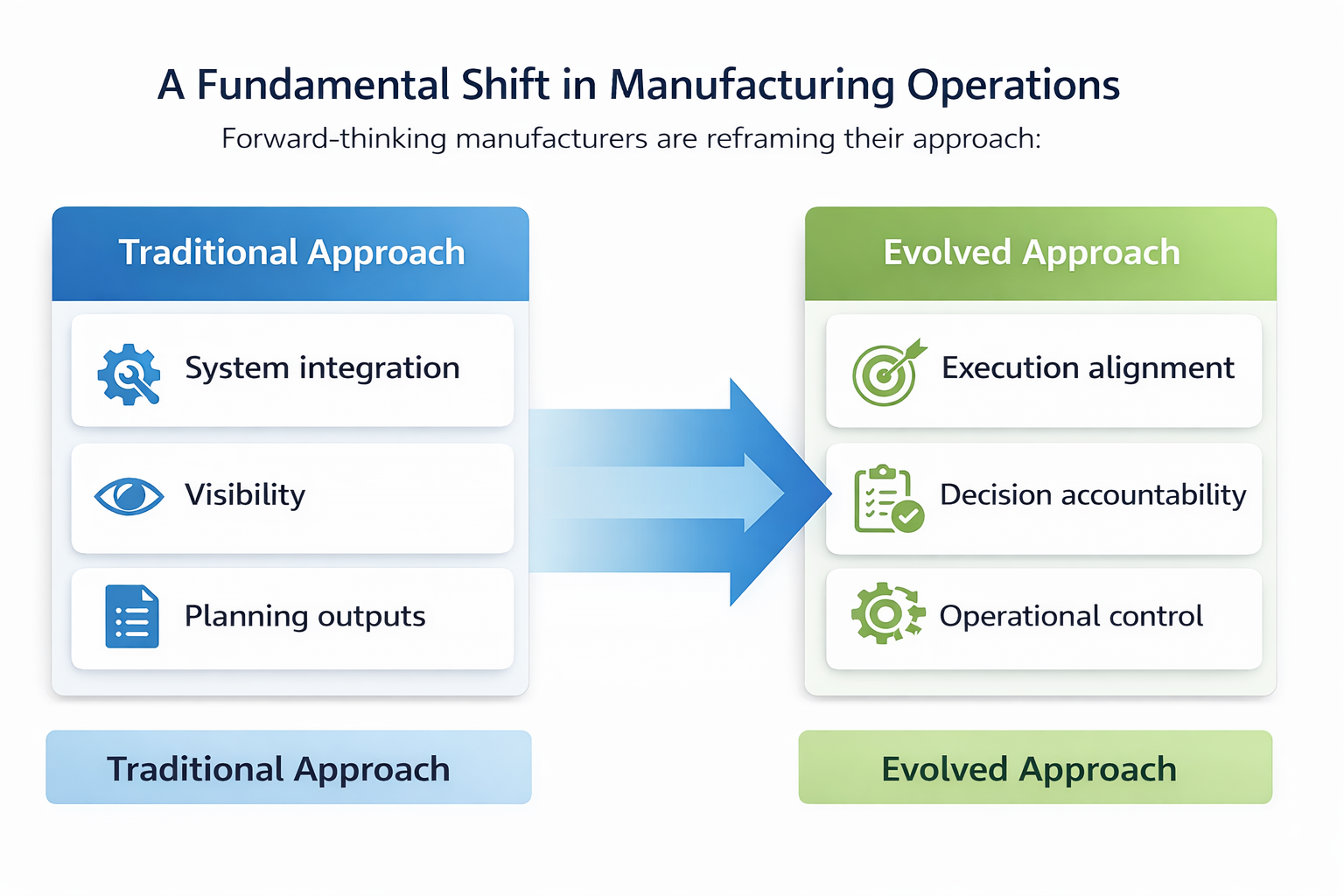
This shift transforms scheduling into a driver of measurable outcomes, not just a reflection of plans.
What High-Performance Scheduling Looks Like
When production scheduling is aligned with real-world conditions, organizations can:
- Align schedules with real-time operational constraints
- Establish clear decision ownership and governance
- Ensure changes propagate across ERP, APS, MES, and execution systems
According to Ted Recio, COO of PlanetTogether:
“Detailed production scheduling is what allows manufacturers to move from what’s theoretically possible to what’s actually possible based on real-world constraints.”
Real-World Impact: From Instability to Performance
In a recent manufacturing transformation highlighted at Hannover Messe:
By aligning scheduling with real-world constraints across systems and teams, the organization achieved:
- Reduced expediting
- Improved OTIF performance
- Faster recovery from disruptions
- More stable and reliable throughput
Importantly, these gains were achieved without replacing core systems but by aligning data, architecture, and decision-making around execution.
What This Means for Manufacturers
The implications are clear:
Production scheduling is not just a function; it is a strategic lever for performance.
When done right, it enables:
- More reliable production schedules under real conditions
- Improved delivery performance and customer satisfaction
- Faster response to disruptions and variability
- Reduced manual intervention and operational firefighting
- Strong alignment between planning decisions and execution outcomes
To explore this topic in depth, PlanetTogether and On Time Edge will host two executive sessions:
Expert Session
The Missing Link Between Digital Investment and Manufacturing Performance
📅 April 20 | 10:50–11:35 AM
📍 Hall 26, Expert Stage 1
Executive Roundtable
When Production Scheduling Fails, Everything Breaks
📅 April 21 | 3:00–3:45 PM
📍 Hall 11, Solution Lab
These sessions are designed for:
- Operations leaders
- Supply chain executives
- Digital transformation leaders