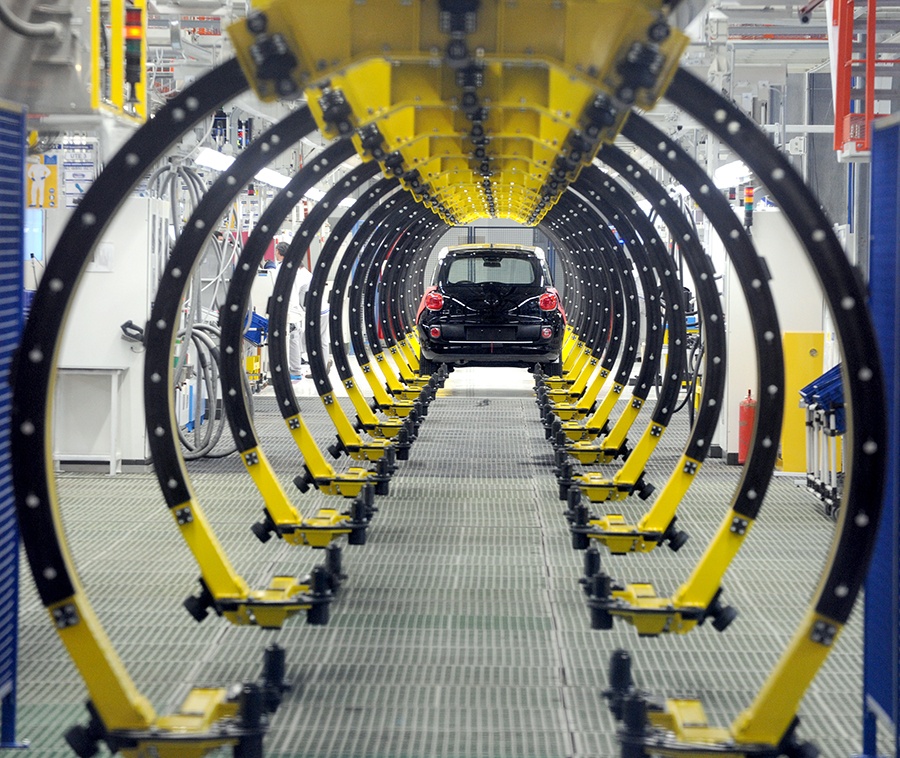
As pioneers of lean manufacturing, Toyota is known worldwide for their streamlined manufacturing process. But when the financial crisis of 2008 hit, the auto giant recorded their first loss ($1.7 billion) in their 75+ year history. During this time, Volkswagen Group’s began implementation of its MQB (Modular Transversal Toolkit) platform. For many in the industry, the German automaker’s simplified manufacturing process appeared set to overtake Toyota in production and sales. But after years of several years overcapacity and high fixed costs, Toyota’s engineers have unveiled a new process in the hopes of reestablishing themselves as the world’s lead manufacturing powerhouse.
Volkswagen Group’s MQB Platform
Thanks to technological innovation, automobile production is exponentially more complicated when compared to the assembly line days of Henry Ford. In response to the increasingly complex automobile manufacturing process, Volkswagen came up with their MQB, or Modular Transversal (translated from the German Modularer Querbaukasten) Toolkit. The company's transverse, front-wheel drive cars share the same components in different modular configurations.
The MQB system's “matrix” of standardized components reduces the variety of manufacturing processes and number of facilities required to assemble each model. In turn, it increases efficiency, cuts costs, and reduces the time it takes to build a car by 30%.
Toyota’s Engineering Response
Earlier last year, the Japanese automaker announced plans to adopt the still relatively radical concept of modular production. They are calling it the Toyota New Global Architecture (TNGA). Part of the plan involves a $1 billion investment to build a new manufacturing plant in Central Mexico and shift production to several other North American plants.
The Mexico plant is the first ground-up project for the company since 2011. Within the TNGA ethos, Toyota claims the program will leverage its global supply chain to build smaller parts and production lines. The revamped infrastructure allows Toyota to manufacture multiple models on shared lines, enhancing its flexibility in responding to global customer demand shifts while cutting overall cost.
Sound familiar? Toyota’s response places it in an unfamiliar role in the industry: Follower. Toyota’s modular production rollout comes three years after the Volkswagen Group unveiled their process. Currently, Toyota leads Volkswagen in profits (50% more as of last year) while selling just as many vehicles (10 million). It just goes to show that teaching an old dog a new trick is possible after all.
Video: Lean Automotive Manufacturing – Minimizing Waste with APS
Automotive leaders like Volkswagen and Toyota have shown how powerful modular platforms can be. VW’s MQB architecture reduces complexity, shares standardized components across models, and cuts vehicle build time by around 30%, while lowering production and tooling costs. Toyota’s TNGA response standardizes platforms and parts across its global lineup to gain flexibility, reduce development resources, and increase plant productivity.
In this video, you’ll see how PlanetTogether Advanced Planning & Scheduling (APS) applies the same lean thinking to your operations by:
- Using finite-capacity scheduling to fully load bottleneck resources while avoiding overloads
- Supporting multi-model, multi-plant scheduling, so modular platforms and shared lines can be planned across plants as a single network
- Running what-if scenarios to compare different production mixes, platform allocations, and shift patterns before you commit to a plan
- Reducing waiting, overproduction, and unnecessary changeovers, turning modular design advantages into real throughput and cost gains
This video is ideal for automotive manufacturing, production, and operations leaders who want to connect lean manufacturing, modular platforms, and APS to minimize waste while increasing flexibility.
Turn Platform Strategy into Profit with Better Planning
Volkswagen’s MQB and Toyota’s TNGA show how powerful standardized, modular architectures can be. By sharing common components and platforms, both OEMs cut complexity, reduce costs, and make it possible to produce multiple models on shared lines across a global network.
But the real competitive edge comes from how well you plan and schedule on top of that architecture—deciding which models run on which lines, in what sequence, and at which plants, while honoring capacity, constraints, and customer demand.
Download our “The Money Is in the Planning” infographic to see how Advanced Planning & Scheduling (APS) helps automotive manufacturers:
- Translate modular platform strategies (like MQB and TNGA) into profitable, executable production plans
- Use finite-capacity scheduling to maximize output at bottleneck lines and resources, rather than simply increasing volume everywhere
- Coordinate multi-plant, multi-model production, so global capacity is used where it delivers the best cost and service performance
- Run what-if scenarios to compare different build mixes, localizations, and shift structures before investing or changing tooling
- Turn the operational data in your ERP/MES into a continuous planning advantage, not just a historical record
Share it with your operations, supply chain, and strategy teams as a quick visual guide to how better planning and APS turn modular manufacturing concepts into real-world financial results.
