Answer Capsule
Agile manufacturing helps companies respond faster to changing customer demand, shorter product cycles, and shifting market conditions.
Its biggest advantages are flexibility, faster response, and better alignment across teams. Its biggest disadvantages are higher planning complexity, added training or equipment costs, and the fact that not every production environment is flexible enough to support an agile model.
Key Takeaways
- Agile manufacturing helps manufacturers respond faster to demand changes, product variation, and market shifts.
- The biggest benefits are flexibility, faster decision-making, and better coordination across teams and suppliers.
- The biggest drawbacks are higher planning complexity, added investment, and the fact that some factories are too rigid to benefit fully.
- Advanced planning and scheduling helps agile manufacturers evaluate scenarios, balance capacity, and update schedules faster.
What is Agile Manufacturing?
Agile manufacturing is an operating approach that helps manufacturers respond quickly to changes in demand, product requirements, and market conditions.
In practice, that means adjusting production plans, supplier coordination, labor priorities, and product configurations without losing control of cost, quality, or delivery performance.
Agile manufacturing works best when a company can make changes quickly and still maintain schedule discipline. Agility is not just speed. It is the ability to adapt without creating more instability on the plant floor.
Advantages of Agile Manufacturing
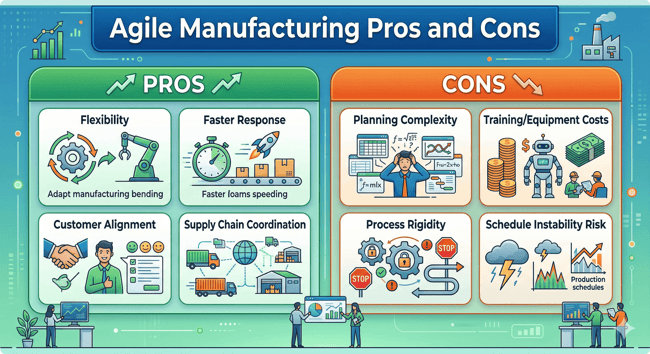
The main advantage of agile manufacturing is that it helps manufacturers respond faster without relying on static plans that become outdated as demand changes.
For managers, the value is not agility by itself. It is the ability to make better scheduling, supply, and product decisions when conditions shift.
1. Customer Focused Product Design
Agile manufacturing helps companies respond more quickly when customer requirements change.
That can be especially valuable in environments with short product life cycles, higher product variation, or frequent requests for customization. Instead of treating product changes as rare exceptions, agile operations are built to evaluate and absorb those changes with less disruption to production.
2. Connected IT
Agile manufacturing depends on timely, accurate production data.
When order status, inventory, capacity, and scheduling information are connected, planners can respond faster and make better decisions. Without that visibility, schedule changes are slower, more manual, and more likely to create downstream problems on the shop floor.
3. Cooperation within Supply Chain
Agile manufacturing works better when suppliers, production teams, and downstream partners are working from the same demand signal.
When those groups can react to the same priorities, manufacturers are better able to adjust supply plans, production sequences, and delivery commitments without creating unnecessary instability.
Disadvantages of Agile Manufacturing
Agile manufacturing can improve responsiveness, but it also creates new planning and execution demands.
Managers need to evaluate whether their process design, resource flexibility, and planning systems are strong enough to support frequent change without creating excess cost or instability.
1. Short Product Life Cycles
Agile manufacturing often requires faster changeovers, more flexible processes, and teams that can adapt quickly.
That may mean additional training, new tools, or equipment upgrades. For managers, the key question is whether the expected gains in responsiveness and service justify the extra investment needed to support a more flexible operation.
2. Production Process Design
Agile manufacturing works best in operations that can adapt without major disruption.
Facilities with shorter lead times, more flexible equipment, configurable products, and responsive suppliers are usually better positioned to benefit. In contrast, highly rigid processes or environments with long, fixed production cycles may find it harder to apply agile methods effectively.
3. Planning and Management is Challenging
The biggest challenge in agile manufacturing is not just making changes. It is making those changes without losing control of capacity, materials, labor, or due dates.
When priorities shift often, managers need a way to evaluate tradeoffs quickly and update schedules without creating new bottlenecks. That is where planning discipline becomes essential.
With PlanetTogether, we’re able to make strategic decisions that improve operations. We can proactively prepare for anticipated increases or slowdowns in demand.
DICK MARX, MATERIALS MANAGER, KNAPHEIDE TRUCK EQUIPMENT
How APS Supports Agile Manufacturing
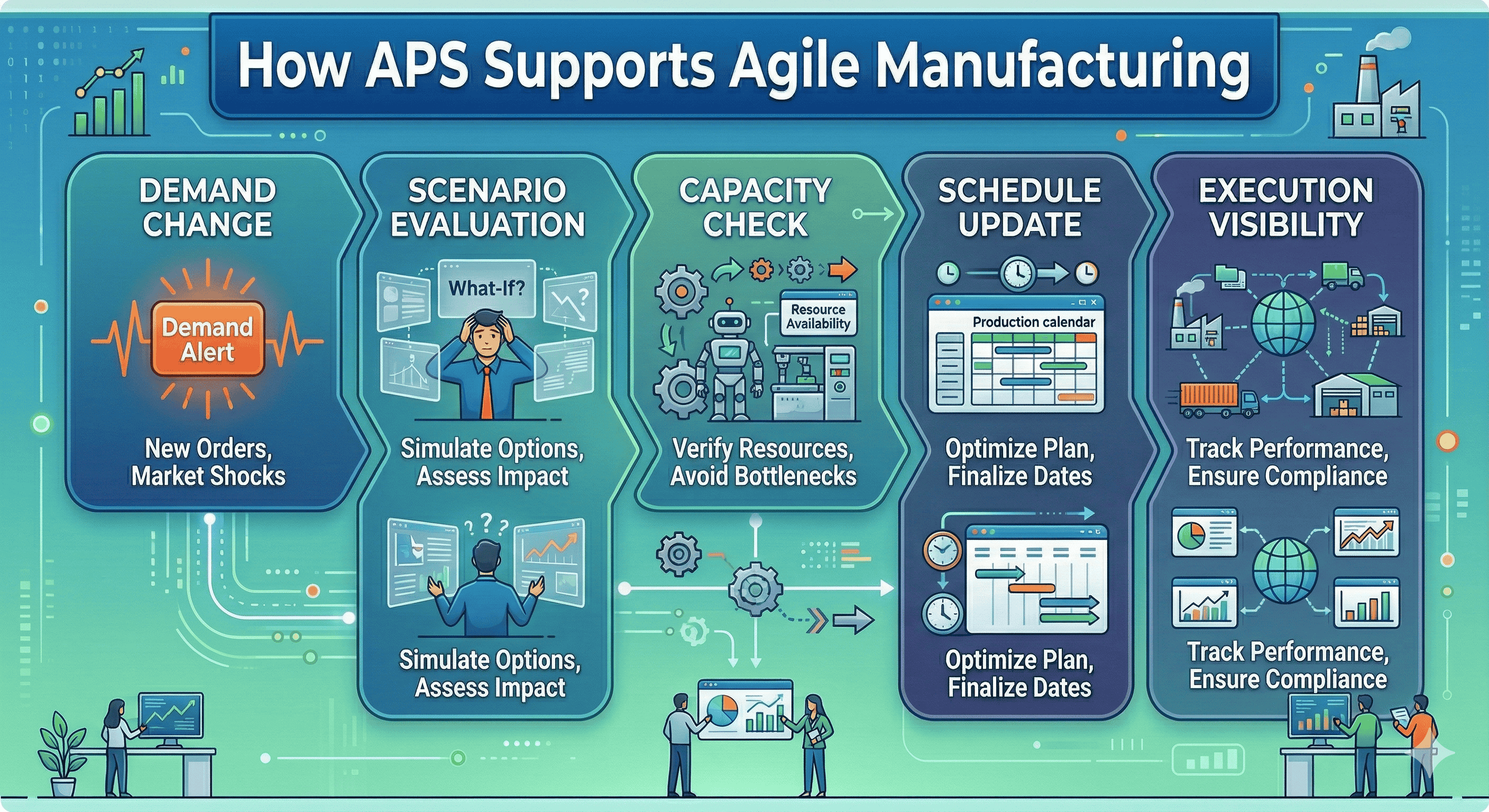
Manufacturers that operate in more volatile environments need better visibility into schedule changes before those changes hit the plant floor.
That is where advanced planning and scheduling becomes valuable. Instead of reacting manually to every shift in demand, planners can evaluate scenarios, understand capacity tradeoffs, and make faster decisions with more confidence.
PlanetTogether APS helps manufacturers evaluate schedule changes, balance demand against available capacity, and respond faster when priorities shift. Instead of relying on manual rescheduling, teams can use APS to improve visibility, manage bottlenecks, and keep production decisions aligned with real operating constraints.
With PlanetTogether APS, manufacturers can:
-
Create schedules that balance delivery performance with production efficiency.
-
Evaluate scenarios before committing to schedule changes.
-
Improve visibility into resource capacity and bottlenecks.
-
Synchronize supply with demand more effectively.
-
Support faster decisions in volatile production environments.
Conclusion
Agile manufacturing can be a strong fit when your operation needs to respond quickly to changing demand, product variation, and supply chain volatility.
The real test is whether your planning process can keep up. If your team is still relying on spreadsheets or manual schedule updates, a PlanetTogether APS demo can show how faster scenario planning and better schedule visibility support a more agile operation.
Video: How PlanetTogether Helps Manufacturers Move Beyond Spreadsheets
After reviewing APS features like what-if scenario analysis, schedule optimization, concurrent planning, and ERP-connected scheduling, this short video shows what those capabilities look like in practice.
It is a useful next step for manufacturers evaluating advanced planning and scheduling software to improve production visibility, build more feasible schedules, and move beyond spreadsheet-based planning.
See What APS Implementation Looks Like in Practice
APS features like what-if analysis, concurrent planning, and schedule optimization create value when they are deployed in a way that fits your operation, data, and ERP environment.
This guide helps manufacturers move from feature awareness to implementation planning by outlining what APS should do, how integration works, and what teams need to prepare before rollout.
- What APS should deliver beyond ERP and spreadsheets
- How APS integrates with ERP in a practical rollout
- Which data supports feasible scheduling
- On-premise vs. cloud deployment considerations
- Who owns testing, proof-of-concept, and rollout steps

FAQs About Agile Manufacturing
What is agile manufacturing?
Agile manufacturing is an approach that helps manufacturers respond quickly to changing customer demand, product variation, and market conditions without losing control of production.
What are the main advantages of agile manufacturing?
The main advantages are faster response to change, better product alignment with customer demand, stronger cross-functional coordination, and improved ability to adjust schedules and supply plans.
What are the disadvantages of agile manufacturing?
The main disadvantages are higher planning complexity, possible investment in training or equipment, and the fact that some production environments are too rigid for agile methods to work well.
Is agile manufacturing right for every factory?
No. Agile manufacturing works best where product mix changes often, lead times are short, and operations can adapt without major disruption.
How does APS software support agile manufacturing?
APS software supports agile manufacturing by helping planners evaluate scenarios, balance capacity with demand, and update schedules quickly when conditions change.
See PlanetTogether APS in Action
Ready to see how better scheduling supports a more agile operation?
Request a PlanetTogether demo to see how APS improves visibility, supports faster decisions, and helps teams respond to change with more control.