Building the Foundation for AI: Is Your Production Planning Ready?
Artificial intelligence is now a board-level priority for manufacturers worldwide. Yet the gap between ambition and execution remains stubbornly wide: while nearly 95% of manufacturers are actively investing in AI, only 29% have successfully scaled it at the plant or network level.
The reason isn't the technology. It's the foundation underneath it.
That's the central argument we explored in our most recent webinar, Building the Foundation for AI: Is Your Production Planning Ready? — hosted in partnership with Aggity, one of PlanetTogether's longest-standing strategic partners across Spain and Latin America. The conversation featured Joan Rubio, Head of Industry at Aggity, moderated by Alejandra Varela of PlanetTogether — two practitioners who work through these challenges with manufacturers daily. With attendees joining from Spain, Mexico, and the United States, it was a candid, experience-backed discussion on what AI-ready production planning actually requires — and what most organizations are still missing.
Why Production Scheduling Is the Starting Point for AI in Manufacturing
When executives think about AI in manufacturing, the conversation usually jumps straight to use cases: predictive maintenance, demand forecasting, autonomous quality control. These are real and valuable. But they all share a common dependency that rarely gets enough attention: structured, reliable, decision-ready data from production planning and scheduling.
Without that foundation, AI tools have nothing meaningful to work with. They surface patterns in noise. They optimize flawed inputs. They automate bad decisions faster.
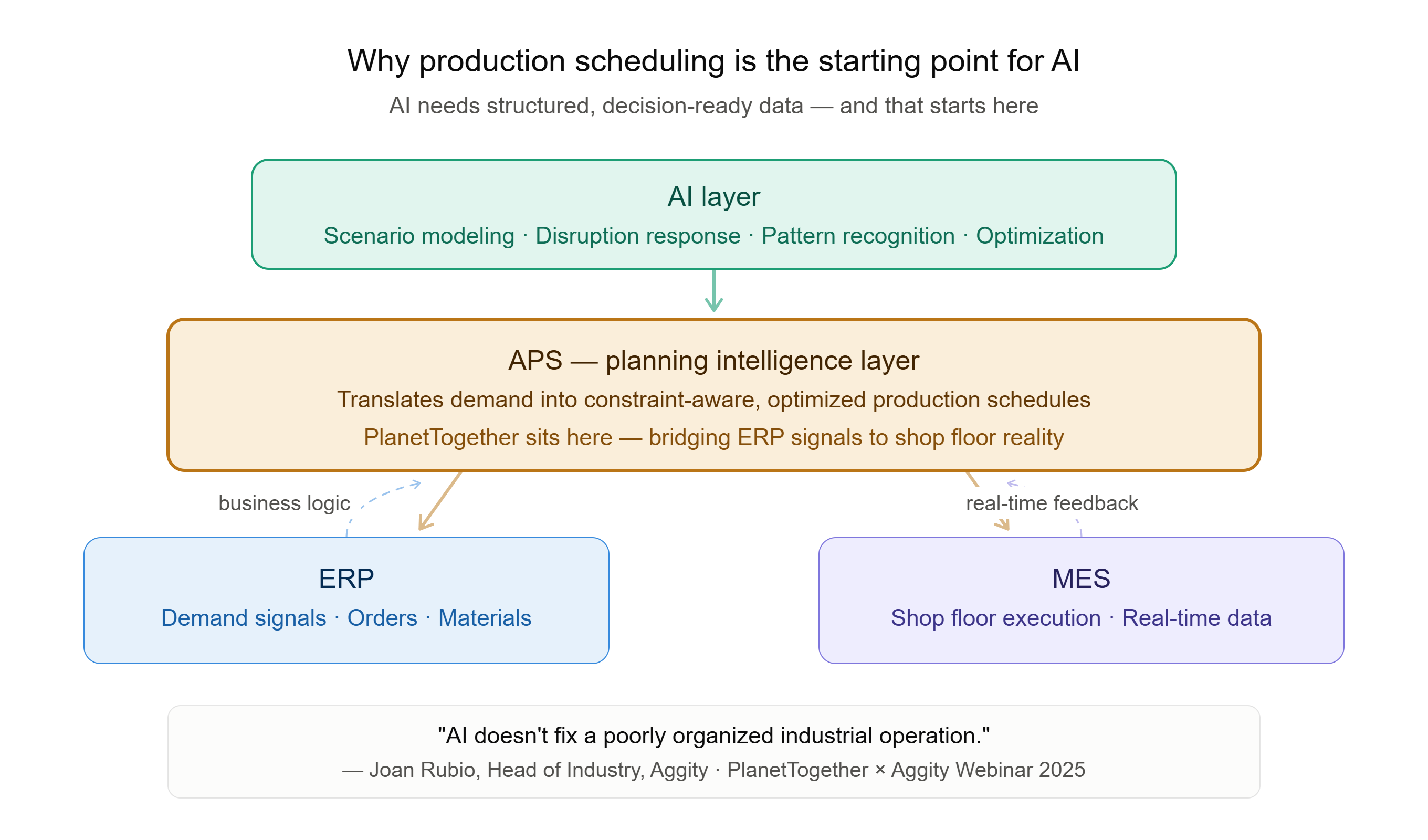
Production scheduling software — specifically Advanced Planning and Scheduling (APS) systems — sits at the intersection of where AI potential meets operational reality. APS is the layer that connects your ERP's demand signals with your shop floor's actual capacity, constraints, and execution data. It's where planning decisions get made. And it's where AI, when applied correctly, can deliver its most measurable impact.
At PlanetTogether, now part of CAI Software — a portfolio of purpose-built software solutions for complex industries — this is the problem we've spent over two decades helping manufacturers solve. The webinar was our opportunity to have that conversation openly, with the expertise of Aggity's field experience behind it.
What AI in Manufacturing Actually Means Today (And What's Still Ahead) (And What's Still Ahead)
Before diving into the substance, it's worth addressing something directly: AI in production planning is not yet about autonomous agents making scheduling decisions.
There's a lot of excitement — and confusion — in the market right now about agentic AI in manufacturing. Agentic AI, where systems independently plan, reason, and act across multi-step workflows, is real and advancing quickly. But as one industry analyst noted, generative and agentic AI are still "not yet suitable for mission-critical use cases" in production environments where data sets aren't sufficient and human oversight remains essential.
What AI can do today — powerfully — in production planning:
- Scenario simulation: Model hundreds of scheduling alternatives in seconds to find the least-cost, on-time plan
- Constraint optimization: Balance machine capacity, labor shifts, material availability, and changeover sequences automatically
- Disruption response: Recalculate schedules in real time when a machine goes down, a supplier is late, or an urgent order arrives
- Pattern recognition: Surface inefficiencies and bottlenecks that manual planning processes would never catch
PlanetTogether's production scheduling software is built to deliver these capabilities today — and is actively developing the next generation of AI-assisted planning features as part of CAI Software's broader technology roadmap. The path to agentic AI in scheduling runs directly through the data foundation we're discussing here.
The Real Problem Isn't the AI
One of the sharpest moments in the webinar came when Alejandra asked Joan what separates companies that extract real value from AI versus those that invest and see little return.
His answer was unambiguous: reliable data, well-defined processes, documented business rules, and planning discipline. Companies that succeed with AI have done the foundational work first. Companies that struggle have tried to shortcut it.
As Joan stated plainly: "AI doesn't fix a poorly organized industrial operation."
This is the reframe that manufacturing leaders need to hear. The question is not whether your AI tools are sophisticated enough. The question is whether your planning environment is structured enough to give AI something solid to work with.
What's Usually Missing: The Hidden Asset in Every Plant
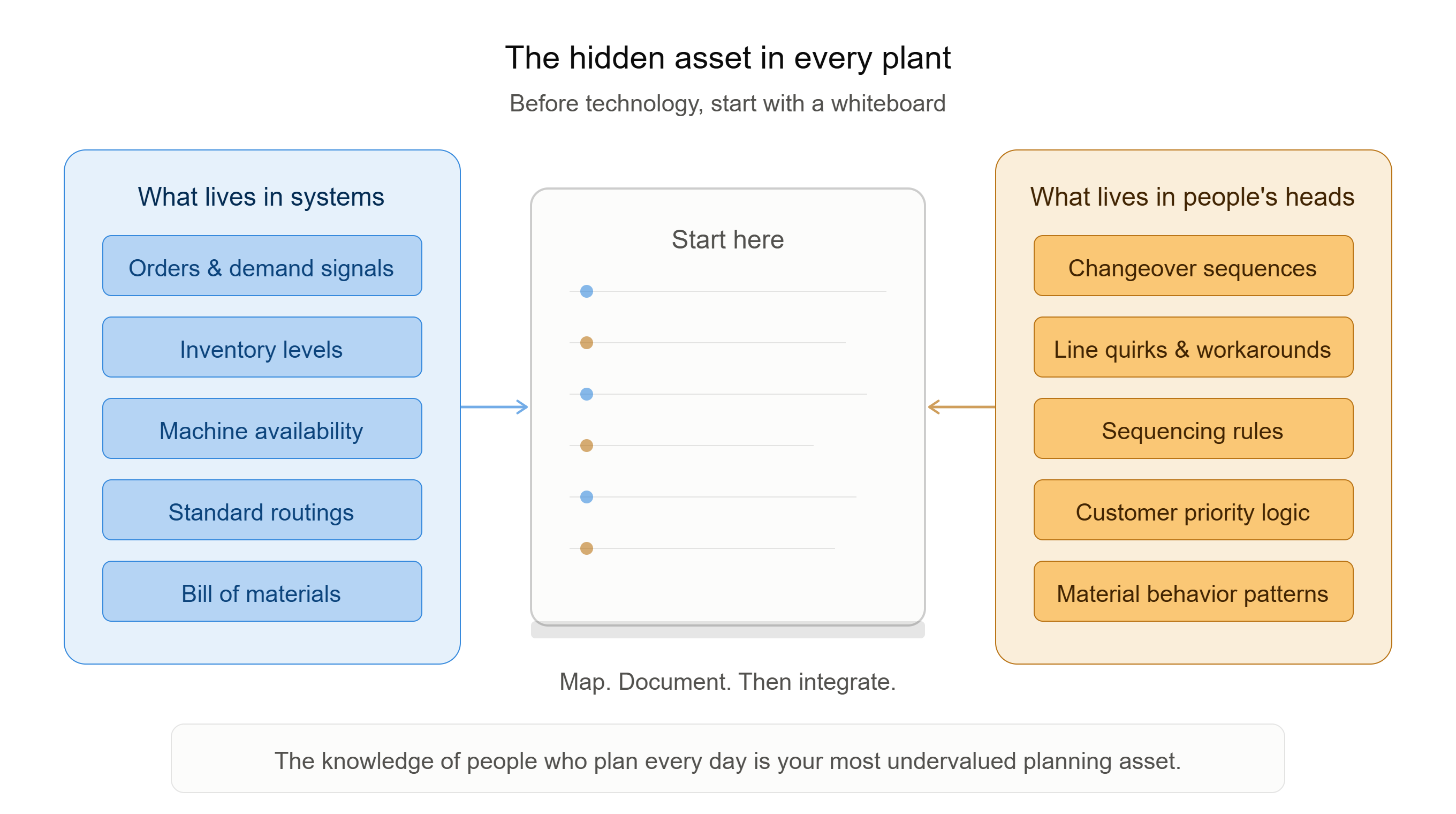
When companies begin a digitalization initiative, the instinct is to focus on systems — which applications to connect, which platform to adopt. Joan's experience points to a different starting point: the knowledge that exists only in people's heads.
Constraints that experienced schedulers apply intuitively but have never been written down. Changeover sequences that work in practice but aren't captured in any system. Sequencing rules developed over years on a specific production line. Workarounds for a particular material's behavior.
This operational knowledge is, in many plants, the most valuable and most overlooked planning asset. And it's invisible to any AI system until it's documented.
Joan's approach before any technology integration: start with a whiteboard. Map the process. Understand what actually happens — not what the system shows. Document the rules. Then bring in the technology to encode and scale what's been learned.
As Alejandra noted in response: "Many times we think data is the most important asset. But so is the knowledge of the people who plan every day."
Connecting ERP, APS, and MES: Where Integration Goes Wrong
A well-functioning planning environment requires three systems working in concert:
- ERP provides demand signals, orders, materials, and business logic
- APS translates that demand into optimized, constraint-aware production schedules
- MES executes those schedules on the shop floor and feeds real-time performance data back up
When these three systems are properly integrated — with PlanetTogether APS as the planning intelligence layer — the result is a connected data environment where AI has access to the structured, real-time inputs it needs.
But Joan identified three integration mistakes that consistently derail these efforts:
1. Confusing data integration with process integration. Connecting systems so they share data is not the same as aligning the processes those systems support. Data can flow while processes remain siloed. Integration without process alignment creates faster confusion, not faster decisions.
2. Assuming business rules are obvious. Every plant has rules — about priorities, sequences, constraints, customer commitments. When those rules aren't explicitly defined in the planning system, schedulers override the system constantly. AI cannot learn from or optimize against rules it doesn't know exist.
3. Automating before processes are validated. Automation amplifies whatever is already happening. Automating a broken or inconsistent planning process doesn't fix it — it scales it. The sequence matters: understand the process, define the rules, then automate.
When integration is done right, Joan observed, the nature of planning meetings changes fundamentally: they stop being about reconstructing what happened and start being about deciding what to do next.
The Five Pillars of AI-Ready Production Planning
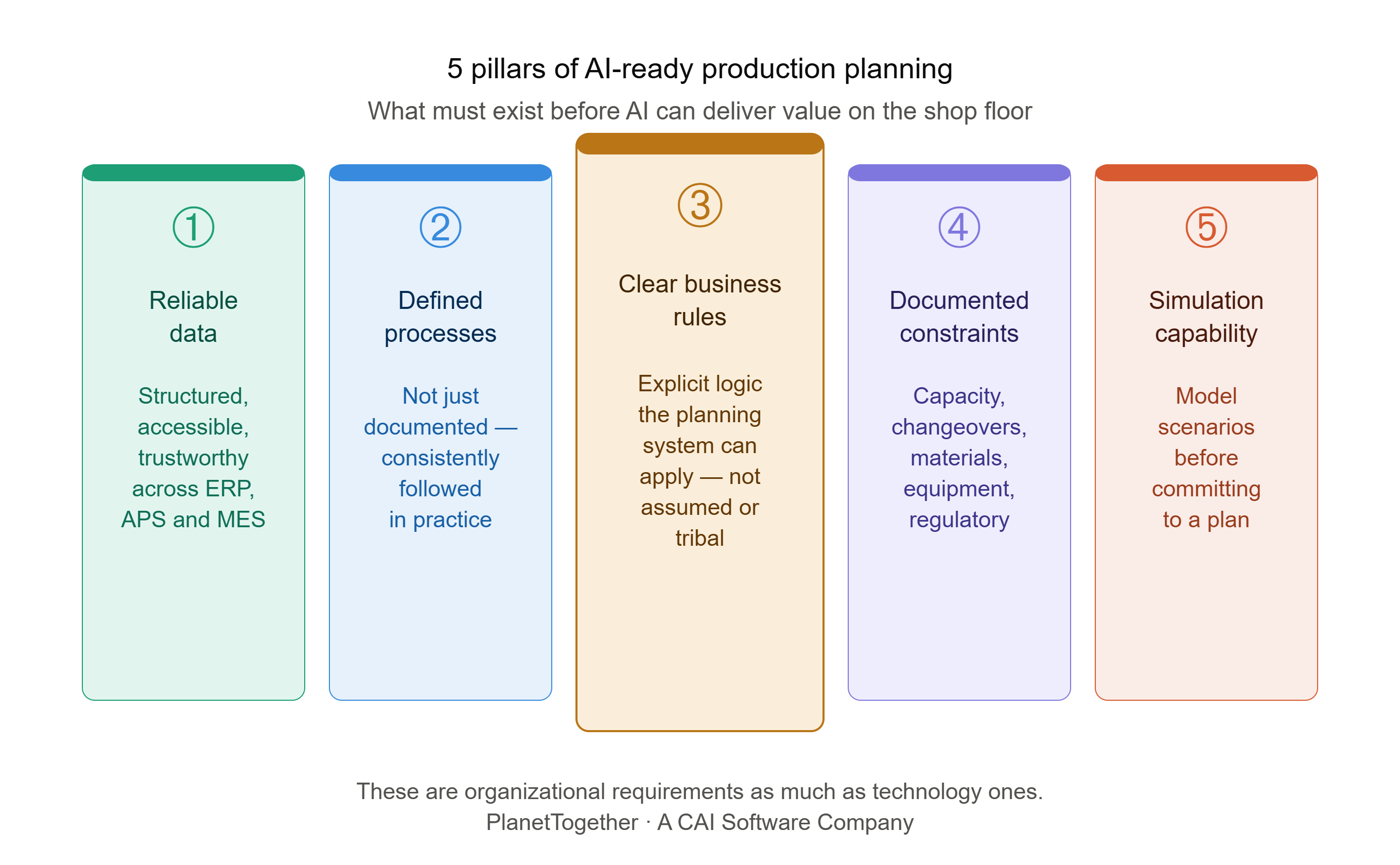
Midway through the webinar, Alejandra laid out the framework that anchors the entire conversation — the five conditions that must exist before AI can deliver meaningful value in a production planning context:
1. Reliable Data
Structured, accessible, and trustworthy data across ERP, APS, and MES. Not perfect data — but consistent data that the planning system can use without constant manual correction.
2. Defined Processes
Not just documented on paper, but consistently followed in practice. If the actual scheduling process diverges from the documented one, the system's outputs will consistently miss reality.
3. Clear Business Rules
Explicit logic governing priorities, sequences, and trade-offs. Which orders take precedence? How are changeovers sequenced? What are the non-negotiable constraints? These need to live in the system, not in people's heads.
4. Documented Constraints
Capacity limits, material dependencies, equipment compatibility, changeover times, allergen restrictions, regulatory requirements — every constraint that affects what can be scheduled and when.
5. Simulation Capability
The ability to model scenarios before committing to a plan. What happens if this machine goes down? If this order is expedited? If this supplier is three days late? Scenario simulation is where APS and AI create genuine competitive advantage.
These are organizational requirements as much as technology requirements. And they apply whether you're evaluating production scheduling software for the first time or adding AI capabilities to an existing planning environment.
AI and the Human Planner: Not a Replacement, a Partnership
The concern about AI displacing experienced planners and schedulers comes up in nearly every conversation on this topic. Joan addressed it directly, and his answer reflects what the most mature AI implementations in manufacturing actually look like.
AI helps. AI accelerates. AI analyzes at a scale no human can match. But the qualities that make a great planner — judgment, contextual understanding, experience with a specific plant's quirks, the ability to make a call when the data is ambiguous — those remain distinctly human.
The goal of AI in production scheduling is not to replace the planner. It's to give the planner better information, faster, so their decisions are grounded in reality rather than intuition alone.
As Alejandra summarized: "This isn't about replacing people. It's about helping them make better decisions."
This is also why the human knowledge-capture step — the whiteboard, the documentation of tacit expertise — isn't just a prerequisite for technology. It's a way of honoring and preserving the expertise that makes a plant run well.
Starting Smart: Why a Proof of Concept Changes the Equation
For executives concerned about the scope and risk of a planning transformation, Joan made a strong case for the Proof of Concept approach. Rather than committing to a full implementation, a well-designed POC lets organizations:
- Validate assumptions with real data before investing at scale
- Reduce risk by testing in a contained environment
- Build internal confidence among planners, IT, and leadership
- Demonstrate measurable value that justifies the next investment
- Create a foundation for scaling without starting over
This is also how CAI Software approaches technology adoption across its portfolio of manufacturing solutions. Transformation doesn't require doing everything at once. It requires doing the right things in the right order — and proving value at each step.
Five Priorities for Manufacturing Leaders Ready to Begin
Based on Joan's experience across dozens of Process and Discrete Manufacturing implementations, here's where to focus first:
1. Map your planning processes as they actually happen — not as they're supposed to happen. The gap between the two is where most problems live.
2. Document your operational constraints and business rules — explicitly, in writing, in a form a system can encode. Don't assume they're obvious.
3. Assess your integration points between ERP, APS, and MES — not just whether systems are connected, but whether the data flowing between them is structured and trustworthy.
4. Define how you'll measure success before any implementation begins. Baseline your key metrics — schedule adherence, changeover time, on-time delivery — so improvement is visible and credible.
5. Build a culture of data discipline — because consistent outputs require consistent inputs. This is a people and process challenge as much as a technology one.
Frequently Asked Questions
What does "AI-ready production planning" mean? AI-ready production planning means your organization has the data quality, process consistency, documented business rules, and system integration needed for AI tools to generate reliable, actionable outputs. Without this foundation, AI in manufacturing produces recommendations based on incomplete or inconsistent inputs — and the results reflect that.
What is Advanced Planning and Scheduling (APS) software? APS software is a production scheduling solution that uses algorithms to balance demand, capacity, and operational constraints to generate optimized production schedules. It sits between ERP systems (which manage orders and materials) and MES systems (which execute on the shop floor), acting as the planning intelligence layer that connects business signals to operational reality.
How do ERP, APS, and MES work together in AI-ready manufacturing? ERP provides demand signals and business logic. APS translates those signals into constraint-aware, optimized schedules. MES executes those schedules and feeds real-time performance data back to APS. When integrated correctly, this three-layer architecture creates the structured data environment that AI tools need to deliver meaningful results.
Is AI replacing production planners and schedulers? No. AI in production planning augments human decision-making rather than replacing it. AI handles scenario modeling, constraint optimization, and real-time disruption response at a scale humans cannot match. Human planners contribute experience, contextual judgment, and accountability for decisions. The most effective implementations treat AI as a tool that makes experienced planners significantly more effective — not a substitute for them.
What is the APS Readiness Score? The APS Readiness Score is a structured assessment tool from PlanetTogether that helps manufacturing organizations evaluate their current planning maturity before investing in AI or advanced scheduling initiatives. It identifies risks, surfaces improvement opportunities, and provides a prioritized roadmap for building the foundation AI requires.
How is PlanetTogether connected to CAI Software? PlanetTogether is now part of CAI Software, a portfolio of purpose-built technology solutions for complex manufacturing and industrial environments. As part of CAI Software, PlanetTogether continues to develop and deliver its Advanced Planning and Scheduling platform while benefiting from CAI's broader technology investment, customer relationships, and implementation expertise across industries.
Assess Your Readiness Before You Invest
Before committing to an AI initiative or advanced planning implementation, it's worth understanding where your organization actually stands. The APS Readiness Score is built precisely for this moment — to give manufacturing leaders a clear, honest picture of their planning maturity and a practical roadmap for what to address first.

Watch the Full Webinar
The complete session is available on demand, delivered in Spanish by Alejandra Varela and Joan Rubio. If you're building the business case for a planning transformation, evaluating production scheduling software, or trying to understand what AI readiness actually requires in a manufacturing context — this conversation is a useful 45 minutes.
PlanetTogether is a CAI Software company, delivering Advanced Planning and Scheduling solutions that help manufacturers build smarter, more agile operations. This webinar was produced in partnership with Aggity, a leading digital transformation partner for manufacturing companies across Spain and Latin America.
Learn more at [planettogether.com] | [caisoftware.com]