
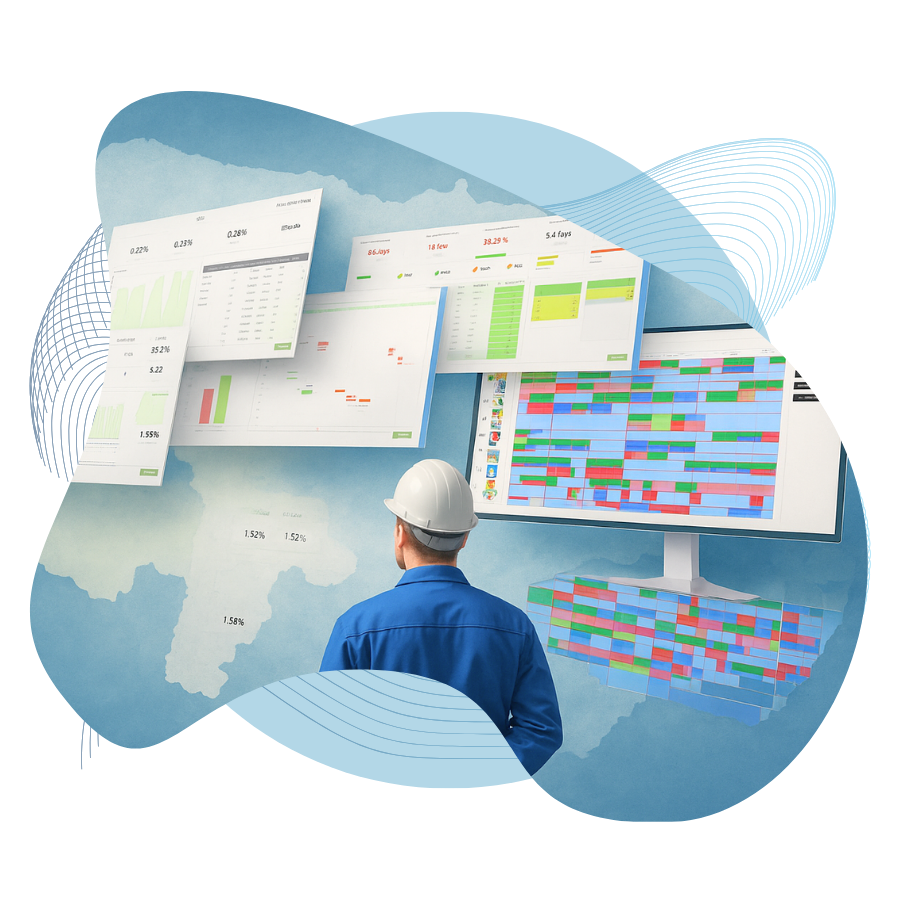





What Makes An Advanced Planning And Scheduling (APS) Project Successful In Manufacturing?
Successful APS implementations depend on data, alignment, and phased execution. Here’s what separates high-performing manufacturing projects from...
Concepts, applications, and insights to help manufacturers plan better, schedule smarter, and operate more efficiently.
This page serves as a central knowledge hub for Advanced Planning and Scheduling (APS), connecting key concepts, systems, and real-world applications used in modern manufacturing.
Manufacturers face increasing pressure to deliver faster, operate with fewer resources, and respond to supply chain disruptions. Traditional planning tools and spreadsheets cannot keep pace with modern production complexity.
Advanced Planning and Scheduling (APS) provides the visibility and intelligence needed to coordinate production, materials, labor, and machines across manufacturing operations. These capabilities include finite capacity scheduling, capacity planning, and production scheduling systems, enabling organizations to create realistic, executable production plans.
APS software helps manufacturers improve production scheduling, optimize capacity planning, reduce delays, and increase overall operational efficiency.
If your organization is evaluating APS solutions or looking to improve scheduling performance, this resource hub provides a structured starting point for understanding how advanced scheduling drives operational success.


Advanced Planning and Scheduling (APS) is manufacturing software that creates optimized production schedules by accounting for real-world constraints such as machine capacity, labor availability, material supply, and order priorities.
Unlike traditional ERP planning tools, APS systems evaluate these constraints simultaneously to generate feasible schedules that improve production efficiency and delivery reliability.
APS platforms allow planners to:
By aligning production planning with real operational constraints, APS systems enable manufacturers to improve service levels while maintaining efficient use of resources.
Manufacturing environments today face more variability than ever before.
Common challenges include:
Frequent demand changes and expedited orders
Limited machine or labor capacity
Material shortages or supply chain disruptions
Complex product mix and production routing
Without advanced scheduling tools, planners often rely on spreadsheets or ERP planning modules that cannot fully account for these constraints.
APS systems provide a structured approach to managing this complexity by synchronizing production plans with real operational conditions.
This allows manufacturers to:
Improve on-time delivery performance
Reduce lead times and production delays
Increase throughput without additional equipment
Respond faster to supply chain changed
PlanetTogether has focused exclusively on solving these manufacturing planning and scheduling challenges since its founding, enabling manufacturers to coordinate production across complex operations worldwide.
Ensures production plans reflect real-world constraints such as machines, labor, and materials. Learn more about finite capacity scheduling.
Translate production plans into executable schedules across manufacturing operations.
Highlights the differences between transactional systems and advanced scheduling tools.
Explains how material planning integrates with capacity-based scheduling.
Manufacturers typically evaluate APS implementations based on improvements in operational performance metrics.
Common APS performance indicators include:
PlanetTogether offers advanced scheduling software for complex manufacturing environments.
The platform enables organizations to:
These capabilities help planners quickly adapt to disruptions while keeping production efficient. PlanetTogether APS offers features like constraint management, bottleneck detection, scenario comparison, and multi-factor optimization.
Advanced scheduling technology is widely used across industries with complex production environments. Examples include:
These industries rely on APS to manage complex production flows, maintain compliance requirements, and optimize resource utilization across multiple production lines or facilities.
.png?width=800&height=450&name=planettogether%20aps%20(2).png)
This knowledge hub organizes the core concepts, systems, and methodologies behind Advanced Planning and Scheduling (APS). Use the sections below to explore how manufacturers improve production scheduling, optimize capacity, and coordinate operations across complex environments.
Each of these topics provides deeper insight into how manufacturers optimize production, improve delivery performance, and respond to operational complexity using advanced planning and scheduling.
Understanding these foundational concepts is essential for building effective production schedules and evaluating advanced planning systems.
Modern manufacturing relies on integrated systems to balance demand, resources, and production execution.
APS does not operate in isolation. It connects with broader manufacturing strategies that improve efficiency and responsiveness.
Advanced Planning and Scheduling works alongside other enterprise systems to create a complete production planning strategy.
Successful APS implementations depend on data, alignment, and phased execution. Here’s what separates high-performing manufacturing projects from...
See why production plans fail on the shop floor and how APS closes the gap. Key insights from a PlanetTogether webinar on real-time scheduling.
See the 5 stages of production scheduling maturity, from spreadsheets and ERP planning to constraint-based APS and AI decision support.
Production scheduling in Excel can slow decision-making as complexity grows. Learn how spreadsheet scheduling creates operational dependency and...
ERP plans rarely absorb MES events like downtime, QA holds, or labor shifts. See how PlanetTogether APS recalculates feasible priorities in real time.
PlanetTogether v12.3.0 transforms tank scheduling with realistic storage, targeted optimization, and a faster client for smoother daily planning.
See what manufacturers learned at the Scheduling Summit about smarter scheduling, cultural readiness, and real results with APS.
Your ERP plan looks perfect until the factory starts. Connect ERP to real-time APS scheduling and turn plans into production you can trust.
Your MRP plan looks perfect until the factory starts. Connect MRP to real-time scheduling and cut downtime with constraint-based APS.
Still scheduling in Excel? PlanetTogether APS adds real-time updates, finite-capacity optimization, and quick what-if planning to improve on-time...
Machine scheduling based on material characteristics or attributes.
Understanding the benefits of OEE can provide a thorough insight into your operation and ultimately ensure that you are decreasing downtime.
Discover how integrating PlanetTogether with ERP, SCM, and MES systems optimizes manufacturing scheduling, enhancing change management efficiency.
ERP systems are considered a necessary management tool. However, misconceptions have evolved along with its own evolution.
Learn how manufacturers can adopt APS and automation while improving workforce alignment, training, and change management.
Easily manage production across multiple plants with PlanetTogether. Gain visibility into capacity, inventory, and sourcing to plan smarter and...
Unlock the potential of data-driven maintenance with integrated systems like PlanetTogether and ERP solutions to boost margins in industrial...
Manufacturing planning and control software offers an extension to your ERP software and helps plan and control your manufacturing operation.
The difference between MRP and MRP II pertain to various components within the software. The difference between MRP and MRP II are key to understand.
Discover what ERP is, how it integrates finance, operations, and supply chain, and why it improves visibility, control, and decision-making.
Value stream mapping (VSM) in manufacturing is an analysis on the steps within a manufacturing process. Value stream mapping (VSM) software is...
Discover the pros and cons of using Excel for production planning. Learn about more efficient alternatives that boost productivity and streamline...
Supply chain management is hard enough without APS software. Our solutions engineers provide customer support to ensure manufacturing optimization.
There are many benefits of scheduling software for small business. The benefits of production scheduling software for small business include a...
Multi-Facility software can link multiple factories with an integrated system. This will allow for production to flow throughout multiple facilities.
Learn PPC functions and benefits to cut costs, reduce waste, and improve quality with PlanetTogether APS—finite-capacity scheduling and what-if...
If your company is ready to implement production planning software, it’s going to show at least one of these 4 signs. Read all about them here.
Learn valuable lessons from Quincy Hall's Olympic success and apply them to optimize your Advanced Planning and Scheduling (APS) strategies in the...
Project management software for manufacturing enhances a production facility through optimized production & output. Project management software is...
Identifying need in production planning in turn increases ROI for your business. The principles of lean production and control get you there.
Choosing manufacturing capacity planning software system can be beneficial to manufacturing operations. Manufacturing capacity planning software is...
The benefits of production planning software far outweigh the risks. However, if risks are on your mind, here’s a guide to help you through them.
Discover how Edge AI revolutionizes real-time decision-making in manufacturing scheduling, maximizing efficiency and minimizing downtime.
Shift from fragile to agile production planning—build adaptable schedules, respond fast to disruption, align with lean, and continuously improve.
Discover how constraint programming and integrated scheduling solutions revolutionize efficiency in chemical manufacturing. Unlock optimization...
Standard Process, a 90-year-old company, chose PlanetTogether's Advanced Planning and Scheduling software to solve production scheduling problems.
Learn how integrating PlanetTogether with ERP, SCM, and MES systems optimizes production lead times, streamlining manufacturing efficiency.
Learn how multi-facility enterprises integrate data plans to excel in lean manufacturing. A fully integrated system can benefit a production...
Benefits of Cloud Integrated Demand Planning include components of the software. Benefits of Cloud Integrated Demand Planning include real-time...
Disadvantages of production scheduling in manufacturing are key to understand when attempting to implement a software that can aid with productivity.
Constraints on your planning process
Learn 3 operations management trends for 2019: digital internal communications, process automation, and mobile tools—plus how PlanetTogether APS...
Resource planning can offer a company a plethora of benefits. See how it can help your business today on the blog.
Stages of manufacturing planning and control include factors such as MPS, MRP, and More. Stages of manufacturing planning and control are important.
Integrating a production planning system will establish the groundwork for how production should be running, & locate areas where productivity is...
Meet the founders and team members of PlanetTogether, an APS software development company based in San Diego, CA.
Capacity planning software offers a tool that are able to develop insight into your process. Capacity planning software can efficiently reduce cost.
Handling Schedule Variation
Improve your process through benefits that production processes offer. Gain visibility and insight within your production process and improve areas.
Enhance production planning in industrial manufacturing by forecasting market expectations with PlanetTogether integrated into SAP, Oracle,...
PlanetTogether software is ideal for planners looking to lighten their load and increase efficiency within their production schedules.
Master production scheduling has many different benefits and capabilities. Master production scheduling benefits include finite capacity scheduling &...
Getting your team on board for capacity planning has never been so easy. Here are a few of our tips. These tips can enhance your production &...
Understanding the five types of supply chain management tools can easily provide a boost in production efficiency within your manufacturing...
Our clear, visual dashboard allows Planners to easily create multiple what-if scenarios for powerful advanced scheduling and planning.
Identifying and eliminating this limiting factor is the key to improving production and profits for their company. Learn how production planning...
Production planning schedule improvement depends on an overview of production processes, strong communication, forecasting key constraining elements.
Learn how to manage the intricacies of supply chain traceability in industrial manufacturing, integrating PlanetTogether with leading ERP, SCM, and...
Capacity planning software is key within manufacturing operations and allow you to control capacity within your production facility.
Understanding the benefits of logistics automation in a transportation management system is key to understand when attempting to boost efficiency.
Even the simplest things can have real results in reducing stress in the workplace. Here are five ways inventory software can alter employee...
Examine leadership lessons from George Washington highlighting connections between historical vision and modern business complexities.
Grouping jobs by material thickness.
Learn how to find and reduce labor bottlenecks with cross-training, capacity planning, APS scheduling, and clearer production priorities.
Discover how Colgate-Palmolive optimizes its global supply chain for efficiency and agility, shared at the high-energy Kinexions 2025 event in...
Implementing ERP software into your manufacturing operation is extremely important & includes benefits that can take your operation to the next...
Toyota is famous for implementing lean manufacturing tools into their production process. But what are the origins of the method?
How can Visibility Across Departments Aid Production? Visibility is key within manufacturing operations that want to aid their decision-making...
Five steps to planning a distribution center are important to understand when attempting to increase visibility across your operation.
Your master production schedule is the document that keeps your manufacturing facility running smoothly. Everything is included on this plan
Planning software within manufacturing has various faces such as excel, ERP, APS, & various other forms that vary from each.
Objectives of production planning are essential to understand before implementing a planning system. Production planning objectives are key in...
Founded in 1959, the Mott Corp. possessed a low-tech approach to production scheduling. Planet Together's scheduling software addressed this need.
Improvements in planning are the most valuable opportunities a company can make to their operations. Operations enhancement can easily be achieved.
Learn how PlanetTogether APS and ERP integration helps plant managers control costs tied to schedules, labor, inventory, downtime, and bottlenecks.
Is manufacturing software for small manufacturers? Small manufacturers and ERP function well together, but there is room for improvement.
MRP systems existed for years. Here's an overview of MRP-based supply chain planning, the idealized model it creates, and problems that still occur.
Production planning and control is constantly evolving. See what we think it holds for the future here.
Learn how to choose APS software that optimizes production and integrates with ERP, MES, CRM and SCM for more efficient manufacturing.
Many manufacturers schedule their processes through Excel but Excel can pose serious limitations to your production schedule.
Master customer demand with agile scheduling—integrate PlanetTogether with SAP, Oracle, Microsoft, Kinaxis, or Aveva for precision and speed.
Understanding the advantages and disadvantages pertaining to cloud-based ERP vs on-premise ERP for manufacturing are essential to manufacturing...
It is important to consider the essential features of advanced planning and scheduling software (APS) within a manufacturing operation.
Learn how concurrent planning and scheduling helps manufacturers create feasible schedules, react faster to disruptions, and improve delivery.
Apply sustainability KPIs (energy, water, waste, CO2e) to scheduling decisions. Integrate ERP/MES data to reduce impact without delays.
Manufacturing scheduling and planning software is extremely advantageous to manufacturing operations that wish to improve efficiency among...
Improve lean manufacturing with APS, ERP integration, and constraint-based scheduling for better flow, visibility, and plant performance.
Explore Lean 2020 tactics—cross-functional teams, order processing, and flow predictability—to cut waste with PlanetTogether APS optimized schedules.
Achieve operational excellence in medical manufacturing with integrated systems, enhancing efficiency, compliance, and product quality at every stage.
See how APS software helps project managers improve ERP-driven planning, visibility, what-if analysis, lean execution, and scheduling agility.
Inventory planning software in manufacturing is key within operations that wish to improve inventory. Inventory planning software in manufacturing is...
Advanced scheduling software is a great investment for small production facilities. Learn why here.
4 Steps to Take Before Implementing APS Software. These steps can increase and enhance efficiency greatly within manufacturing operations around the...
The things to consider before reshoring operations.
Learn what Advanced Planning and Scheduling (APS) is, how it works, and how it helps manufacturers improve efficiency, delivery, and flexibility
Learn how real-time shop floor data collection improves visibility, reporting, quality, and production scheduling in manufacturing.
Learn 2021 operations management trends—data, workforce, mobile comms, agility, customer focus—and how PlanetTogether APS supports faster replanning.
Use the Capable to Promise feature to get a realistic picture of whether or not you are able to fulfill demand within a given time frame.
Managing bottlenecks through operations management is a key aspect within manufacturing facilities that are seeking to enhance efficiency.
An overview of the benefits Logistics Automation offers for Transportation Management.
PlanetTogether can help you identify gaps in your routing data and understand why jobs are not scheduling using the eligibility dialog tool.
Types of demand forecasting with advanced planning and scheduling software (APS) systems, that may have simulation or predictive analytics...
Spaghetti Diagrams are an advantageous and beneficial method when it pertains to waste elimination within a facility.
It is essential to understand the challenges of supply chain management to improve the efficiency of your manufacturing operations.
Optimize cost, quality, and output in medical manufacturing with PlanetTogether APS integrated with SAP, Oracle, Microsoft Dynamics, Kinaxis, or...
See how PlanetTogether APS integrates with ERP/MRP to build optimized, finite schedules—boost throughput, cut inventory, and improve on-time delivery.
Finite capacity scheduling within manufacturing can schedule production within your operation. Finite capacity scheduling is a form of capacity...
Discover how integrating Finite Capacity Scheduling (FCS) with ERP, SCM, and MES systems maximizes efficiency in industrial manufacturing. Learn more!
Advanced planning and scheduling concepts are important to understand before implementing the software. Advanced planning and scheduling concepts are...
Production planning software can be a great way to reduce costs and increase efficiency with a relatively low level of initial investment.
Finite capacity scheduling software has become a choice for operations that want to optimize production. Finite capacity scheduling software is key.
Discover the game-changing Superchain approach to supply chain management, where seamless communication among manufacturing plants operating under...
Using overall equipment effectiveness (OEE) as a financial key performance indicator (KPI) is a must when attempting to boost performance.
Understanding how an Enterprise Resource Planning (ERP) System works is important for your manufacturing operation in terms of optimal efficiency.
Maximize eco-efficiency in industrial manufacturing with integrated planning solutions. Discover the power of PlanetTogether in synergy with ERP,...
There are various advantages and disadvantages associated with ERP software that are important when considering to purchase the software.
Production planners and schedulers should use what-if scenarios to evaluate and compare various production schedules and increase production...
The five strategies for enhanced supply chain management are a must to understand in order to boost the production efficiency within an operation.
Advanced planning and scheduling software (APS) is an extremely beneficial software that enables visual production scheduling.
Explore the transformative power of Sustainable Scheduling with PlanetTogether, integrating seamlessly with SAP, Oracle, Microsoft, Kinaxis, Aveva,...
Utilizing non-spreadsheets is key within operations. Utilizing non-spreadsheet production planning and control software is a must for manufacturers.
What is Overall Equipment Effectiveness (OEE)? Overall Equipment Effectiveness (OEE) is important to operations. OEE functions and calculations are...
Understanding bottleneck management in operations management is key when attempting to increase profitability and cut overall costs.
Types of Scheduling in Operations Scheduling include various methodologies to help boost efficiency within a production facility.
It is important to understand the three elements of materials requirements planning (MRP) within manufacturing operations.
Updated post to learn even more about TOC and other TOC-derived tools so your company can accurately determine the constraints in your production...
Learn the 3 levels of supply chain management—strategy, planning, execution—and how APS aligns them for resilience, throughput, and on-time delivery.
The Importance of What-If Scenarios in Production Planning are key within locating ways to effectively reduce cost and waste within your operation.
Discover the key trends driving Mexico's manufacturing sector, including reshoring, technological advancements, sustainability, rising domestic...
Understanding elements of lean manufacturing is important when it comes to attempting to boost efficiency within your manufacturing operation.
The Objectives of Master Production Scheduling are important within manufacturing operations that wish to take their facility to the next level.
MRP and DRP have varying methods of approach when it comes to manufacturing and production optimization, which makes these two completely different.
Explore the intricacies of manufacturing efficiency through a comparison of Master Production Scheduling (MPS) and Advanced Planning and Scheduling...
Lot for Lot is an important concept within manufacturing that can provide thorough insight into your production.
It's a must to understand the limitations of process flowcharts when attempting to utilize them within a continuous improvement project.
Lean cuts waste in manufacturing, but disruptions expose risk. See what works, where lean breaks, and how APS scheduling improves resilience and...
Leading vs Lagging Indicators in Manufacturing are key to understand in an operation that is attempting to take their operation to the next level.
The importance of production planning & control is the process in which production is able to become efficient. Production planning & control is a...
See how operations management helps manufacturers improve quality, delivery, waste, coordination, and scheduling with realistic APS planning.
How technology plays a role in modern manufacturing includes various components such as automation, robotics, & various others.
Learn how Goldratt’s Theory of Constraints helps manufacturers identify bottlenecks and how APS supports realistic, constraint-aware schedules.
Functions of master production scheduling include capabilities that improve production efficiency. Functions of Master Scheduling are vital.
The characteristics of enterprise resource planning (ERP) are key in boosting the efficiency within your manufacturing operation.
Bottlenecks are difficult to eliminate, which is why it is so important to identify them and learn concepts that can effectively reduce them.
The basic concepts of materials requirements planning (MRP) are key to understand before implementing the software into your manufacturing operation.
See how plant managers balance cost, quality, and output with realistic schedules, constraint visibility, and ERP-connected APS.
Learn what MPS is, key benefits, and best practices to stabilize production and improve order promising. See when APS makes MPS feasible under...
Understanding the advantages of distribution requirements planning (DRP) is essential when attempting to optimize production within your operation.
There are many advantages and disadvantages of MRP and MRP II. The advantages and disadvantages of MRP and MRP II include various improved...
Understanding the advantages and disadvantages of make to stock will greatly enhance the way you run your warehouse and production operation.
Understanding the advantages and disadvantages of make to order are essential when seeking to enhance operational efficiency.
Understand JIT manufacturing’s advantages and drawbacks—lower inventory and waste vs. stockout risk—and see how PlanetTogether APS enables JIT...
Understanding the advantages and disadvantages of forecasting is a must when attempting to locate the best option for your supply chain.
Assemble to order is a crucial manufacturing process that may be the best fit for your operation all depending on what kind of product you...
5 practical benefits of APS in manufacturing, from better production scheduling and capacity visibility to lower inventory and stronger on-time...
Understanding how MRP can aid your operation is an absolute must when attempting to boost efficiency within your manufacturing operation.
Still scheduling in Excel? Reduce errors, replan faster, and improve throughput with PlanetTogether APS—built for optimized, finite-capacity...
Learn how finite capacity planning uses machines, labor, and material constraints to create feasible schedules and realistic promise dates.
Strategies to capitalize on the amazon effect with concurrent planning and scheduling.
Economic order quantity (EOQ) advantages and disadvantages are a must to understand when attempting to boost inventory performance.
Manufacturing production scheduling software is a must for manufacturing operations that are seeking to enhance efficiency within the operation.
It is essential to understand forecasting within supply chain management and why it is so important to your overall supply chain.
Learn the key collaboration models in supply chain management and how advanced planning systems improve coordination and on-time delivery.
It is important to understand the difference between finite capacity scheduling and infinite capacity loading within a manufacturing operation.
It is essential to understand the five benefits of an enterprise resource planning (ERP) system within a manufacturing operation.
See job shop scheduling software features for complex routings, constrained machines, labor, customer updates, and ERP-connected planning.
There are various limitations within Enterprise Resource Planning (ERP) that are important to consider before implementing the software.
Advanced planning & scheduling (APS) tools are incredibly important to utilize within your process. Advanced planning & scheduling tools are key.
Materials Requirements Planning provides many benefits to manufacturers, such as improving customer satisfaction, reducing costs, and enhancing...
Learn the 5 core components of APS software in manufacturing: demand forecasting, production planning, scheduling, distribution planning, and...
Manufacturing scheduling and production planning software is extremely important in increasing production efficiency. Manufacturing scheduling is a...
Advanced production planning and scheduling software is an extremely vital component to optimize your supply chain. APS is vital for manufacturing.
Explore APS features like what-if analysis, finite scheduling, and ERP integration for large and small manufacturers.
Gantt scheduling tools govern resources for production & are in wide use today. Gantt has become the representative for the allocation of task...
MRP plans materials, but it relies on accurate data and stable lead times. Explore MRP pros/cons and when APS adds feasible, capacity-aware schedules.
PlanetTogether can help you model a resource through what-if scenarios. Utilizing capabilities within APS such as What-if scenarios can promote...
Strategic management is a complex function that requires timely, trusted data to respond nimbly to ever-changing situations.
Optimize your supply chain using capacity planning. The method increases efficiency in your end-to-end supply chain keeping your business relevant.
The key to optimizing capacity planning is to consider as many important aspects of growth as possible.
Advanced planning and scheduling (APS software) can optimize production schedules for large and small manufacturers alike. Read through the benefits
Capacity planning can be a real feat. Read this article to learn about a better way to integrate new equipment into your production facility.
Balancing demand & resource planning can be tricky. Here are our top 3 tips for utilizing both. Demand & resource planning can both lead to...
Learn how to build a stronger production schedule by planning around orders, capacity, labor, maintenance, KPIs, and real constraints.
Theory of constraints within manufacturing presents ideas that locate ways to enhance your supply chain. The theory of constraints is essential.
Ever wondered what “finite capacity” means to scheduling and planning? We’ve broken it down for you here.
Advanced Planning and Scheduling, APS, is a type of manufacturing software used to create optimized production schedules. APS systems evaluate real-world constraints such as machine capacity, labor availability, materials, and order priorities to generate feasible production plans. Unlike traditional planning tools, APS continuously adjusts schedules to maintain efficiency and improve delivery performance.
Manufacturers use APS software to manage complex production environments where multiple constraints affect scheduling decisions. APS improves visibility across production resources, identifies bottlenecks, and helps planners evaluate different scheduling scenarios. These capabilities allow organizations to improve on-time delivery, reduce lead times, and increase production efficiency.
APS improves production scheduling by analyzing multiple factors simultaneously, including machine capacity, labor availability, material supply, and order priorities. Optimization algorithms generate schedules that balance resource utilization while meeting delivery commitments. This enables manufacturers to respond more effectively to disruptions and changing demand.
Organizations typically measure APS return on investment using operational performance metrics. These may include on-time delivery rates, production throughput, capacity utilization, inventory levels, and production lead times. Improvements in these metrics indicate that scheduling decisions are better aligned with real production constraints.
APS technology is widely used in manufacturing industries with complex production environments. Common industries include food and beverage manufacturing, chemicals production, high-tech electronics, packaging and printing, life sciences and pharmaceuticals, and aerospace and defense. These sectors rely on APS to coordinate multiple resources and maintain efficient production operations.
MRP systems calculate material requirements based on production plans and demand forecasts. APS extends this functionality by coordinating those material plans with production capacity and scheduling constraints. Together, MRP and APS create a more complete manufacturing planning environment that balances material availability with production resources.
Stay ahead in the dynamic world of manufacturing with our blog, where PlanetTogether explores the latest industry trends, challenges, and innovations.
Whether you're seeking strategic guidance or practical tips, this blog is your go-to resource for navigating the future of manufacturing.